At least 68 people have been killed and more than 100 injured after a high-speed train slammed into a stationary train in central Spain, in one of Europe's deadliest rail disasters this century and Spain's second fatal high-speed crash of 2026. The Spain train crash happened on Wednesday morning near the village of Urda, about 130 kilometres south of Madrid, when a state-run Renfe service struck the back of a private Iryo train that had stopped on the tracks.
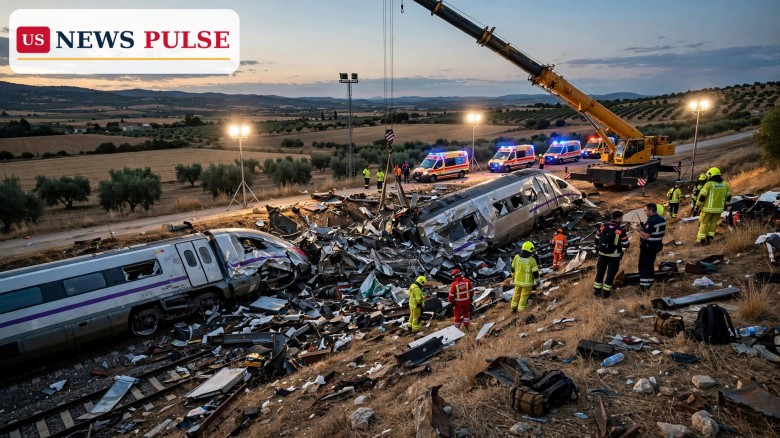
Rescue teams worked through the night beside mangled carriages on an elevated stretch of track in Castilla-La Mancha, using cranes, drones and floodlights to search for survivors and further victims in the cold. The regional leader, Emiliano Garcia-Page, confirmed the death toll had risen to 68 from an earlier count of 64, and warned it could rise again. "We don't know if another body might appear when the carriages are moved," he said.
The collision happened at around 9 a.m. local time on Wednesday, October 28, on the main high-speed line linking Madrid with southern Spain. The Iryo train, carrying 147 passengers, had halted on the tracks because of a technical problem. The Renfe train, carrying 397 passengers, was travelling from Madrid toward Seville when it struck the stationary train from behind.
The force of the impact embedded one train into the other and sent at least three carriages plunging down an embankment, scattering twisted metal and debris across the hillside. One carriage caught fire. Survivors described seats ripped from their fixings, suitcases thrown across the aisles and passengers trapped among the wreckage, some breaking windows to escape.
Pablo Mejia, 42, said he survived with head injuries after changing his seat shortly before the crash. "A very strong hit. It lasted a long time until it stopped, lots of people on the floor, on top of each other, seats ripped out, suitcases, a lot of chaos," he said, blood staining his jumper. Salvador Arriza, 62, a passenger on the Renfe train, said the force of the crash was brutal and that some people could not move because they were trapped among the seats. Josimar Medina, 31, a Peruvian tourist holidaying in Spain, said he had been asleep and woke up "in the air".
Manuel Ortiz, 49, who lives in Urda, spent the morning ferrying survivors in his car. He described a "horrific, horrible" scene that "smelled of an accident, of metal". Ambulances, funeral home vans and helicopters gathered beside the wreckage, and a school in Urda was opened to relatives seeking news of missing loved ones, with Red Cross workers and psychologists on hand. The Civil Guard set up offices in Madrid, Toledo, Cordoba and Seville to collect DNA samples and help identify victims.
Renfe confirmed that the main high-speed line from Madrid to southern Spain had been suspended after the accident. Spain's health minister, Monica Garcia, said 15 of the injured were in a very serious condition. Police drones resumed flights over the site at daybreak on Thursday as emergency crews continued to lift mangled metal carriage by carriage.
Transport Minister Oscar Puente gave the first official account of the chain of failures on Wednesday. A computer communications failure in the automatic control system had stopped all traffic on a 69-kilometre stretch of track, issuing a red signal because of the stationary train ahead. The control centre in Madrid, which takes over operations when such a failure occurs, then took what Puente called an erroneous decision to restart the Renfe train.
"The decision to resume traffic, while that system had not been restored, belongs to the control centre," Puente told reporters, adding that traffic was restarted "in circumstances that, from our point of view, are inexplicable". The Renfe train then travelled about 25 kilometres before colliding with the stationary Iryo train at a speed that could have reached up to 200 kilometres per hour.
"The control centre had more than enough time to verify the error, and they did not fix it," Puente said. He questioned why the centre had failed to identify and correct the mistake before allowing traffic to resume, and why no speed restrictions were imposed when services restarted. Investigators will now examine the control centre's logs, the signalling system and the communications between controllers and drivers to establish exactly who authorised the restart and on what information.
The crash is the second such disaster to strike Spain this year. In January, 46 people died when a train derailed and crossed onto an adjacent track near Adamuz in Andalusia, colliding with another service. That investigation remains ongoing. Before 2026, Spain's high-speed network had not suffered a deadly crash since it entered service more than three decades ago, and the network had become a source of national pride, second in size only to China's. It carried 45 million travellers last year, and almost 26 million passengers used it between January and August this year alone.
The last comparable disaster was in 2013, when 80 people died after a train veered off a curved section of track outside Santiago de Compostela in northwestern Spain. Wednesday's crash, with 68 dead, is now Europe's deadliest rail accident since that tragedy, and Spain's deadliest train accident in 13 years.
Prime Minister Pedro Sanchez visited the crash site in Toledo province after regional authorities confirmed the toll, and addressed the country in a televised speech from near the scene. He said "all of Spain" was in mourning, vowed that the tragedy would be investigated and promised to address any failures that came to light.
"If we need to further strengthen safety in order to rebuild confidence in our high-speed rail system, we will do so, because what is unacceptable for a country like Spain is to suffer two high-speed rail accidents in the same year," Sanchez said. His government declared three days of mourning starting on Thursday, and his Socialist party halted campaign activities.
The leader of the main opposition conservative Popular Party, Alberto Nunez Feijoo, who leads in most polls, also suspended campaigning but struck a sharper note, saying: "Spain has the right to know what is going on with its infrastructure." The crash comes just four weeks before Spain votes in an early general election on November 29, at which Sanchez, who has faced heavy criticism over the January disaster, is seeking to overturn unfavourable polls and extend his eight-year premiership.
Condolences flooded in from across Spain and Europe. The Spanish royal household said on X that it was "shocked and concerned", conveying its support to the victims, their loved ones and the emergency services. Messages of sympathy also arrived from European leaders, while rail unions called for a full and transparent investigation into the signalling failure and the control centre's decisions.
The Urda collision matters far beyond the immediate horror because it strikes at a system Spaniards trusted. High-speed rail is woven into daily life in Spain: commuters, families and millions of tourists rely on it, and the network's safety record was one of its proudest selling points. Two deadly crashes in a single year, with a combined toll of 114, shatter that record and raise a direct question about whether rapid expansion and heavy investment in new lines have been matched by investment in signalling, staffing and safety culture.
The minister's own language makes the political stakes unusually high. When a transport minister calls his own system's decision "inexplicable" within hours of a disaster, he signals that the failure was not a freak mechanical event but a human and organisational one. That puts the control centre, its procedures and its oversight under immediate scrutiny, and it gives the opposition a powerful line of attack four weeks before an election. For Sanchez, who already faced criticism after Adamuz, a second disaster risks turning rail safety into a defining issue of the campaign.
There is also a wider European dimension. Spain's network is the second largest in the world, and its trains carry passengers across borders and through some of Europe's busiest corridors. Regulators in other countries will watch the investigation closely, particularly the question of how a single communications failure could cascade into a decision to restart a train at full speed toward a known obstruction. The answers will shape safety rules well beyond Spain.
The investigation will now move in parallel on several fronts. Railway safety investigators will recover the trains' data recorders, examine the signalling and communications logs for the 69-kilometre affected stretch, and interview the control centre staff who authorised the restart. Prosecutors may open a separate criminal inquiry depending on what those records show.
Victim identification will continue in the coming days, with DNA collection under way in four cities and families being supported at the Urda school and local hospitals. The death toll may still change as cranes move the remaining carriages. Funerals and memorials are expected during and after the three days of national mourning.
On the railway itself, the Madrid to southern Spain high-speed line remains suspended while wreckage is cleared and the track is inspected. Renfe and the infrastructure manager will have to decide what interim safety measures, such as stricter speed restrictions and manual authorisation checks, apply before services resume. Sanchez has promised to strengthen safety if the investigation demands it, and the government is expected to face detailed questions in parliament once the initial findings are published.
Politically, campaigning is paused but not cancelled. Both major parties will return to the trail in the coming days, with rail safety now certain to feature prominently. The November 29 election, already framed as a verdict on eight years of Sanchez's government, will now also be fought, in part, over who can be trusted to keep Spain's trains safe.
How many people died in the Spain train crash?
At least 68 people died and more than 100 were injured, 15 of them in a critical condition, according to Castilla-La Mancha regional authorities. The toll rose from an earlier count of 64 and could change as wreckage is cleared.
Where did the crash happen?
Between Urda and Los Yebenes in Toledo province, in the Castilla-La Mancha region about 130 to 150 kilometres south of Madrid, on the high-speed line toward Seville.
What caused the collision?
According to Transport Minister Oscar Puente, a computer communications failure stopped traffic on a 69-kilometre stretch and issued a red signal, but the Madrid control centre then erroneously restarted the Renfe train, which travelled 25 kilometres and hit the stationary Iryo train at up to 200 kilometres per hour.
Which trains were involved?
A state-run Renfe service carrying 397 passengers travelling from Madrid toward Seville, and a private Iryo service carrying 147 passengers that had stopped on the tracks because of a technical problem.
Is this Spain's first deadly high-speed crash this year?
No. In January 2026, 46 people died when a train derailed near Adamuz in Andalusia and collided with another service. Wednesday's crash is Spain's second deadly high-speed rail disaster of 2026.
Related coverage on US News Pulse: North Korea fires missiles toward the East Sea as border tensions surge, Melania Trump ceasefire brings hope to Oleshky as Ukraine aid mission begins, and Israel election 2026: Netanyahu fights for survival as Israel votes.
Leave a Comment



 | Today's Date: