The Trump robotics imports decision has put America's factory floor at the centre of the next big trade fight. President Donald Trump signed a proclamation on October 28, 2026, agreeing with the Commerce Department that imports of robotics, industrial machinery and their parts and components are entering the United States in quantities and under circumstances that threaten to impair national security. Instead of imposing tariffs at once, he ordered negotiations with trading partners first, giving talks a 180-day window before any tougher measures are considered.
That sequence matters. In a year crowded with tariff announcements, this proclamation deliberately pauses before the penalty stage. It tells the Secretary of Commerce and the US Trade Representative to pursue or continue talks aimed at adjusting those imports, and it warns in plain terms that tariffs, duties, quotas, fees or a new domestic investment programme could follow if the talks fail, stall or prove ineffective.
The proclamation rests on Section 232 of the Trade Expansion Act of 1962, the law that lets a president adjust imports when the Commerce Department finds they threaten national security. Within the preceding 90 days, the Commerce Secretary transmitted a report on the investigation into robotics and industrial machinery imports, and advised the president of his opinion that those imports threatened to impair national security. Trump concurred with that finding and determined that negotiations were the necessary and appropriate first step.
Under the operative terms, the Commerce Secretary and the US Trade Representative must jointly pursue or continue negotiations with any foreign trading partner they deem appropriate. The Commerce Secretary must also keep monitoring the covered imports, in consultation with senior executive branch officials as appropriate, and alert the president to any circumstances that might warrant further presidential action. Provisions of earlier proclamations and executive orders that conflict with the new order are superseded.
Crucially, the document names no country, sets no tariff rate and fixes no quota. India is not mentioned, and no special agreement, exemption or restriction for any individual partner was announced. That leaves the negotiating mandate deliberately broad: officials choose the partners, the administration judges the progress, and the president keeps every remedy in reserve.
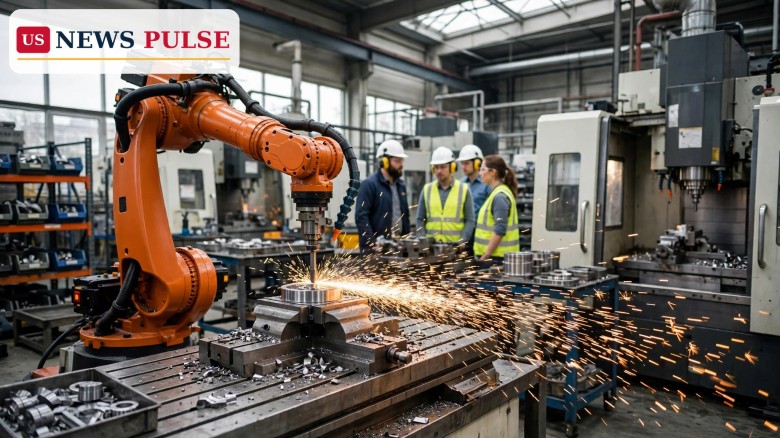
Section 232 is not new to this administration. It has already been used to impose high tariffs on steel, aluminium, automobiles and auto parts, and the same national-security logic has been extended across a widening list of sectors. What makes the robotics case different is the product itself: these are not finished consumer goods but the machines that make other things. A CNC mill, a welding robot or a specialist metalworking tool is the equipment a factory buys before it can produce parts at all.
The White House fact sheet puts that point bluntly. Robotics and industrial machinery, it says, are critical to virtually all modern manufacturing, including defence systems such as aircraft, tanks, ships, weapons and munitions, as well as to all 16 critical infrastructure sectors. The Commerce report argued that the United States relies on imports for most types of robotics and industrial machinery, and that domestic capacity is not yet enough for national security needs even after recent manufacturing investment.
There is also a cybersecurity strand to the case. Reporting on the proclamation notes concern that foreign-made equipment could pose risks when it processes or stores sensitive information, because modern factory machines are connected machines: they run software, collect production data and can be linked to wider networks. That argument turns a trade question into a security question, and it is why the administration framed the move under Section 232 rather than as an ordinary tariff dispute.
The contrast with drones is instructive. On August 13, Trump signed a separate Section 232 proclamation on imported drones, putting tariffs of 25% to 100% on imported drones and listed components from September 3. The robotics order reaches further down the production chain: instead of the flying machine, it covers the factory equipment used to make parts in the first place. The administration chose talks first this time, a sequencing choice Bloomberg noted as a deliberate delay to allow further negotiation.
The 180-day clock is the heart of the proclamation. Commerce and the US Trade Representative must report periodically on the negotiations, with the first joint update due within 180 days of October 28, 2026, which runs to late April 2027. If an agreement is not reached within that period, or if an agreement is not implemented or proves ineffective, the president may consider alternative measures.
Those measures are spelled out, not hinted at: imposing or modifying tariffs, duties, quotas and fees, and establishing a programme to incentivise new investment in US production of robotics and industrial machinery and their parts and components. The Commerce Department will continue to monitor import levels and advise the president if further action is warranted, so the negotiation window is also a monitoring window.
For manufacturers, that creates a planning problem with a deadline. A company buying CNC equipment or a robot line must now weigh whether to order now, wait for a negotiated outcome, or shift sourcing, without knowing which partners will be negotiated with first or what remedy might follow. For trading partners, the message is equally clear: the finding is already on the record, and the talks are the chance to change what comes next.
The president's own wording, reported from the proclamation, keeps the threat open-ended: "Depending on the status or outcome of the discussions, I may consider alternative measures in the future." The measures named in that sentence, according to the White House summary, could include tariffs, fees, quotas or adjustments to existing regulations, alongside a possible programme to boost domestic investment in robotics and industrial machinery production.
Trade advisers have noted the restraint in the design. KPMG's summary of the proclamation stresses that it "does not immediately impose new tariffs" but "explicitly states that the president may deploy alternative remedies depending on the progress of negotiations." That distinction is the story: the national-security finding is final, but the commercial penalty is not yet chosen.
No trading partner government was singled out in the initial reporting, and no domestic manufacturer group was quoted in the proclamation summaries as welcoming or opposing the move at the time of publication. That silence is itself telling. Because the order opens talks rather than closing a tariff schedule, the first public reactions are likely to come from capitals and factory boardrooms once negotiators make clear which imports and which partners are first in line.
This matters because robotics and industrial machinery sit underneath almost every other industrial argument. If the machines that make cars, aircraft parts, medical devices and defence equipment depend heavily on foreign suppliers, then a supply disruption, a cyber vulnerability or a geopolitical rupture does not just hit one product line, it hits the capacity to make things at all. The administration's case is that this dependency has become a security weakness, not merely a commercial inconvenience.
It also matters for the wider tariff debate five days before the November 3 midterms. Voters are already hearing arguments about prices, jobs and manufacturing, and a move framed as protecting factory capacity speaks directly to that debate without immediately raising the price of a finished product. By deferring tariffs, the White House avoids an instant cost shock while still recording a tough national-security finding.
For US allies and rivals alike, the proclamation is a signal about where American industrial policy is heading: toward domestic capacity in the tools of production, not just in the headline technologies such as chips and AI. A country that exports robots or CNC machines to the United States now has 180 days to show that its trade can be adjusted by agreement rather than by penalty.
Watch first for who negotiates with whom. The Commerce Secretary and the US Trade Representative choose the partners they deem appropriate, and their early choices will reveal whether the focus is on the largest suppliers, on security-sensitive equipment, or on specific technologies such as CNC controls and robot components. Watch also for the first joint update, due within 180 days, which will be the first official test of whether talks are producing anything concrete.
Watch second for any domestic investment signal. The proclamation leaves open a programme to incentivise US production, and any such proposal would matter as much to factory builders as a tariff would to importers. A credible investment plan could pull new capacity into the United States; a vague one would leave the security finding without a supply answer.
Watch third for the tariff trigger. If talks fail, stall or prove ineffective, the president may move to tariffs, quotas or fees. That decision would land in the spring of 2027, well after the midterms, but its shadow will shape purchasing and investment decisions from now on. Until then, the proclamation is best read as a warning with a timetable, not as a tariff in disguise.
What did Trump sign on October 28, 2026?
A Section 232 proclamation concurring with the Commerce Department's finding that robotics and industrial machinery imports threaten to impair US national security, and directing negotiations with trading partners.
Does the proclamation impose tariffs now?
No. It imposes no new tariff, quota or fee immediately. Those remedies are held in reserve depending on the status or outcome of negotiations.
What is covered?
Robotics, industrial machinery and their parts and components, including CNC machines and specialist metalworking tools used across manufacturing and defence production.
How long do negotiators have?
Commerce and the US Trade Representative must give periodic updates, with the first joint update due within 180 days of October 28, 2026, running to late April 2027.
What happens if talks fail?
The president may consider imposing or modifying tariffs, duties, quotas and fees, or establishing a programme to incentivise domestic production of the covered goods.
Related coverage on US News Pulse: US-India trade talks near the finish as the White House calls them productive, the US warning to the EU over a $3.4 billion Airbus loan, and the Justice Department inquiry into Nvidia's Hugging Face deal.
Leave a Comment



 | Today's Date: