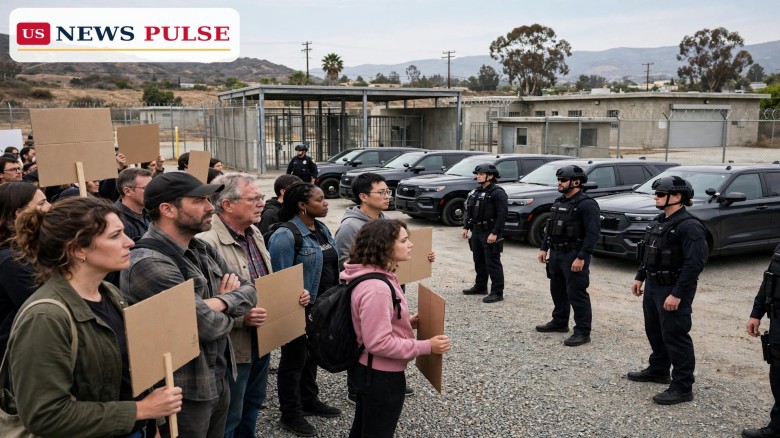
An ICE Monterey County Jail operation in Salinas, California, turned into a tense hours-long standoff on Tuesday, October 27, 2026, as about 50 protesters gathered outside the jail's sallyport gate, federal officers in unmarked vehicles worked inside the perimeter, and the Monterey County Sheriff's Office locked the facility down as a precaution. By early evening the federal agents had left, the lockdown's immediate trigger had passed, and a community already on edge after days of reported immigration activity was left waiting for answers about who had been targeted and why.
The confrontation was brief by the standards of a long day, but it packed in almost every fault line of the current immigration debate in California: a county that voted to bar its own property from being used for civil immigration enforcement, a sheriff's office that said it was never told the operation was coming, legal observers documenting every vehicle, and protesters who said the mere presence of federal agents at a jail gate was meant to frighten people. No injuries were reported, and officials did not publicly name anyone detained.
The scene built through the afternoon at the jail in Salinas, the Monterey County seat. According to the Monterey County Now, about 50 people gathered outside the sallyport gate, the secured entrance through which inmates are released, where unmarked vehicles were parked along a gravel area. Some of the federal officers on site wore uniforms with "ICE" lettering, identifying them as U.S. Immigration and Customs Enforcement personnel.
A person identifying themselves as an ICE operative told local station KSBW that agents were conducting a targeted operation involving people at the Monterey County Jail, the New York Post reported. Officials did not disclose who was being targeted, and the Post reported that five individuals were arrested by ICE. That figure sits uneasily alongside local reporting: the Solidarity Network Monterey County Rapid Response confirmed one individual detained on Tuesday at about 4:30 p.m. while leaving a county health clinic on the government campus adjacent to the jail. ICE itself had not publicly confirmed a number, named anyone detained, or described the operation's objectives by the time the evening's reporting was published, and one account noted it remained unclear whether anyone had been taken into custody during the jail operation itself. The honest picture, on the reporting available, is that arrests were reported but not fully confirmed in public.
As the afternoon wore on, the crowd grew more confrontational. About 10 legal observers were present, documenting the activity, alongside immigration lawyers and local politicians. The encounter grew more heated toward the end, the Monterey County Now reported, as about 30 protesters drew closer to the federal officers' vehicles. Some grabbed rocks and threw them at the vehicles as they drove away toward Constitution Boulevard. The protest featured honking horns and chants of "Fuck ICE," the local report said. No injuries were reported in any account of the evening.
At 5:40 p.m., the Sheriff's Office announced the lockdown. "The Monterey County Jail is not accepting any new bookings, all inmate releases have been temporarily suspended, and the facility is closed to all public visitation, with the exception of attorneys visiting their clients," the office said. Attorneys meeting clients were still allowed inside, and the office later stressed the lockdown was precautionary, intended to protect staff and inmates while federal activity continued nearby.
Eventually, under pressure from the protesters on scene, ICE agents left the area at about 6:30 p.m., after several hours, the Monterey County Now reported. The New York Post similarly reported that ICE agents had left before 7 p.m. The lockdown announcement and the departure together closed the day's most visible confrontation, but not the questions around it.
Tuesday's jail protest did not come out of nowhere. For two days, October 26-27, legal observers had documented ICE agents parked outside the gate where inmates are released, and the same pattern had been reported in neighbouring counties, including Santa Clara and Santa Cruz. According to the Solidarity Network, up to a dozen ICE vehicles had been seen in the area, sometimes parked and sometimes patrolling nearby parking lots, including at Natividad Medical Center and county health clinics.
The activity extended beyond Salinas. The Network reported that two people were detained by ICE in Seaside on the morning of Sunday, October 25, near Sonoma and Yosemite streets, in two vehicles described as a black Nissan Murano and a white Dodge Durango without plates. The Seaside Police Department said ICE had been conducting targeted investigations in Seaside and had made several apprehensions, adding that its understanding was that the operations involved individuals suspected of federal criminal violations. The Weekly said it had been unable to confirm the names or details of the people detained in Seaside.
The hospital angle sharpened the response further. Union nurses with the California Nurses Association held an emergency press conference on Tuesday, October 27, at 3 p.m. at Watsonville Community Hospital to denounce the presence of ICE around Natividad Medical Center in Salinas and Watsonville Community Hospital. Nurses reported seeing ICE vehicles and the arrest of at least one individual within the previous 24 hours at Natividad, and said several ICE vehicles were parked outside Watsonville Community Hospital on Tuesday morning. Their demands were blunt: that ICE and other federal immigration agents stay away from hospitals, that employers refuse to cooperate, that ICE leave their communities, and ultimately that the agency be abolished.
That local backdrop collided with a formal county position adopted only weeks earlier. In September, the Monterey County Board of Supervisors adopted a policy prohibiting county property from being used for civil immigration enforcement activity. "The use of County-owned facilities as staging areas, operational bases, or processing locations for federal civil immigration enforcement activities is not the intended use of these community assets and may undermine community trust, limit access to public spaces, and interfere with the County's authority over its own property," the resolution said. It was approved 5-0 on September 29. The policy includes exceptions for criminal enforcement and the execution of lawful judicial warrants, but generally restricts local cooperation with federal immigration efforts, according to reporting on the jail lockdown.
The jail operation tested that policy in the most public way possible, because a jail gate is where the county's authority and the federal government's authority physically meet. The Sheriff's Office said local officials had not been notified of the action by federal authorities, and added a point it had made before: "Federal law enforcement agencies are not required to notify our office when conducting independent enforcement operations within our jurisdiction." That statement, first issued on October 26 in response to the earlier Salinas reports, framed the sheriff's position on Tuesday as well.
The office also restated its commitment to California law, specifically citing the California Values Act, known as SB 54, and the TRUTH Act, which set the parameters and limits for interaction between local law enforcement and federal immigration authorities. In practice, that means the Sheriff's Office would not itself carry out civil immigration enforcement, even as it said it could not stop federal agents from conducting their own independent operations. The lockdown, in that light, was the office's own safety measure rather than cooperation with the federal operation: a way to control movement in and out of its own facility while armed federal activity unfolded just outside it.
For protesters and legal observers, the distinction mattered less than the location. The sallyport gate is where people walk free from custody, and the presence of unmarked vehicles there, day after day, raised the fear that release from county jail could lead directly into federal detention. That fear is precisely what rapid-response networks are organised to document, and it is why about 10 legal observers were on site on Tuesday evening, filming and logging vehicles. It also explains why the crowd included immigration lawyers, who would be among the first called if someone leaving custody were detained.
The county's September resolution anticipated exactly this tension. Its language about community trust and access to public spaces reads, after Tuesday, less like an abstract policy statement and more like a description of what happened at the gate: a county facility became the backdrop for a federal operation, public access to it was suspended, and a crowd gathered to say the county's own ground should not be used that way. Whether the operation itself used county property as a staging area, or stayed on ground federal agents could claim as their own, is one of the unanswered questions from the evening.
The sharpest single quote of the evening came from Chris Barrera, president of LULAC Council #2055, who was among those gathered at the gate. "ICE is not wanted here. ICE is here to intimidate," Barrera said. The line captured the protesters' argument in full: that the operation's purpose was not only the people it targeted, but the message its visibility sent to a wider immigrant community.
The Sheriff's Office, for its part, kept its public language procedural. Its lockdown announcement stuck to operational facts: no new bookings, releases temporarily suspended, visitation closed except for attorneys. Its broader statement about notification, that federal agencies are not required to inform the local office of independent operations, was both an explanation and a distancing device, making clear that the county had not invited or coordinated the federal presence.
The nurses' protest added a second institutional voice. By holding an emergency press conference at Watsonville Community Hospital on the same afternoon, the California Nurses Association linked the jail operation to a wider pattern of federal activity around places people cannot easily avoid: hospitals and clinics. Their claim that at least one person had been arrested at Natividad Medical Center within the previous 24 hours, and that ICE vehicles were outside Watsonville Community Hospital on Tuesday morning, widened the story from a single jail gate to a county-wide presence.
Seaside police offered the most sympathetic official account of the federal operations, saying the targeted investigations there involved individuals suspected of federal criminal violations. That framing, criminal rather than civil enforcement, matters legally, because the county's September policy and California's sanctuary laws draw lines around civil immigration enforcement while leaving room for criminal enforcement and judicial warrants. But without names, charges or confirmation from ICE itself, the public cannot yet test which side of that line Tuesday's jail operation fell on.
Tuesday matters first because of where it happened. A jail release gate is a choke point: everyone leaving custody passes through it, and anyone waiting there with enforcement authority changes what release means. If people leaving county custody fear immediate federal detention, lawyers argue, the consequences ripple outward, discouraging families from coming to collect loved ones and discouraging cooperation with local authorities. That is the community-trust argument at the heart of the county's September resolution, and it played out in real time on Tuesday.
It matters second because of the information gap. A targeted operation was confirmed, arrests were reported, a detention at a clinic was confirmed by observers, a lockdown was imposed, and a crowd gathered, yet by evening the public still did not know who had been targeted, on what authority, or how many people had been taken. That gap is not unusual for federal enforcement operations, which rarely come with running commentary, but it is politically combustible one week before the November 3 midterm elections, when immigration enforcement is already a central campaign issue in California and nationally.
It matters third because the pattern is regional, not local. The same release-gate surveillance was reported in Santa Clara and Santa Cruz counties, the same hospital-adjacent activity was reported in Salinas and Watsonville, and the same rapid-response documentation is now routine across the Central Coast. A single evening at one jail gate is therefore best read as one visible episode in a wider enforcement push, and the response, legal observers, lawyers, nurses and protesters coordinating in public, is equally organised.
The immediate questions are factual and should be answerable in the coming days. ICE has yet to publicly confirm how many people were arrested on Tuesday, who they are, what they are accused of, or whether the operation was criminal, civil or both. The Sheriff's Office has yet to say when normal bookings, releases and visitation fully resumed, or whether it will seek any clarification from federal agencies about the use of ground around its jail. The county board may also face questions about whether its September policy was breached, and if so, what enforcement of that policy would even look like against a federal agency.
Watch, too, for the legal follow-up. Immigration lawyers who were on site on Tuesday will be checking whether anyone detained is being held locally, has access to counsel, and appears before an immigration judge promptly. Rapid-response networks will keep logging vehicles at the release gate, at Natividad and at county clinics, and any repeat appearance in the coming days will be treated as evidence of a sustained operation rather than a one-off visit.
The political calendar adds urgency. With the November 3 midterms days away, every immigration confrontation in California becomes campaign material, and both sides will frame Tuesday to suit their argument: supporters of the operation will point to targeted criminal enforcement and the rock-throwing at departing vehicles, while critics will point to unmarked vehicles at a jail gate, a hospital-adjacent detention and a county policy they say was ignored. The facts that emerge next, names, charges and warrants, will decide which framing holds.
What happened at Monterey County Jail on October 27, 2026? Federal ICE agents conducted a targeted operation at the jail in Salinas, gathering at the sallyport gate in unmarked vehicles. About 50 protesters, legal observers, immigration lawyers and politicians gathered outside, and the Sheriff's Office locked the jail down as a precaution at 5:40 p.m. ICE agents left at about 6:30 p.m.
How many people were arrested? The New York Post, citing officials, reported five people were arrested by ICE. Local rapid-response observers confirmed one detention on Tuesday at about 4:30 p.m. at a county health clinic next to the jail. ICE has not publicly confirmed a total or named anyone detained.
Why did the jail go into lockdown? The Sheriff's Office said the lockdown was a precautionary measure to protect staff and inmates while federal activity continued. It suspended new bookings and inmate releases and closed the jail to public visitors, while still allowing attorneys to visit clients.
Did the county know the operation was coming? No. The Sheriff's Office said it received no prior notification, and said federal agencies are not required to notify local law enforcement when conducting independent operations. The county had adopted a policy on September 29 barring county property from use in civil immigration enforcement.
Was this an isolated incident? No. Legal observers documented ICE vehicles at the jail's release gate on both October 26 and 27, reported similar activity in Santa Clara and Santa Cruz counties, and reported two detentions in Seaside on October 25. Nurses also reported ICE vehicles at Natividad Medical Center and Watsonville Community Hospital.
Related reading on US News Pulse: San Diego Islamic Center lockdown: mosque reopens after Tuesday security scare, DOJ charges green card holders with illegal voting in 5 states and California ballots hearing: judge questions DOJ bid to block 20,000 votes.
Sources: Monterey County Now, October 27, 2026; New York Post / KSBW, October 27, 2026; Salinas Valley Now, October 27, 2026; Times Now World, October 28, 2026; National Nurses United / California Nurses Association, October 27, 2026; Monterey County Sheriff's Office statements, October 26-27, 2026.
Leave a Comment



 | Today's Date: