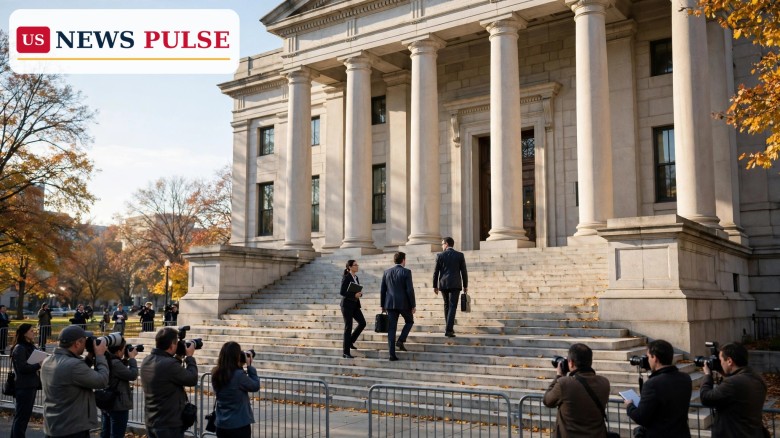
Former FBI Director James Comey was back in a federal courtroom on Friday, 30 October 2026, as his legal team prepared to argue that the Justice Department's latest attempt to bring criminal charges against him should be thrown out. The James Comey hearing centres on a criminal information filed earlier in October, in which federal prosecutors allege that Comey broke the Espionage Act by passing national defence information to someone who was not legally entitled to receive it, in connection with a 2016 New York Times article.
The case is the third time in just over a year that the Justice Department has tried to charge Comey, and it arrives with an unusual procedural twist. According to the CBS News report of the hearing, Comey has not been charged by criminal complaint and has not been indicted by a federal grand jury in this Espionage Act matter. Instead, prosecutors used a criminal information, a filing that does not require grand-jury approval or a magistrate judge's finding of probable cause, and the two sides now dispute whether that filing can survive at all.
At stake is not only Comey's own fate, but a broader question about how far prosecutors can go when they revive an old leak allegation years after investigators first looked at it. Comey's lawyers say the matter was already examined and dropped, and that the clock has run out. The Justice Department says it acted in time, and that the filing was needed to preserve its case. The judge hearing the dismissal argument will have to decide which reading of the law, and of the calendar, controls.
Comey, who was fired as FBI director by President Donald Trump almost a decade ago, was due in court on Friday with his legal team ready to press for dismissal of the criminal information. The report does not name a specific court, judge or hearing time for this Espionage Act matter, and it does not say that a ruling was expected on the same day. What it does make clear is the shape of the dispute: a defence team asking a court to end the case before it ever reaches a trial, and prosecutors insisting that the case is properly before the court.
The procedural history matters because a criminal information is not the usual route for a felony case of this kind. A grand jury normally decides whether charges should be brought, and a magistrate judge normally tests whether there is probable cause. By filing an information, prosecutors avoided both steps, at least for now. That choice is part of why the defence calls the filing faulty, and part of why the Justice Department has been careful to frame the information as a charge that the rules allow to stand in place of an indictment in a felony case.
The Justice Department also told the court, in substance, that Comey's dismissal effort came too early. Its position is that there is no indictment to dismiss, because no grand jury has returned one. That argument, if accepted, would not necessarily end the dispute for good. It would mean the court should not strike down a charging document that, in the government's view, has not yet taken the form the defence is attacking. The defence, by contrast, wants the court to treat the information itself as the charge to be tested, and to test it now.
An earlier emergency hearing in October already shaped the timetable. After that hearing, the Justice Department agreed not to seek an indictment for 30 days. The report does not give the exact date on which that period ends, and it does not say what prosecutors plan to do when it expires. The agreement does, however, explain why Friday's hearing was about dismissal of the information, rather than about a fresh indictment, and why the next steps in the case will be watched closely once the 30-day window closes.
The alleged disclosure at the heart of the case dates to 5 October 2016, in the final weeks of that year's presidential campaign, when Comey was still FBI director. Comey's lawyers say the disclosure was investigated by two separate US attorneys' offices, and that both declined to bring charges. That history is central to the defence case: if two prosecutorial offices looked at the same conduct and chose not to act, the defence argues, a third attempt a decade later should not be allowed to proceed on a filing that does not satisfy the rules for an extended limitations period.
The Justice Department's answer turns on the length of the clock. Espionage allegations, the government argues, carry a ten-year statute of limitations, so a 2016 disclosure was still within time when the information was filed in October 2026. The defence disputes that reading, arguing that the filing does not meet the express statutory requirements for that extended ten-year period. In plain terms, the two sides are not just arguing about dates. They are arguing about which legal category the alleged conduct falls into, and whether the government has shown that it belongs in the longer category at all.
This is the third attempt to charge Comey in just over a year, and the earlier attempts help explain why Friday's hearing drew so much attention. In September 2025, Comey was indicted for allegedly lying to Congress. A judge later dismissed those charges on the ground that the Trump-appointed prosecutor who oversaw them had been unlawfully appointed. Earlier in 2026, Comey was charged over a social media post showing a photo of seashells arranged to read 86 47, which prosecutors treated as a threat against President Trump. His lawyers in that separate threats case have argued that the charges were politically motivated and have asked a judge to dismiss them on grounds of selective and vindictive prosecution. That case is said to be overseen by a judge in North Carolina, who had not yet ruled on those motions, according to the report.
Comey has consistently denied wrongdoing in the Espionage Act matter. His legal team says he maintains his innocence, and the defence position is that the case should never have been revived in this form. The Justice Department, for its part, has not, in the report, been shown to dispute the fact that earlier offices declined to charge. Its argument is narrower: that the law still allows this charge, that the filing was timely, and that the court should let the case proceed rather than dismissing it at this stage.
The statute-of-limitations fight is the hinge on which the whole case turns, and it is worth spelling out why it is so contested. A statute of limitations is a deadline: after it passes, prosecutors generally cannot bring charges, even if they believe a crime was committed. The deadline exists to protect defendants from stale evidence, faded memories and the unfairness of facing charges long after the events in question. When the deadline is short, prosecutors must move quickly. When it is long, they have more room, but they must still show that the longer deadline applies to the conduct they allege.
Here, the defence says the government has not done that. Its argument, in essence, is that the information does not qualify for the extended ten-year period, so the ordinary, shorter deadline has already expired and the case is time-barred. The government says the opposite: that espionage charges carry ten years, that the 2016 disclosure therefore remained chargeable in October 2026, and that filing the information was a legitimate way to preserve the case before that ten-year period ran out. The court must decide not only which side's arithmetic is right, but which side's legal characterisation of the alleged leak is correct.
That decision will also shape what happens if the government later seeks an indictment. If the court dismisses the information as time-barred, prosecutors would face a difficult choice: accept the ruling, appeal it, or try to present the case to a grand jury and face the same limitations argument again. If the court rejects the dismissal bid, the case would move forward, but the limitations question could resurface at trial or on appeal. Either way, Friday's hearing was unlikely to be the last word, even if it produced a clear ruling on the day.
The use of a criminal information adds a second layer of controversy. Supporters of the procedure say it is a recognised charging tool that can be used in appropriate felony cases, and that it avoids the delay of a grand-jury presentation when time is short. Critics say it sidesteps the independent check that a grand jury provides, and that it should not be used to revive a declined, decade-old leak allegation. The report does not resolve that policy debate, but it shows why the procedure itself, not just the underlying leak claim, has become a focus of the case.
Comey's lawyers framed the case as a revival that should not have happened. They pointed to the two earlier declinations, described the information as defective, and argued that the extended limitations period had not been properly established. Their position is that a court should not allow prosecutors to use an uncommon filing to get around a deadline that has already passed, particularly when other prosecutors had already decided not to act on the same conduct.
The Justice Department framed the case as a timely preservation of a serious national-security allegation. Its lawyers argued that the dismissal bid was premature, that no indictment exists to be dismissed, and that the information is a valid substitute for an indictment under the rules. Their position is that the court should not cut the case short on procedural grounds when, in their view, the substantive allegation — that national defence information was passed to someone not entitled to receive it — still falls within the ten-year period for espionage offences.
Legal observers will note what the report does not contain. It does not name the judge who heard Friday's arguments in the Espionage Act matter, it does not give a hearing time, and it does not record a ruling. It also does not quote President Trump directly on this hearing. Those gaps matter for readers: they mean Friday's story is best understood as a contested procedural fight whose outcome was still to be decided, rather than as a verdict on whether Comey leaked classified information in 2016. The facts of that alleged leak, and whether they can be proved, have not been tested at a trial in this case.
The wider context is political, but the courtroom arguments themselves are legal. Comey's lawyers in the separate threats case have explicitly raised selective and vindictive prosecution, arguing that the charges against him were politically motivated. In the Espionage Act case, the arguments reported on Friday were framed in terms of timeliness, statutory requirements and the validity of the charging document. That distinction matters: a court can reject a case on limitations grounds without ever deciding whether a prosecution was politically motivated, and it can allow a case to proceed without endorsing the politics behind it.
The case matters for three reasons. First, it tests the limits of Espionage Act prosecutions of former senior officials. If prosecutors can revive a declined 2016 leak allegation in 2026 through a criminal information, that will encourage similar filings in other old leak cases. If courts block that route, prosecutors will have to bring such cases sooner, or not at all, and will have to satisfy stricter requirements before using an extended limitations period.
Second, it tests the role of the grand jury. The grand jury is meant to stand between the government and the citizen, deciding whether there is enough to charge. A criminal information bypasses that step. How courts treat that bypass in a high-profile case involving a former FBI director will set a practical precedent for less prominent cases, where defendants have far fewer resources to challenge a filing.
Third, the case sits at the intersection of national security and public accountability. The alleged conduct involves a 2016 newspaper article, a staple of public debate about government transparency. Leak prosecutions always raise a tension: the government says classified information must be protected, while journalists and their sources say the public has a right to know how power is exercised. A dismissal on limitations grounds would not resolve that tension, but it would keep the focus on procedure rather than on the merits of the leak claim itself.
The immediate next step is a ruling on the dismissal bid. The report does not say when that ruling will come, and readers should not assume it arrived on Friday. Courts often take time to consider limitations arguments, especially when the parties dispute which statutory period applies. When a ruling does come, it will determine whether the criminal information survives, whether prosecutors can proceed, and whether they will need to seek an indictment instead.
The 30-day agreement not to seek an indictment, reached after the emergency hearing earlier in October, is the other clock to watch. Once that period ends, the Justice Department will be free, in procedural terms, to present the case to a grand jury if it chooses to do so. Whether it does so will depend on the dismissal ruling, on the strength of the evidence as prosecutors assess it, and on whether a grand jury is willing to return an indictment in a case that has already been declined twice and challenged as time-barred.
In the separate threats case, the North Carolina judge's ruling on the selective and vindictive prosecution motions is still pending, according to the report. That case will continue on its own track, independent of Friday's Espionage Act arguments, but the two cases together will shape public understanding of how the Justice Department has pursued Comey over the past year. For now, the Espionage Act case remains exactly what Friday's hearing showed it to be: a contested, unresolved attempt to charge a former FBI director, with the law and the calendar at the centre of the fight.
Former FBI Director James Comey returned to a federal courtroom on Friday, 30 October 2026, as his lawyers argued that the Justice Department's latest criminal case against him — a criminal information alleging an Espionage Act violation — should be dismissed. The report does not name a specific court, judge or hearing time for this matter, and does not record a ruling on the day.
Prosecutors allege that Comey transmitted national defence information to someone not legally entitled to receive it, in connection with a 2016 New York Times article, and that he leaked classified information. Comey maintains his innocence, and the allegation has not been tested at a trial in this case.
They argue the criminal information is defective and time-barred, that the alleged 5 October 2016 disclosure was investigated by two separate US attorneys' offices that both declined to charge, and that the filing does not meet the requirements for an extended ten-year limitations period.
The department argues the case is within a ten-year Espionage Act limitations period, that it filed the information to preserve the case before time ran out, that the dismissal bid is premature because no indictment has been returned, and that an information may substitute for an indictment in a felony case under the rules.
No. It is the third attempt in just over a year. He was indicted in September 2025 for allegedly lying to Congress, but a judge dismissed those charges because the prosecutor was unlawfully appointed. Earlier in 2026 he was charged over a seashells social media post treated as a threat against President Trump, and his lawyers have sought dismissal of that case on selective and vindictive prosecution grounds.
Related coverage on US News Pulse: James Comey third criminal case: DOJ accuses ex-FBI chief of leaking in 2016; Cassidy Hutchinson grand jury rejects DOJ bid to indict former Trump aide; DOJ charges green card holders with illegal voting in 5 states ahead of midterms.
Leave a Comment



 | Today's Date: