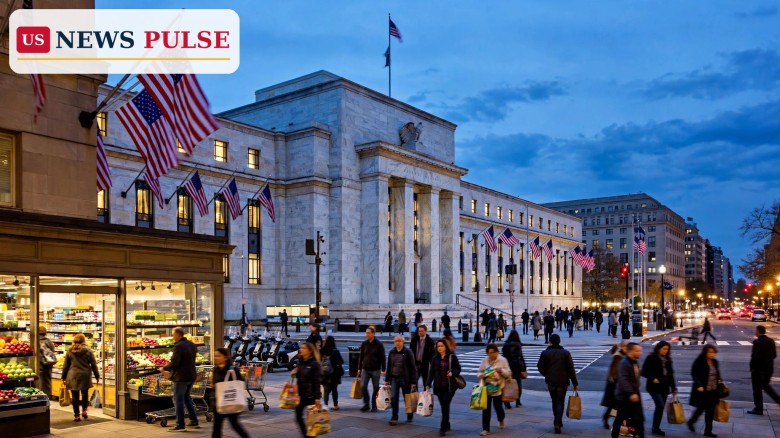
The US economy grew at a 3.4% annualised pace in the third quarter of 2026, the Bureau of Economic Analysis reported on Thursday, October 29 — a much stronger performance than expected, but one that arrived alongside a fresh rise in inflation that leaves the Federal Reserve facing an awkward choice at its December meeting.
US GDP growth accelerated from 2.2% in the second quarter and beat the 3.1% consensus forecast, powered by robust consumer spending and a surge in business equipment investment. On the same day, the BEA reported that the Fed's preferred inflation gauge, the personal consumption expenditures (PCE) price index, rose 0.5% in September alone and 3.6% from a year earlier — further above the central bank's 2% target than it was in August.
The combination — an economy running hotter than officials consider sustainable, with price pressures broadening rather than fading — is why markets now put roughly 80% odds on a quarter-point rate increase when the Fed meets on December 8-9, after it voted 10-2 on October 28 to hold its benchmark range at 3.75%-4%.
The Commerce Department's advance estimate, released on October 29, showed output expanding at a 3.4% annualised rate in the July-September period. That figure is an annualised pace — what the quarter's growth would amount to if sustained for four quarters — equivalent to roughly 0.8% growth in the quarter itself. It was driven by investment, consumer spending and government spending, partly offset by falling exports, while imports increased.
Consumer spending, the engine of the US economy, rose 3.8%, matching the previous quarter's pace. Gross private domestic investment surged 19.4%, fuelled by a 20.9% jump in equipment spending and an 8.4% rise in intellectual property products. Real sales to private domestic purchasers — a measure combining consumption with private fixed investment that Fed officials watch closely for underlying demand — rose 4.9%, up from 4.6% in the second quarter.
The inflation data told a less comfortable story. The PCE price index climbed 0.5% on a seasonally adjusted basis in September, the largest monthly jump since March, taking the annual rate to 3.6%, up from 3.4% the previous month and further from the recent low of 2.3% in March 2025. Core PCE, which strips out volatile food and energy prices, rose 0.3% on the month and 3.1% over the year, both in line with forecasts but hotter than August. Gasoline and other energy goods jumped 9.2% in the month, while broader energy goods and services surged 5.4%, services excluding energy and housing rose 0.4%, and housing costs increased 0.3%.
The household detail was the report's sting. Personal income and disposable income each rose just 0.2% before inflation in September, and the personal saving rate was 3.8%. Once prices were accounted for, real disposable income fell 0.3% and inflation-adjusted consumer spending rose less than 0.1%. In other words, Americans spent more dollars in September but bought barely more goods and services — and had less real income left over.
The data landed a day after the Federal Reserve's October 28 decision to hold its target range at 3.75%-4%. That 10-2 vote included dissents from Governor Lisa Cook and Cleveland Fed President Beth Hammack, both of whom favoured raising rates immediately. Fed Chair Kevin Warsh told reporters after the decision that he did not think the economy was "too hot" and that he did not want "to throw sand in the gears" of an expansion gaining steam from artificial intelligence investment and consumer spending that keeps growing despite tepid income gains.
The new figures test that judgement. If sustained, 3.4% growth would far outstrip even the most optimistic Fed official's sense of the economy's long-run, non-inflationary trend: in policymakers' September projections, the highest estimate of long-run growth was 2.5%, with most officials in the 2%-2.2% range and a median of 2%. Warsh himself acknowledged the measurement problem, telling reporters: "We never know what potential growth really is. We can't measure it precisely. Economic growth is higher. But that doesn't tell me that economic growth is somehow causing inflation and making our job harder."
Inflation's breadth is a further worry. Measures cited by Reuters show roughly 50% to nearly 60% of items in the PCE basket posting annual price increases of more than 3% in September — far above pre-pandemic norms for a gauge Warsh has described as a good indicator of underlying inflation. The number of items above that level fell slightly last month, but the persistence, especially in services where rate rises bite more slowly, is what has economists uneasy.
Context from the labour market points the same way. Initial jobless claims edged down to a seasonally adjusted 194,000 for the week ended October 24, near levels last seen in the late 1960s, showing an economy that has not slowed despite the prospect of tighter policy. Across the Atlantic, the European Central Bank held its deposit rate at 2.50% on October 29, warning that higher energy prices threaten to raise inflation and weaken growth. And the advance GDP figure itself is only a first estimate: the BEA will revise it as more complete data arrive, with the second estimate scheduled for November 25.
The 3.4% headline flatters the economy in one important respect: it measures production, not household welfare. A business buying an imported machine can expand even though the import is subtracted from GDP arithmetic; government demand can support output without appearing as extra take-home pay. The September income data show the gap plainly — nominal spending up 0.5%, real spending up less than 0.1%, real disposable income down 0.3%.
Economists also warn the pace may not last. Spending grew faster than income in the GDP report, a pattern unlikely to continue indefinitely, and Warsh himself noted that a recent tightening in credit markets showed investors becoming "more discerning in their capital allocations" — a possible precursor to slower investment growth. The quarterly figures also smooth over a weaker end to the period: a strong quarter and a soft month can coexist, and one month does not prove a lasting consumption downturn, just as one strong quarter does not guarantee a strong holiday shopping season.
For households, the practical question is what remains after recurring expenses, not whether nominal income ticked up. A shop can register higher dollar sales while selling little more merchandise; a family can spend more at the till while its real purchasing power falls. That squeeze is the political backdrop too: with midterm elections on November 3, affordability has dominated the campaign, and a growth headline that does not feel like prosperity is a difficult message for any incumbent party to sell.
Diane Swonk, chief economist at KPMG, said the PCE details showed inflation "broadly persistent across the economy, particularly in service industries where Fed rate hikes may have less of an impact." She said she felt policymakers should have raised rates this week, but understood the motivation for patience because "they don't want a recession for 3% to 4% inflation" if they could tackle the problem more slowly and keep the expansion going.
Swonk added a sharper warning: "That said, it is not clear you can just cool things around the margin, given inflation is getting very sticky. The Fed is looking behind the curve," particularly with financial markets now anticipating two to three more rate hikes and tightening financial conditions on that basis. On Warsh's argument that credit tightening would itself help return inflation to target, she replied: "That is sand in the gears. Why has there been tightening? They expect more rate hikes ... You have to deliver on that."
Vincent Reinhart, chief economist at BNY Investments and a former head of the central bank's monetary affairs division, said Warsh "is clearly trying to paint the most optimistic picture both for the economic expansion and the leverage the Fed has" to lower inflation — arguments that, if true, would mean the Fed could get by with fewer rate hikes. Reinhart himself feels the Fed will have to raise rates two more times, but with risks "decidedly to the upside," particularly if the benchmark global oil price remains around the current level of nearly $115 a barrel.
Reinhart added that even if AI investment proves sensitive to rate increases, the Fed may still have to cool demand to meet its inflation goal: the large US services sector is "just trundling along and will adjust only slowly. If you really want to make faster progress on inflation, you are going to have to work harder on demand to get the stuff that can adjust to adjust quickly."
The December decision now hinges on whether this combination persists. A 3.4% growth rate with 3.6% inflation and a labour market still near 57-year lows for jobless claims is, by the Fed's own framework, an economy running above its sustainable speed — and the market has already moved: the 10-year Treasury yield hovered near 5% before easing below it as tech shares sold off, and traders price further tightening into 2027. If the Fed holds again in December after signalling patience, it risks the "behind the curve" charge Swonk levelled; if it hikes, it risks cooling an expansion whose household foundations already look thin.
For ordinary Americans, the stakes are concrete. A December hike would likely keep mortgage rates elevated — the 30-year rate was around 7.39% in recent reporting — and keep credit-card borrowing costs near record levels, with average card APRs around 21.19%. For savers and retirees, higher rates help; for borrowers, car buyers and small businesses, they bite. And for investors, the data reinforce the defensive turn already visible in markets: Wall Street slipped on October 29 as megacap tech sold off, with the Nasdaq down 1.4%, even as the economy's headline numbers improved.
The Fed's next meeting is December 8-9, and the data calendar between now and then will decide it: October ISM manufacturing on November 2, September JOLTS job openings and durable goods on November 3, October ADP employment and ISM services on November 4, and October nonfarm payrolls plus University of Michigan sentiment on November 6. The BEA's second estimate of Q3 GDP follows on November 25.
Watch three things in particular: whether real incomes recover enough to sustain consumption into the holidays; whether business investment holds up as credit tightens; and whether inflation's breadth narrows or stays stuck above 3% for most of the PCE basket. If growth stays hot and inflation stays sticky, Reinhart's call for two more hikes — and the market's pricing of two to three — starts to look like the base case rather than the hawkish one. If instead the September household squeeze deepens into a genuine spending slowdown, the Fed's patience will look prescient, and the December hike could yet be deferred.
The US economy grew at a 3.4% annualised rate in the third quarter of 2026, according to the Bureau of Economic Analysis advance estimate released October 29 — up from 2.2% in the second quarter and above the 3.1% forecast.
The personal consumption expenditures price index is the Federal Reserve's preferred inflation gauge. It rose 0.5% in September and 3.6% from a year earlier; core PCE, excluding food and energy, rose 0.3% on the month and 3.1% on the year.
The Fed held its benchmark at 3.75%-4% on October 28 in a 10-2 vote. Chair Kevin Warsh argued the economy was not 'too hot' and that he did not want to 'throw sand in the gears' of the expansion, preferring to wait for more data before moving.
Markets put roughly 80% odds on a quarter-point increase at the December 8-9 meeting, and analysts including BNY's Vincent Reinhart expect two more hikes in total, though that depends on incoming jobs and inflation data.
Not on September's evidence: real disposable income fell 0.3% and inflation-adjusted spending rose less than 0.1%, even as nominal spending rose 0.5% — meaning higher prices absorbed almost all of the extra spending.
Related coverage on US News Pulse: Fed holds rates at 3.75%-4% as two officials push for a December hike; US jobless claims fall to 194,000, near 57-year lows; Bank of Japan holds rates at 1.25% but signals more hikes.
Leave a Comment



 | Today's Date: