A Virginia man who worked for a federal defence contractor has pleaded guilty to helping North Korean IT workers land remote jobs at American companies, in a case prosecutors say exposed how far Pyongyang's illicit employment pipeline reaches into the United States. John Allen Kurrle Jr., 62, of Gainesville, admitted on Wednesday, October 28, 2026, to conspiracy to commit wire fraud, the U.S. Attorney's Office for the Eastern District of Virginia announced, in a scheme that produced nine job offers from U.S. companies, including government contractors.
The guilty plea landed on the same day the U.S. Treasury Department's Office of Foreign Assets Control (OFAC) imposed sanctions on 10 people and one entity accused of running similar North Korean IT worker schemes, which Washington says funnel wages to the regime's weapons of mass destruction and ballistic missile programmes. Together, the two actions offer the clearest public picture yet of a revenue machine the Treasury Department says raised nearly $800 million for North Korea's weapons programmes in 2024 alone.
According to the U.S. Attorney's Office, Kurrle worked for a U.S. government defence contractor from June to August 2025, while holding an active Top Secret clearance from June to October 2025. During that period, prosecutors said, he allowed foreign nationals to apply for remote job positions using borrowed identities — his own, and that of an unsuspecting second person.
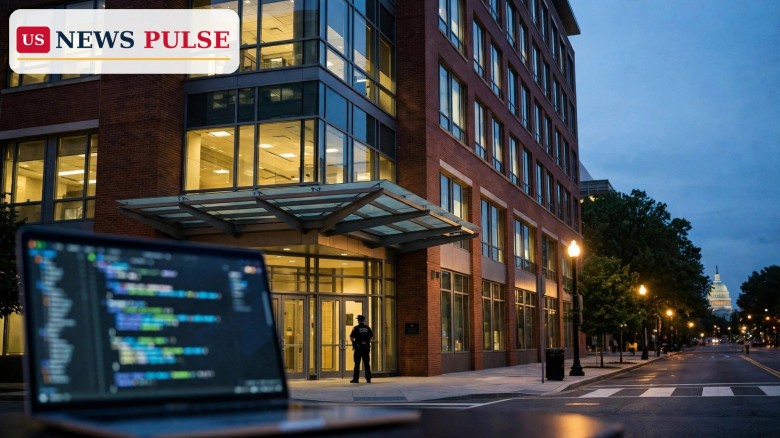
The applications worked. Nine of them resulted in job offers from American companies. Kurrle then had laptops issued by the victim companies shipped to his home in Gainesville, in suburban Washington, D.C., and enabled remote access to people outside the United States, so the employers would believe their new remote workers were based domestically. It is the classic "laptop farm" pattern federal investigators have described in a string of recent cases: a U.S.-based facilitator hosts the hardware, while the person actually doing the work sits overseas.
In his plea agreement, Kurrle did not dispute that the wages earned by the hired workers he enabled would eventually benefit the North Korean government, but said he was unaware of those connections while he was taking part in the scheme. His lawyer, Assistant Federal Public Defender Nate Wenstrup, said in a statement that Kurrle had accepted full responsibility for his conduct, adding: "As the government agreed (in the Statement of Facts), Mr. Kurrle was unaware of the connections to North Korea during his involvement in the conspiracy."
Kurrle is scheduled to be sentenced on January 28, 2027, and faces up to 20 years in prison for the wire fraud conspiracy count.
The U.S. Attorney's Office says the scheme is part of a broader North Korean government strategy to employ thousands of information technology workers in remote positions around the world, generating income for the regime while evading economic sanctions. North Korea has been under United Nations sanctions since 2003, primarily because of its nuclear weapons programme, and the United States has had trade and economic sanctions in place on North Korea since 2016.
The playbook, as described by the Treasury Department and the Justice Department, is consistent across cases. North Korean IT workers use fraudulent documents, stolen identities and fabricated personas to win remote jobs at legitimate companies in the United States and allied countries. The regime then appropriates most of the workers' wages. U.S. residents who host the arrangement — receiving and running company-issued computers — earn fees for their role, and in doing so give the operation its American footprint.
The scale is enormous. The Treasury Department said such schemes allowed North Korea to raise nearly $800 million for its weapons programmes in 2024. The department also warned that fraudulently placed workers have exploited their access to corporate networks to deploy malware and steal sensitive data, and that the networks have used sophisticated cryptocurrency transactions, money laundering techniques and emerging technologies, including artificial intelligence tools, to move millions of dollars to the North Korean government.
Kurrle's case is not an isolated prosecution. Earlier in October 2026, the Justice Department announced coordinated actions against North Korean remote IT worker schemes that affected more than 70 American companies, with 14 people charged, two Americans arrested, and about 187 laptops and keyboard-video-mouse devices seized from suspected "laptop farms" in Texas during Operation Lonestar Roundup. That indictment, unsealed in the Northern District of Ohio, covered conduct from 2019 to about July 2025 and alleged roughly $3 million in revenue believed to have gone to sanctioned entities controlled by North Korea.
The sanctions announced on October 28 targeted a North Korean-controlled entity based in Russia, the First Financial and Technical Development Center, which Treasury said used IT workers to raise money for the North Korean government. Six North Korean IT staffers working on that entity's behalf were sanctioned, along with two North Korean nationals leading a separate Russian-based delegation of similar IT workers and a Russian national who served as an intermediary handling illicit financial transactions.
In total, the designations covered eight North Korean nationals and two Russian nationals. Among those named in reporting on the action were Russian national Vitold Viktorovich Obertas, accused of processing cryptocurrency and currency transfers for North Korean operatives, and North Korean delegation lead Kim Ki Hyok. The designations block any U.S.-linked property of those named and generally prohibit Americans from dealing with them.
Treasury Secretary Scott Bessent said in a statement: "The North Korean regime continues targeting and exploiting American companies through fraudulent activities conducted by its overseas IT operatives, who weaponize sensitive data and extort businesses for substantial payments." The Treasury Department added that the networks "have leveraged sophisticated cryptocurrency transactions, money laundering techniques and emerging technologies, including artificial intelligence tools, to generate and transfer millions of dollars for the DPRK government."
The department also sanctioned a separate North Korean IT worker network in March 2026, covering six individuals and two entities, showing that the designations are part of a rolling campaign rather than a one-off action.
The Treasury Department's message was blunt: the regime is "targeting and exploiting American companies" and turning ordinary hiring pipelines into a funding channel for weapons programmes. Bessent's statement framed the sanctions as a strike at the financial plumbing — the crypto conversions, money laundering channels and intermediaries that turn stolen payroll into money for Pyongyang.
Kurrle's defence, meanwhile, drew a line between the fraud he admitted and knowledge of its ultimate beneficiary. Wenstrup's statement stressed that the government itself agreed Kurrle was unaware of the North Korea connections during his involvement, even as his client accepted full responsibility for the wire fraud conspiracy. That distinction may matter at sentencing in January, though it does not change the admitted conduct: lending his identity, and a second person's, to job applications, and hosting company laptops so overseas workers could appear to be working from inside the United States.
North Korea's mission to the United Nations in New York did not immediately respond to a request for comment on the sanctions, according to reporting on the Treasury action.
The case matters for three reasons. First, it shows the scheme reaching the most sensitive corner of the American workforce: a man with a Top Secret clearance, working for a defence contractor, lending his identity to a hiring fraud that touched government contractors. Prosecutors have not said that classified information was compromised in Kurrle's case, but the clearance alone explains why investigators treat these cases as national security matters, not ordinary fraud.
Second, it shows how cheap and scalable the model is. Nine job offers, a handful of laptops delivered to a suburban home, and a remote-access setup were enough to place workers inside American companies. Multiply that by thousands of workers and dozens of facilitators, and the Treasury's $800 million figure for 2024 starts to make sense — as does the FBI's warning that the farms are splitting into smaller operations with fewer laptops each, precisely to survive raids like the Texas searches in September.
Third, it shows Washington now attacking the scheme on both tracks at once: criminal prosecution of the American enablers, and sanctions against the overseas networks and their financial intermediaries. Either track alone leaves the other half of the pipeline intact; together, they raise the cost for facilitators at home and cut off the money flows abroad.
Kurrle will return to court for sentencing on January 28, 2027, where he faces up to 20 years in prison, though the final sentence will depend on federal sentencing guidelines and the judge's assessment of his role and cooperation. The Treasury designations take immediate effect, freezing any U.S.-linked assets of those named and barring Americans from transactions with them.
Employers, meanwhile, face a sharper warning. The FBI issued a public advisory in October 2026 describing how the scheme is evolving, and investigators have repeatedly urged companies hiring remote IT workers to verify identities more rigorously, watch for laptops routed through third-party addresses, and treat inconsistencies in interviews, payment details and device locations as red flags. With the midterm elections days away and scrutiny of foreign interference high, further enforcement actions in this pipeline would surprise no one.
Related coverage on US News Pulse includes the Polymarket hack that drained $27 million in a vendor-script attack, the Binance hack that suspended withdrawals for all users, and the Justice Department hearing in the James Comey Espionage Act case.
John Allen Kurrle Jr., 62, is a Gainesville, Virginia, man who worked for a U.S. government defence contractor from June to August 2025 and held an active Top Secret security clearance between June and October 2025. He pleaded guilty on October 28, 2026, to conspiracy to commit wire fraud.
He admitted allowing foreign nationals to apply for remote U.S. jobs using his identity and that of an unsuspecting second person, producing nine job offers, and having company laptops sent to his Gainesville home so workers abroad could log in remotely.
He faces up to 20 years in prison and is scheduled to be sentenced on January 28, 2027.
Treasury sanctioned 10 people — eight North Korean nationals and two Russian nationals — and one entity, the Russia-based First Financial and Technical Development Center, over North Korean IT worker fraud schemes.
The Treasury Department said such schemes allowed North Korea to raise nearly $800 million for its weapons programmes in 2024, with the regime appropriating most of the workers' wages.
Leave a Comment



 | Today's Date: