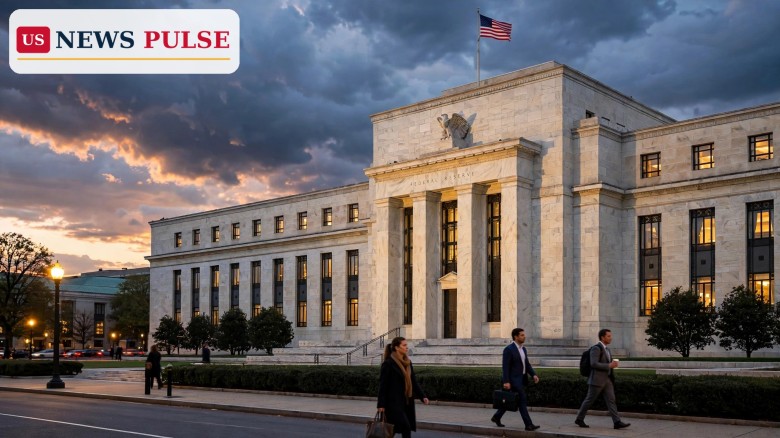
The Federal Reserve held interest rates steady on October 28, 2026, keeping its benchmark at 3.75% to 4% — but the calm headline hides a divided committee, a rare dissent from a sitting governor, and a market now betting heavily that the next move, in December, will be up. The Fed holds rates decision came at the central bank's final meeting before the November 3 midterm elections, and it followed the first rate hike in three years just six weeks earlier.
Ten of the Federal Open Market Committee's 12 voting members backed the pause. Governor Lisa Cook and Cleveland Fed President Beth Hammack dissented, both preferring another quarter-point increase immediately. It was the clearest sign yet that patience inside the Fed is wearing thin as inflation stays well above the central bank's 2% target — and it set up a December meeting that traders now treat as a near-certainty for a hike.
The Federal Open Market Committee met on October 27 and 28 and announced its decision at 2 p.m. ET on Wednesday, October 28. The federal funds rate — the benchmark for short-term borrowing across the American economy — stays in the 3.75% to 4% range set by September's quarter-point hike, the Fed's first increase since 2023.
The statement described economic activity as expanding at a strong pace, with robust capital investment and strong productivity. That upgraded language mattered: it told markets the committee sees an economy that can handle higher rates, even as it chose to wait one more meeting before moving again.
Stocks closed slightly higher on the day. The S&P 500 and the Nasdaq each gained about 0.3%, and the Dow Jones rose about 0.2%, according to USA TODAY's market coverage — a muted reaction to a decision traders had priced with more than 90% confidence before the announcement. The real action came in the currency market, where the dollar slipped through Chair Kevin Warsh's press conference even though the news was, on its face, hawkish. The dollar index dipped toward 101.90, and the euro rose to about $1.1160, as traders concluded Warsh had declined to confirm the December hike they had already paid for.
The meeting also produced a structural change. Warsh announced that one of the committee's eight meetings in 2027 will be devoted entirely to "broad monetary policy strategy," with no rate vote — leaving seven rate decisions next year. In 2028, he said, two meetings will be strategy sessions, cutting rate decisions to six a year.
The October pause did not come out of nowhere. September's consumer price inflation ran at 3.7% year over year, and producer prices rose 6.3% — numbers that pushed the committee to hike in September for the first time in three years. But the case for waiting was strong too: the committee wanted time to judge how that hike was filtering through the economy, and it was meeting just days before an election in which the path of the war in Iran — a major driver of this year's inflation through energy prices — could shift.
Then came Thursday's data, which sharpened both sides of the argument. The Bureau of Economic Analysis reported that real GDP grew at a 3.4% annual rate in the third quarter, up from 2.2% in the second and ahead of forecasts of about 3.1% to 3.2%. Consumer spending rose 3.8%, equipment investment surged about 20.8%, and real final sales to private domestic purchasers — a clean read on underlying demand — rose 4.9%. The quarterly inflation readings inside the GDP report looked benign: the PCE price index rose at a 2.1% annual rate in the quarter, and core PCE at 2.5%, down from 5.0% and 3.3% in the second quarter.
The monthly inflation report released at the same time told a less comfortable story. The PCE price index — the Fed's preferred gauge — rose 0.5% in September alone, lifting the annual rate to 3.6% from 3.4% in August, the highest in four months. Core PCE, which strips out food and energy, rose 0.3% on the month and 3.1% over the year, up from 3.0%. Energy was a major factor: gasoline and other energy goods prices jumped 9.2% in September. Personal income rose only 0.2%, real disposable income fell 0.3%, and the saving rate dropped to 3.8%, its lowest since October 2022.
The dissenters had been signalling their impatience for weeks. Hammack told the National Association for Business Economics on October 12 that "with each passing month, persistently elevated inflation raises the risks of an inflationary mindset becoming entrenched in the economy." Vice Chair Philip Jefferson, by contrast, said on October 1 that his colleagues "will need to come to our own judgment, which may take more time" — the patient wing's case in a sentence.
The committee's recent voting history shows how quickly the balance has swung. It held 9-3 in July, with three members pressing for an increase, then raised rates 12-0 in September. A 10-2 vote with two dissents demanding a hike suggests the hawks are back — and no longer willing to wait quietly.
A hold is not a pivot, and this hold is less dovish than it looks. The Fed holds rates outcome keeps borrowing costs at their highest in years, and the dissents point in only one direction: up. Before the meeting, futures priced roughly a 71% chance of a December hike; after the statement and press conference, that probability rose to about 85%, according to CME FedWatch readings reported after the decision. Every economist in a Reuters poll taken October 16-20 expected a quarter-point December increase.
For households, the arithmetic is unforgiving. The average credit card APR was 21.19% across all accounts in August 2026, before the September hike, so variable-rate cards may be a little higher now; a quarter-point move changes the annual interest on a $6,000 balance by only about $15, but the level itself is what hurts. On a $100 balance, one quarter-point hike adds about 25 cents a year in interest — small on its own, punishing at scale. The national average savings rate is just 0.38%, while competitive high-yield accounts offer around 4% — meaning money in a typical savings account is losing purchasing power against 3.6% PCE inflation.
Mortgages are a different story. The average 30-year fixed rate sits at 7.39%, according to Bankrate data, and it tracks the 10-year Treasury note — trading around 5% — more than the Fed's overnight rate. If the Fed holds but keeps the door open to another increase, mortgage rates face upward pressure; a more flexible tone acknowledging risks to growth could let them drift lower.
The jobs picture complicates the Fed's task. Warsh described labour market conditions as "quite positive," and the unemployment rate is 4.2%. But job seekers describe a "ghost market" of endless applications and silent rejections: the average duration of unemployment has climbed past five months, more than 27% of job seekers have been looking for 27 weeks or longer, and the average time to fill an open role has stretched from 41.4 days in 2022 to 61.5 days in the first eight months of 2026, according to recruiting platform Greenhouse data reported by USA TODAY.
Warsh used his press conference to defend both the decision and the institution. "The period right in front of us is information-rich. There's a lot happening in the world. My colleagues and I are keen to take notice of it," he said, adding that in coming weeks the committee would determine "the appropriate protocol" to deliver the price stability it promised in June.
Asked about President Donald Trump saying he approved of the Fed chair but that his colleagues on the committee "would like to see the country do badly," Warsh declined to engage. "We just came out of a heck of a family fight," he said, describing the meeting as a "serious" and "sober" discussion. "I think we came to the right policy decision for this moment, and I'm honored to be here and honored to be the chairman of this group." He added flatly: "Politics played no role in the decision. I just spent two days with my colleagues upstairs. I didn't hear an utterance about politics."
On artificial intelligence — the force behind much of the investment boom — Warsh said interest rates have had an effect on the industry "whether you pronounce it AI or SI," a nod to Trump's September proclamation that official documents should call it superintelligence. "Interest rates get in the cracks," he said. "Interest rates affect directly or indirectly, almost everything." He added that economic growth is higher, "but that doesn't tell me that economic growth is somehow causing inflation and making our job harder."
The Cook dissent drew special attention. It is "very rare" to see a Fed governor dissent, Chris Rupkey, chief economist at FWDBONDS LLC, said in a note after the decision. Rupkey suggested her vote could have been a protest: the Trump administration has been trying to remove Cook from the Board of Governors since August 2025 over allegations she committed mortgage fraud in 2021, which she denies. The Supreme Court blocked her removal, saying Trump could only fire her "for good reason," but Trump revived the effort this month with a "committee of inquiry" demanding she testify at the White House. Her lawyer, Abbe Lowell, called the committee "demonstrably biased" and said the earliest Cook could appear is after the Fed's December meeting.
Economists outside the Fed read Thursday's data as reinforcing the hawks. "Persistently elevated inflation is likely to keep the Fed on track to hike rates at future meetings," Mortgage Bankers Association chief economist Mike Fratantoni said, adding that the MBA holds to its forecast of two additional hikes over the next six months. "Perhaps of note for the mortgage market, the September reading for PCE inflation showed an increase to 3.6 percent from the prior reading of 3.4 percent. While this increase was certainly impacted by the recent spike in oil prices, core PCE inflation remained at 3.1 percent, still well above the Fed's target of 2 percent."
This decision matters because it is the last one before voters go to the polls, and because it locks in the shape of the December debate. A 10-2 vote with hawkish dissents, plus GDP growth of 3.4% and PCE inflation accelerating to 3.6%, leaves the committee with little room to argue that inflation is beaten — and little excuse to surprise markets in December by standing still. At the same time, the decision to cut rate-setting meetings to seven in 2027 and six in 2028 is a lasting institutional change: fewer votes, more strategy sessions, and longer gaps between decisions in a world where inflation can move fast.
For the broader economy, the stakes run through energy and the war in Iran. Oil near $100 a barrel and Brent above $116 would add fresh pressure for a hike, and the Fed itself flagged the timeline for war in Iran as a factor in its wait-and-see stance. The Bank of Canada, meanwhile, raised its own policy rate 25 basis points to 2.5% on October 28 — a reminder that the United States is not tightening alone. The European Central Bank decided on October 29 and the Bank of Japan on October 30, in a week of coordinated central-bank scrutiny.
For ordinary Americans, the message is simpler: borrowing stays expensive, saving in an ordinary account still loses to inflation, and the holiday spending season arrives with rates at their highest in years. As TransUnion's Charlie Wise advised, it is important "to stay within a budget and avoid charging more than you can repay over one to two months" while inflation remains persistent and rates stay elevated.
The calendar now points to the Fed's final meeting of 2026 in December, where markets expect a quarter-point hike to 4.00%-4.25%. Before that, the committee will watch the next inflation prints, the labour market, and whether energy prices stay elevated. Warsh has made a point of refusing forward guidance — "we're not in that business anymore," he said at a Bangkok conference earlier in October — so markets will have to read the data themselves.
The 2027 calendar is already set: meetings on January 26-27, March 16-17, April 27-28, June 8-9, July 27-28, September 14-15, October 26-27 and December 7-8, with one of those meetings given over to strategy rather than a rate vote. The minutes of the October meeting, due in about three weeks, will show how close the committee came to hiking now — and whether Cook's and Hammack's dissents were the start of a larger hawkish bloc.
One more date matters: the midterm elections on November 3. Warsh insisted politics played no role, but the Fed's own framing — waiting to see whether election results affect the timeline for war in Iran — means the vote's outcome could shape the December debate in ways the committee will not discuss in public.
It held. The Federal Open Market Committee left the federal funds rate unchanged at 3.75% to 4% on October 28, 2026, in a 10-2 vote, after raising rates by a quarter point in September.
Governor Lisa Cook and Cleveland Fed President Beth Hammack both dissented, preferring an immediate quarter-point hike because inflation remains well above the Fed's 2% target.
Markets now price roughly an 80-85% chance of a quarter-point December hike, and every economist in a mid-October Reuters poll expected one. Nothing is guaranteed — Warsh refuses to give forward guidance — but the odds moved higher after the October decision.
A hold means no immediate change, but no relief either: the average credit card APR exceeds 21%, and the 30-year mortgage rate is about 7.39%. Another hike would add roughly $15 a year in interest per $6,000 of card balance.
Warsh announced one 2027 meeting will focus on broad monetary policy strategy instead of a rate vote, and two such meetings in 2028 — cutting annual rate decisions from eight to seven, then six — to give the committee time to reconsider long-term questions.
Related coverage on US News Pulse: our preview of the October decision, Wall Street's Thursday sell-off, and the Big Tech earnings test facing AI spending.
Leave a Comment



 | Today's Date: