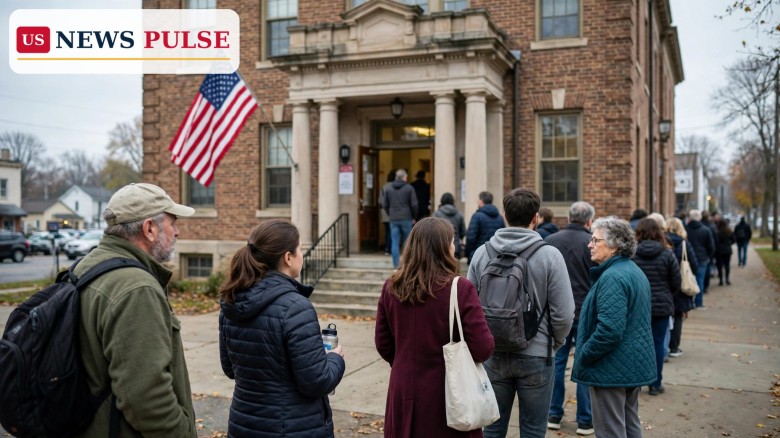
The Justice Department has told a federal court that no FBI or ICE staff will serve as poll monitors in the 2026 midterm elections, drawing a clear line around one of the most disputed parts of its election-monitoring plan five days before Americans vote on November 3. The DOJ poll monitors assurance, filed late on Wednesday, October 28, says the monitors will observe polling places and take notes, will not act as law enforcement personnel while monitoring, and will be prohibited from carrying firearms.
The filing came in a case brought by the NAACP, which has argued that the Trump administration's plan to deploy about 1,000 federal monitors nationwide amounts to voter intimidation. In its court filing, the department said monitors have been trained not to interfere in voting and to follow state and local rules, consistent with past practice. Employees of the Federal Bureau of Prisons, the Bureau of Alcohol, Tobacco, Firearms and Explosives (ATF) and the Drug Enforcement Administration (DEA) will serve as monitors, the filing said, but no FBI or Immigration and Customs Enforcement employees will.
Reuters reported the filing on October 29, after the department submitted it late on Wednesday in the NAACP case. The department's position, as set out in the filing, is narrower than the fears the lawsuit describes: monitors are observers, not enforcers inside polling places. They will mainly watch, take notes and report what they see, rather than question voters, challenge individual qualifications or run investigations at the voting site. They will not carry guns while monitoring, and they have been trained to follow the rules of the state and locality where they are posted.
That description matters because the agencies involved carry very different public meanings. The FBI and ICE are the two federal agencies most associated, in the current political argument, with criminal investigation and immigration enforcement. Their presence at a polling place, critics have argued, could deter voters, particularly naturalised citizens and members of mixed-status families, even if no one is stopped or questioned. By removing both agencies from the monitor roster, the department answers the most pointed version of that objection, while keeping a federal presence drawn from other agencies.
The filing also frames the work as consistent with past practice. Federal election monitoring is not new: the Justice Department's Civil Rights Division has sent lawyers and staff to polling places for decades to assess compliance with the Voting Rights Act, the Americans with Disabilities Act and other federal protections. What is new, and what the lawsuit attacks, is the scale and the staffing of the 2026 operation, which the NAACP describes as an unprecedented expansion and the department describes as its largest team ever on Election Day.
The dispute began long before this week's filing. Assistant Attorney General Harmeet Dhillon, who leads the Civil Rights Division, said in August that about 1,000 staff members could be dispatched to polling places for the midterms. In September she described the effort as the biggest Justice Department election observer effort in history, and on October 23 she said on social media that the department would field its largest team ever on Election Day, acting as the federal government's "eyes and ears", with findings that could lead to legal action.
Historical comparisons are imperfect because past announcements usually counted jurisdictions rather than people. The department monitored 64 jurisdictions in the 2022 midterms and 86 in the 2024 presidential election, according to reports of its announcements, while reported personnel counts for 2022 vary by source and measure. The NAACP's lawsuit alleges the department has never deployed more than 600 monitors in a prior election. Whatever the exact baseline, the planned 2026 figure of about 1,000 is, on the department's own telling, a record.
The NAACP has challenged the plan in two lawsuits. On September 18 it sued to prevent the administration from deploying federal agents to polling places, naming the Department of Homeland Security, ICE, the Justice Department and the FBI, and arguing that sending federal agents to the polls violates the Voting Rights Act as an intimidation tactic. On October 16 it filed a second case, NAACP v. Blanche, in federal court in Washington, D.C., seeking to block the deployment of criminal prosecutors and law-enforcement agents as monitors. The October complaint rests principally on Section 11(b) of the Voting Rights Act, which bars any person, acting under colour of law or otherwise, from intimidating, threatening or coercing anyone for voting or trying to vote. It also claims the department violated the Administrative Procedure Act when it rescinded its Federal Prosecution of Election Offenses policy.
The relief the NAACP seeks goes beyond the FBI and ICE question. It asks a judge to bar criminal prosecutors and law-enforcement personnel from serving as monitors, to bar monitors from being used to challenge voters' eligibility or limit access to voting sites, and to require the department to disclose the jurisdictions selected, the notices sent to those jurisdictions, any consent given, the civil-rights statutes at issue, and certification that monitors are trained on state law governing third parties at polling sites. The department's latest filing answers one element of that demand, the identity of the agencies involved, without conceding the lawsuit's broader claims.
Conduct during this year's primaries sharpened the argument. The department has said it sent more than 100 monitors to hundreds of polling locations during the primaries. In Minnesota, Hennepin County rejected the department's request to place federal monitors inside polling places during the August primary, and the department agreed to remain outside the 100-foot boundary required by state law, where plainclothes federal personnel could ask departing voters to take part in voluntary interviews. Reports also identified a newly hired department lawyer who had previously pleaded guilty after illegally accessing election websites in 2016 as having served as a monitor in Minneapolis during the primaries, a detail the NAACP's records lawsuit seeks to confirm. State and local officials in several states have described some primary-season monitoring as aggressive or irregular, while the department has said its teams were focused on uniform access, non-discrimination and communication with election officials.
The filing settles the narrow question of who will not be at the polls, but it leaves the larger questions open. It does not say how many monitors will ultimately be deployed, nor does it publish the final list of jurisdictions, which the department has not yet released. State law and local election officials can still limit where ordinary department personnel may go and what they may do, because no federal law guarantees Justice Department monitors access inside a polling place. That is why the Minnesota standoff ended outside the building, and why similar boundary disputes are possible on November 3.
It also does not resolve whether monitors drawn from the Bureau of Prisons, ATF and DEA will satisfy the NAACP's objection. The lawsuit's target is law-enforcement personnel in general, not only the FBI and ICE, and its complaint argues that no federal statute gives the department authority to "turn polling places into interrogation rooms". The department's answer is that its monitors observe and report, and refer possible violations for later review, rather than questioning voters about citizenship or conducting investigations inside polling places. Whether a court accepts that distinction, and whether voters experience the presence the same way, will be tested in practice on Election Day.
Attorney General Todd Blanche, speaking to reporters in Virginia on October 22, said it was not his intention to "improperly interfere with elections", while not ruling out department action in an extreme worst-case scenario over state certification of results. Dhillon was asked on CBS's "60 Minutes" on October 18 whether the administration planned to send ICE agents to polling places and said there was no such plan. The new filing puts that position in writing, in a court case, five days before the vote, which gives it a weight a television answer does not carry.
"There is no federal statute that gives Defendants the authority to turn polling places into interrogation rooms," the NAACP said in its October 16 complaint, filed in the U.S. District Court for the District of Columbia. The complaint names Blanche and Dhillon, and asks the court to declare that the department's conduct and threats violate Section 11(b) of the Voting Rights Act and the Administrative Procedure Act.
"The Voting Rights Act exists to protect voters from exactly this kind of intimidation, including by the DOJ," said Carmen Daugherty, executive director of the civil-rights nonprofit Advancement Project, whose lawyers are involved in the case. "Generations of Black and brown voters faced down sheriffs and poll taxes to cast a ballot, so we know intimidation when we see it."
The department's position, as reported from the filing, is that monitors will mainly observe and take notes, will be prohibited from carrying firearms, and have been trained not to interfere in voting and to follow state and local rules, consistent with past practice. The administration's broader argument, repeated throughout its election-oversight push, is that stricter measures are needed to ensure public confidence in the vote, and that it is pressing states for voter-registration data in pursuit of that goal.
President Donald Trump, asked in May whether he would consider sending ICE and the National Guard to polls in November, said: "I would do anything necessary to make sure we have honest elections." In February, the White House said it did not plan to send ICE to polling sites during the midterms, and in July a group of Democratic senators wrote to administration officials asking whether federal agents or National Guard troops were planned for midterm polls. The new filing is, in that light, the administration's clearest written answer to a question it has been asked all year.
Some state officials told Reuters this month that they are preparing for potential federal interference in the midterm elections, a sign that the filing will be read less as an end to the dispute than as a change in its terms. Election officials who welcomed traditional civil-rights monitoring in past cycles have, in this cycle, drawn sharper lines about access, and the department's own history shows that some jurisdictions have denied entry altogether, requiring monitors to observe from outside.
Poll monitoring sits at the intersection of two legitimate interests that are now in open tension: protecting access to the ballot, and policing the integrity of the vote. Traditional monitoring served the first interest. Civil-rights lawyers watched for discrimination, for barriers facing disabled voters, and for failures of language access, and their reports fed later enforcement. The 2026 operation adds a second emphasis, on fraud and voting by noncitizens, and that shift in mission is what makes the same tool feel different to different voters.
The stakes are also unusually concrete. The midterms will decide control of Congress for the final two years of Trump's presidency, along with dozens of governorships and thousands of state offices. Early voting is already under way, and the courts are already ruling on election cases days before the vote: on October 28 a federal judge in Los Angeles rejected the Justice Department's request to set aside more than 20,000 California ballots it flagged as likely noncitizens, and the department has separately issued more than 100 subpoenas seeking voter records in at least a dozen states. Against that backdrop, a written assurance about who will and will not stand inside polling places is not a technical footnote. It is one of the few points on which voters will be able to judge, on the day, whether the federal presence matched the promise.
The assurance also matters for the people who run elections. Local officials decide, under state law, where a monitor may stand, and they bear the practical burden when a federal presence creates confusion at the door. A monitor who observes quietly from an agreed spot is a manageable presence. A monitor who questions voters, challenges qualifications or carries a firearm is a different problem, and the department's filing explicitly rules out the last of those and disavows the first two as the monitors' role.
The NAACP case continues, and the court has not yet ruled on the broader injunction the group seeks. The department has still not released its final list of monitored jurisdictions, and the NAACP's parallel records lawsuit, seeking the legal authority, personnel, training, locations and internal planning behind the operation, is also pending. Either case could produce further filings before November 3, and state officials are likely to test the new assurances against what actually happens at polling places.
On Election Day itself, the test will be visible and local: which agencies' staff arrive, where they stand, whether they carry firearms, and whether they question anyone. Voters who believe they have been intimidated can report the incident to local election officials and to the department's own civil-rights channels, and the NAACP's case gives those reports a court record to land in. The department, for its part, has said its monitors' findings could lead to legal action after the vote, which means the monitoring story is unlikely to end when the polls close.
For voters, the practical message of the filing is simple: no FBI or ICE employee will be serving as a federal poll monitor on November 3, the monitors who do come will not be acting as law-enforcement personnel while monitoring, and they are barred from carrying firearms. Whether that reassures the voters the NAACP says are most at risk, or merely narrows the argument, is the question the next five days, and Election Day itself, will answer.
Will FBI or ICE agents be at polling places on November 3? According to the Justice Department's late-October court filing, no FBI or ICE agents or employees will serve as midterm poll monitors. Monitors will come from other agencies, including the Federal Bureau of Prisons, ATF and DEA.
What will the monitors actually do? The filing says monitors will mainly observe polling places and take notes, will not act as law-enforcement personnel while monitoring, will be prohibited from carrying firearms, and have been trained not to interfere in voting and to follow state and local rules.
Why did the NAACP sue over poll monitors? The NAACP argues the plan to deploy about 1,000 federal monitors nationwide amounts to voter intimidation, particularly for Black, Latino and Asian voters, naturalised citizens and members of mixed-status families. It seeks an injunction under Section 11(b) of the Voting Rights Act.
Is federal election monitoring new? No. The Justice Department's Civil Rights Division has monitored polling places for decades, traditionally with civil attorneys and professional staff assessing compliance with civil-rights laws. The 2026 plan is far larger than past operations, which is the core of the dispute.
Does the filing end the legal fight? No. The NAACP's broader injunction request, its demand for the list of monitored jurisdictions and training details, and its parallel records lawsuit remain pending, and the court has not yet ruled on them.
Related coverage on US News Pulse: Trump noncitizen voter subpoenas hit 100 in a dozen states before midterms, California ballots ruling: judge rejects DOJ bid to set aside 20,000 votes, and James O'Keefe charged in Minnesota over August primary polling-place stunt.
Leave a Comment



 | Today's Date: