Climate change should be formally declared a global health emergency, the authors of the 2026 Lancet Countdown report say, after heat was linked to a record 710,000 deaths worldwide in a single year. The climate health emergency warning, published in The Lancet on Wednesday, October 28, 2026, argues that the health damage caused by a warming planet is now growing faster than the world's response to it — and that treating it as an emergency is the only way to force a coordinated, health-first answer.
The report is the tenth annual assessment from the Lancet Countdown on Health and Climate Change, led by University College London and produced in collaboration with the World Health Organization. It draws on 146 researchers from more than 100 institutions across more than 30 countries and tracks 54 indicators of how climate change harms health — and how climate action protects it. Its central finding is blunt: many health harms grew faster in the decade after the Paris Agreement took effect, from 2016 to 2025, than in the previous decade, from 2006 to 2015.
The 2026 Report of the Lancet Countdown on Health and Climate Change was published in The Lancet on October 28, 2026, just ahead of the 31st United Nations climate conference, COP31, in November. It is not a single study of one heatwave. It is a sweeping, indicator-by-indicator check-up on the health of a warming world, comparing the decade since the Paris Agreement entered into force with the decade before it.
Its headline conclusion is that climate action is failing to keep pace with escalating harm. The authors say the rate of increase in many climate-related health threats is accelerating, even as cleaner energy, more resilient health systems and health-protecting laws deliver genuine benefits in some places. The report therefore goes further than previous editions: it formally calls for climate change to be recognised and addressed as a global health emergency, for a new World Health Organization instrument to enable a coordinated global response, and for governments to put health at the centre of every climate decision, from emissions targets to funding priorities.
That call is important to state precisely. The WHO has not declared climate change a global health emergency. The Lancet Countdown authors are urging the WHO and the United Nations to do so, arguing that emergency status would force governments to prioritise health action, funding and adaptation together, instead of responding to one disaster at a time.
The Paris Agreement, adopted in Paris in 2015, aimed to limit global warming to well below 2 degrees Celsius above pre-industrial levels and to pursue efforts to keep it to 1.5 degrees. The Lancet Countdown report measures what has happened to human health in the years since that agreement took effect, and the picture it paints is one of harm outrunning protection.
Heat is the clearest and deadliest signal. Between 2016 and 2023, heat was linked to an average of 540,800 estimated deaths a year worldwide. Of those, 68%, or about 369,900 deaths a year, were attributed to human-caused climate change. That is a sharp rise from the previous decade, 2006 to 2015, when 55% of heat-related deaths — about 219,100 a year — were attributed to climate change. Altogether, the report estimates that climate change caused almost three million heat deaths between 2016 and 2023.
The worst year in that period was 2023, then the hottest year assessed, when heat was linked to a record 710,000 estimated deaths — more, the report notes, than deaths from malaria or HIV in that comparison. About 71.5% of the 2023 heat deaths were driven by human-caused climate change. The researchers stress that these are modelled estimates drawn from health and climate data, not a count of death certificates officially recorded as caused by warming. That distinction matters, but it does not soften the trend: on the report's consistent method, the heat death toll is rising, and the share caused by climate change is rising with it.
The burden does not fall evenly. Air conditioning is estimated to have prevented more than 360,000 heat-related deaths in both 2022 and 2023, yet in countries with low Human Development Index scores — a measure combining health, education and income — only about 3% of households own an air conditioner. Around 730 million people worldwide still lack access to electricity. The report also estimates that at least two million people died in 2023 from indoor air pollution caused by solid fuels burned in homes, and that deaths linked to fine particulate matter from fossil fuels reached about 2.78 million a year.
The climate health emergency case rests on more than heat alone. Water extremes are worsening alongside it. More than half the world's land — 51.8% — was hit by extreme drought for at least a month in 2025, the second-worst year on record after 2023. Since 2016, the area affected by drought has grown more than 700% faster than it did between 2006 and 2015. A new satellite-based analysis finds that since 2003, 43% of the world's land has seen a long-term drop in water storage, becoming drier, while a separate 37% has seen a long-term rise, becoming wetter. Together, those hydrological extremes affect more than 80% of the world's land, threatening crops, food supplies and sanitation. Very extreme rainfall is also becoming more common, reaching almost 17.2% of global land each year between 2016 and 2025, up from 14.8% the previous decade, raising the risk of floods, landslides and waterborne disease.
The economic toll is equally stark. Heat reduced people's capacity to work productively in 2025, costing the global economy an estimated $1.07 trillion in potential income, equivalent to 0.91% of global economic output. It was the third consecutive year that losses topped $1 trillion. South-East Asia and Africa were hit hardest, with losses equivalent to 3.9% and 3.2% of GDP respectively, compared with 1.5% in the Americas and 0.2% in Europe. Agriculture and construction absorbed the biggest shares, at 38% and 29% of losses, because heat directly impairs labour productivity and puts outdoor workers' health at risk. In Africa, where agriculture accounts for 71% of heat-related potential income losses, the impact is particularly pronounced.
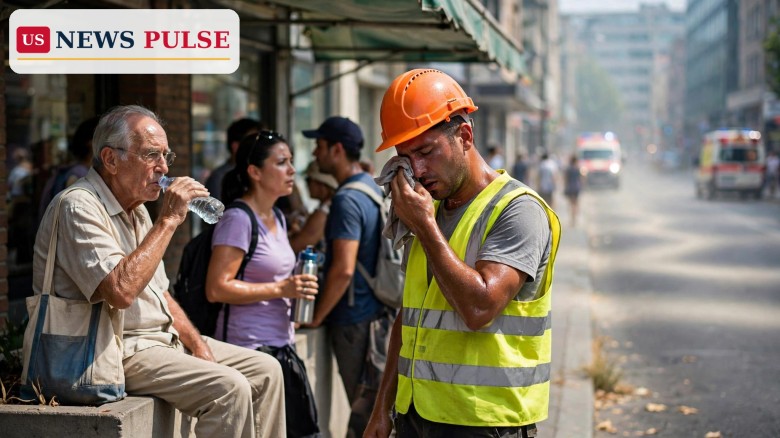
For American readers, that pattern is familiar in miniature: farmworkers, roofers, road crews and delivery drivers are among those most exposed when temperatures soar, and older adults and people with heart or lung conditions face the highest medical risk. The report's Americas figure — heat-related income losses equal to 1.5% of GDP — underlines that this is not a distant problem for the United States, even though the deadliest heat tolls fall on countries with the least cooling, the least shade and the least access to care.
Marina Romanello, executive director of the Lancet Countdown at University College London, put the eight-year toll in human terms at a news conference. She said there were three million heat-related deaths globally in the eight years since the Paris Agreement, adding: "That's roughly equivalent to the entire population of Wales being wiped out in the space of eight years due to heat." She also noted that 68% of those deaths are directly attributable to climate change, and that the findings show health harms growing faster than the world's response — in many cases accelerating — while real progress in clean energy, health readiness and protective regulation remains too slow, too small and not reaching those who need it most.
Helen Clark, former Prime Minister of New Zealand and chair of the board of the Lancet Countdown, said the report is a stark warning that climate change is a health emergency, and that what is missing is not evidence but the political will to act on it. Professor Anthony Costello, co-chair of the Lancet Countdown, noted that ten years ago the group proposed that responding to climate change could offer the greatest health opportunity of the 21st century. A decade on, he said, there is proof that health-centred climate action works — cleaner air, more resilient healthcare and warning systems are protecting health and saving lives — but the pace and scale of emissions reduction remains entirely out of step with the pace and scale of the harm.
The report's authors also point to where progress is real. Global investment in clean energy grew 7.2% in 2025 to a record $2.1 trillion, 82% more than the $1.16 trillion invested in fossil fuels, and renewable electricity grew from 5.5% of total generation in 2016 to 13.5% in 2023. Cleaner air has prevented an estimated 323,000 deaths a year in at least 77 countries where air pollution from fossil fuels has fallen since 2016. Health systems are adapting too: 56 of the WHO's 194 member states now have a national plan for adapting health services to climate change, up from just 14 in 2015, and 47 have completed a vulnerability assessment. Almost half of member states report a health surveillance system that incorporates climate information, and 75 of 145 respondents report at least one climate-informed health early warning system — systems the report finds are slowing the rise in deaths from extreme weather where they exist.
Declaring a global health emergency would not, by itself, cool the planet. Its power would be organisational and political. The authors argue that emergency status would force a single, coordinated response — shared surveillance, shared early warnings, shared funding and shared standards — instead of leaving each country to improvise after each heatwave, flood or drought. It would also put health, rather than energy or trade alone, at the centre of climate negotiations at COP31, where governments will debate emissions targets and who pays for adaptation.
The funding gap shows why that shift matters. The health adaptation needs quantified so far by developing countries put the minimum cost at $3.3 billion a year, based on data from only 48 of the 79 countries that have completed such estimates. Yet only around a third of that declared need — about $1.1 billion — was committed in 2024. The authors call for climate finance for health to be delivered as grants rather than loans, so countries can adapt without taking on more debt, and for urgent, fair cuts to greenhouse gas emissions alongside sustained investment in science.
The fossil-fuel picture explains why the gap persists. The world's 100 largest oil and gas companies are now planning to produce 150% more fossil fuels by 2040 than is compatible with keeping warming to 1.5 degrees, up from 138% in the previous year's assessment. Fossil fuels still supply more than 80% of the world's energy, and climate-heating emissions reached a record high in 2024. Global net fossil fuel subsidies have doubled since 2016, with a cumulative $6.20 trillion allocated since the Paris Agreement, and ten countries spent more on fossil fuel subsidies in 2024 than on their health systems. Fossil-fuel air pollution still kills an estimated 2.73 million people a year worldwide, the report finds. The authors also document lobbying and disinformation by fossil fuel interests and their political allies, and find that governments, international organisations and the private sector are now less engaged with health and climate change than before, reversing earlier progress.
For the United States, the stakes run through hospitals, workplaces and household budgets at once. Extreme heat strains emergency departments, worsens heart and kidney disease, threatens pregnancies and reduces the hours people can safely work outdoors. Drought and extreme rainfall, in turn, hit food prices, water quality and disease risk. A health-emergency framing would press American policymakers, like their counterparts elsewhere, to treat heat plans, cooling access, worker protections and early warning systems as core health infrastructure — not as an afterthought to energy policy.
The immediate test is COP31 in November, where negotiators will hear the Lancet Countdown's call alongside competing demands on emissions, finance and energy security. Whether the WHO or the United Nations takes up the emergency declaration, and whether governments agree a new WHO instrument for a coordinated response, will signal how seriously the health framing is taken. The report also introduces four new indicators this year — covering water availability in land, healthcare sector greenhouse gas footprint assessments, climate-related health research funding and legislative engagement — which will shape next year's assessment.
Watch, too, for national responses: laws referencing both climate change and health have risen roughly 50-fold since 2000, most of that growth since 2016, and funding for climate-related health research rose 655% between 2016 and 2024, from $42 million to $316 million — although almost all of it, 84%, still goes to researchers in the world's wealthiest countries, leaving evidence gaps where risks are often greatest. Closing that gap, the authors argue, is part of the emergency response itself.
For readers, the practical message is simpler and does not wait for a declaration. Heat is now a leading, preventable health risk: check on older neighbours during heatwaves, keep outdoor work and exercise to cooler hours where possible, drink water before thirst sets in, and treat confusion, fainting or a body temperature that will not come down as a medical emergency. Those steps do not replace policy, but they are the first line of defence the report's warning systems are built to support.
The Lancet Countdown on Health and Climate Change is an annual, independent assessment published in The Lancet that tracks how climate change affects health and how climate action protects it. The 2026 edition, its tenth, uses 54 indicators and the work of 146 researchers from more than 30 countries.
No. The 2026 Lancet Countdown authors are calling for climate change to be formally recognised as a global health emergency and for a new WHO instrument to coordinate the response. The WHO has not made such a declaration.
Because 2023 was the hottest year in the period assessed for heat mortality and produced the record figure: an estimated 710,000 heat-linked deaths, with 71.5% attributed to human-caused climate change. The figures are modelled estimates, not official death-certificate counts.
According to the authors, it would drive a coordinated global response — shared surveillance, early warning systems and funding, delivered as grants rather than loans — and put health at the centre of every climate decision, from emissions targets to adaptation finance.
Older adults, young children, outdoor workers in agriculture and construction, and people with heart, lung or kidney conditions face the highest risk. Lack of air conditioning, electricity and access to cool shelter sharply increases danger, which is why the toll falls hardest on low-income communities.
Related coverage on US News Pulse: US opioid deaths fall to lowest in nearly a decade, HHS says, Western US winter storm brings up to 14 inches of snow before Halloween, and Eye drops recall: 4.8 million cartons pulled nationwide.
Leave a Comment



 | Today's Date: