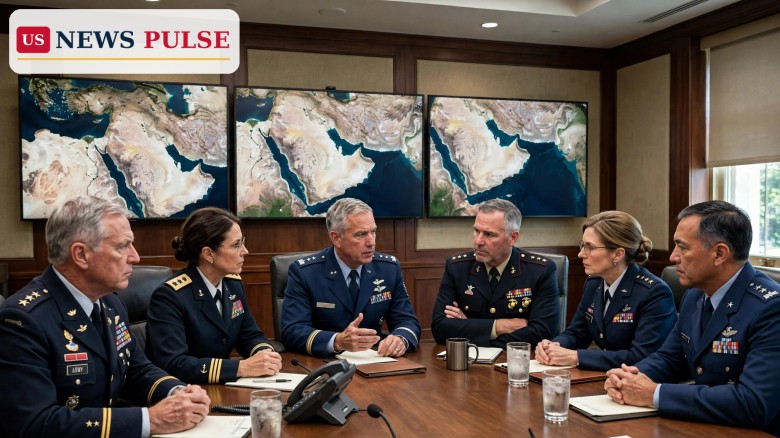
The top American commander in the Middle East walked into the White House on Thursday and laid out military options for Iran directly to President Donald Trump, in a rare face-to-face briefing that has sharpened fears in Washington and across the Gulf that a new round of major combat could follow next week's midterm elections. The meeting, first reported by The Wall Street Journal, brought together the president, Defence Secretary Pete Hegseth, Joint Chiefs Chairman Gen. Dan Caine and Adm. Brad Cooper, the head of United States Central Command, which oversees American forces across the Middle East.
Cooper almost never briefs the president in person, and that alone has set off alarm bells among lawmakers and diplomats who read the session as a sign that Washington is moving closer to significant military action. The Pentagon and Central Command both declined to comment on the meeting, and other news organisations said they could not immediately verify the report independently. The White House session also covered other subjects and included additional cabinet members, according to people familiar with it.
According to The Wall Street Journal, which cited American officials and other people with direct knowledge of the meeting, Cooper presented the Iran options to Trump on Thursday. Hegseth and Caine sat in, alongside other cabinet members, and the discussion ranged beyond Iran to other matters. The day before, the same officers had met Vance at the White House, one person familiar with the sessions said.
The rarity of the encounter is itself part of the story. Cooper, who commands the forces that would carry out any operation in the region, does not routinely travel to Washington to brief the president face to face. His last comparable session came in July, when he, Hegseth and Caine met Trump aboard Air Force One in Delaware. Officials who track the Pentagon's rhythms say a second in-person briefing within months, at a moment when the administration is openly warning of renewed fighting, is difficult to read as routine.
Neither the Pentagon nor Central Command would discuss the meeting. The Times of Israel, relaying the Journal's report, noted that Reuters could not immediately verify it independently. No decision to strike was announced, and nothing in the reporting suggests Trump signed off on an operation on Thursday. What the briefing does establish is that detailed military planning has reached the president's desk at the highest level, days before voters go to the polls.
The United States has not carried out any major strikes against Iran since September, according to reporting this week, but the confrontation has never cooled. In the spring, American and Israeli forces waged a heavy bombing campaign that Trump himself has since nicknamed "Epic Fury". At a rally last week, the president framed the choice facing Tehran in blunt terms: "We may do another little Epic Fury. Or they'll agree."
Since then, the pressure has built on several fronts at once. CNN reported this week that American forces in the region now have enough strength in place to act within 96 hours of a presidential order, and that the planning aims at something more decisive than simply maintaining the status quo. The reported target set spans energy infrastructure, military sites and nuclear facilities. The same reporting said Israeli Prime Minister Benjamin Netanyahu had pressed for a joint operation before Israel's elections this week, but that Trump declined to give the green light.
The Gulf monarchies, meanwhile, have been told to brace themselves. Two diplomats told The Associated Press that American officials urged several Middle East countries to prepare for possible renewed military action after the midterms, warning that a new round could last several days and urging precautions against Iranian strikes on energy facilities and other infrastructure. The Journal separately reported that Washington is moving Patriot interceptor missile systems and troops into the region.
The Strait of Hormuz sits at the centre of the crisis. Iran's Revolutionary Guards claimed this week that three tankers exploded and caught fire after hitting sea mines in the past day, saying the ships were on an unauthorised southern route with their radar and navigation systems switched off. Britain's maritime agency reported one ship on fire about 17 kilometres off Oman, sighted by a passing vessel, without confirming a cause. No independent source has confirmed three tankers or mines, and the Guards also claimed to have captured an American MQM-170 surveillance drone west of the strait, a claim that is theirs alone. Iran-backed Houthi rebels, meanwhile, have targeted Saudi Arabia's oil infrastructure and airports to press their demands in Yemen and add pressure across the wider regional conflict.
A presidential briefing of this kind is not a single plan but a menu: a range of military options, each with different targets, timelines, risks and expected consequences, from which the commander-in-chief can choose, combine or reject elements. The reporting on Thursday did not detail which options Cooper laid out, and officials declined to comment, but the surrounding reporting sketches the shape of the debate.
One strand points to a short, intense campaign after the elections, the phrase Trump officials have used with Gulf allies. Another strand, in the CNN reporting, describes an operation designed to be decisive rather than a holding action, aimed at energy infrastructure, military sites and nuclear facilities. A third strand is the political constraint: on Wednesday, Trump told reporters that "anything's possible" when asked about renewed hostilities, a formulation that keeps every option open without committing to any of them.
What is clear is that no final decision has been made public. The diplomats who described the warnings to allies stressed that Trump has not made a final decision, even as he has repeatedly indicated he is considering fresh strikes after the November 3 elections. The briefing therefore matters less as a declaration of war than as evidence of how far the machinery of war has advanced, and how little time remains for diplomacy to head it off.
The sharpest reaction came from Senator Chris Murphy, a Connecticut Democrat who said he has previously been briefed on some of the classified planning. Speaking on Wednesday at the Middle East Institute, after a visit to Qatar and Saudi Arabia, Murphy called the plans "insane".
"It will lead to devastating escalation and the likely destruction of our commitment to the rule of law," Murphy said. He went further on the human cost, warning that American troops and diplomats in the Gulf could not be guaranteed protection if fighting resumed: "I don't think anyone should have any degree of confidence that we can protect our soldiers and our diplomats in the region. So, if the president restarts an active war with Iran, he does it with knowledge that it will likely end up in Americans being killed."
Representative Thomas Massie, a Kentucky Republican, raised the constitutional objection, writing that American law and the Constitution prohibit the executive branch from fighting a war that is not declared or authorised by Congress. Murphy, for his part, sketched a Democratic counter-move: if Democrats win power next week, he expects a continuing resolution that pushes the budget fight into January or February, with Democrats funding the Defence Department but attaching a provision barring any money from going to the war against Iran, including funds to replenish missile stocks used to continue it.
From Tehran, Foreign Minister Abbas Araghchi struck a different note, saying Iran continues to give diplomacy a chance. "We remain in close and ongoing contact with intermediaries to review ideas that can ensure implementation of our 7-Day Plan in even less than a week," he wrote on X. Trump, asked about the diplomatic track, played down its significance, saying Vance's outreach concerned medical supplies: "Iran needs help with medical supplies. Basically, it's getting supplies in to help people that are not well."
The briefing lands five days before an election that will decide control of Congress, with 35 of the 100 Senate seats and all 435 House seats contested. Nonpartisan analysts generally favour Democrats' chances of capturing a House majority, with the Senate seen as very close, and the Iran war has become a first-order issue in the campaign. A recent New York Times and Siena University poll found that 65 per cent of voters disapprove of Trump's handling of the war in Iran, and the conflict has divided the Republican Party itself, with figures such as Vance privately opposed to going to war even as the administration prepares for it.
The stakes beyond American politics are larger still. A renewed campaign would put American personnel across the Gulf in the line of retaliation, threaten energy infrastructure that the region's economies depend on, and risk closing or disrupting the Strait of Hormuz, the narrow waterway through which Gulf oil reaches world markets. The spring campaign showed how quickly such a conflict can escalate; the warnings to Gulf allies this week show how seriously governments in the region are taking the prospect of a second round.
There is also a legal and institutional dimension that Murphy and Massie have both raised. A war launched without congressional authorisation, funded through defence budgets that Congress controls, would set up a direct confrontation between the White House and Capitol Hill, particularly if Democrats emerge from Tuesday with the House. The funding fight Murphy described would begin in the first three months of next year, turning the war into the defining early test of the next Congress.
Three clocks are now running at once. The first is the election: Americans vote on Tuesday, November 3, and the administration's own messaging to allies points to action after, not before, that date. The second is diplomatic: Iran says it is reviewing ideas with mediators to implement its seven-day trust-building plan, under which Washington would lift its naval blockade of Hormuz and release some frozen Iranian assets, after which Tehran would open the strait and begin negotiations immediately. Iranian leaders are reported to have received Vance's proposal constructively and suggested Qatar or Turkey as possible venues, with Rezaei expected to deliver a formal response.
The third clock is military. Gulf states have been urged to take precautions against Iranian strikes on energy facilities and infrastructure, and American air defences and troops are being repositioned in the region. If diplomacy fails and the president gives the order, the CNN reporting suggests forces could act within 96 hours, with a campaign lasting several days and retaliation prolonging the conflict beyond that.
For now, the White House has said nothing about Thursday's briefing, the Pentagon has declined to comment, and the only public signals are the ones the participants have chosen to send: a president who says "anything's possible", a vice president quietly writing to a hardliner, a foreign minister talking about a seven-day plan, and a senator who has seen the classified planning and calls it insane. Voters will have their say on Tuesday. What happens after that may be decided very quickly.
Adm. Brad Cooper is the commander of United States Central Command, the military command responsible for American forces across the Middle East. He rarely briefs the president in person, which is why Thursday's White House session drew so much attention.
No decision has been announced. Diplomats briefed on the warnings to allies stressed that Trump has not made a final decision, though he has repeatedly indicated he is considering fresh strikes after the November 3 midterm elections and told reporters this week that "anything's possible".
"Epic Fury" is the name President Trump has used for the heavy American and Israeli bombing campaign against Iran in the spring of 2026. At a rally last week he said of Tehran: "We may do another little Epic Fury. Or they'll agree."
Iran's seven-day trust-building plan, proposed to Washington last month, calls for a series of steps over a week, including lifting the naval blockade of the Strait of Hormuz and releasing some frozen Iranian assets, after which Iran would open the strait and begin negotiations immediately. Foreign Minister Abbas Araghchi says Tehran is in close contact with mediators about implementing it in even less than a week.
Murphy, who says he has been briefed on the classified planning, warned that a renewed campaign would lead to devastating escalation, prolong the war, endanger American soldiers and diplomats in the region, and undermine the commitment to the rule of law. He also said Congress could use its funding power to block money for the war if Democrats win power.
Related coverage on US News Pulse: US warns Gulf states to brace for short, intense strikes; Vance letter to Iran hardliner confirmed by Trump; US strike plans ready within 96 hours of Trump order, reports say.
Leave a Comment



 | Today's Date: