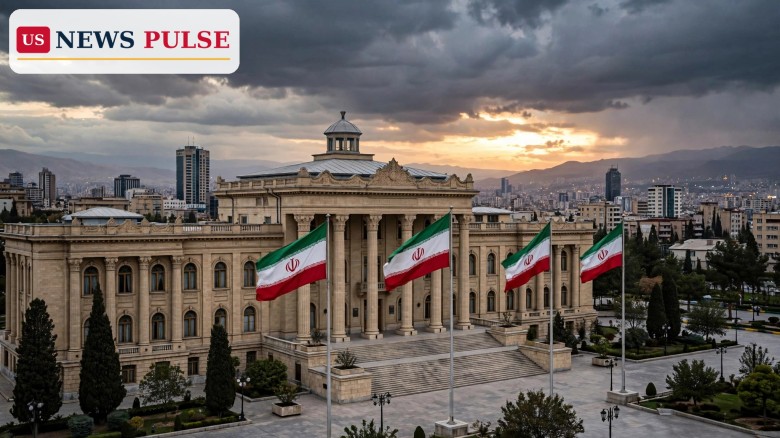
Iran's supreme leader has ordered his government to end the country's long state of "neither war nor peace" with the United States, a directive that landed in Tehran on Wednesday just as a secret American backchannel to Iran's top security official came into public view. The move does not amount to a peace offer, and it does not signal surrender. It is, instead, an instruction to settle the standoff on Tehran's terms while staying ready for the fighting to resume — a balancing act that now sits at the centre of the most dangerous confrontation in the Middle East, five days before Americans vote in the midterm elections.
President Masoud Pezeshkian told his cabinet on Wednesday, October 28, that his administration would carry out the directive from Supreme Leader Ayatollah Mojtaba Khamenei earnestly and with its full capacity. Ministers were told to maintain full readiness, to use every available resource to strengthen national power, and to prepare for fresh threats and sanctions. At the same meeting, Foreign Minister Abbas Araghchi briefed ministers on diplomatic developments and regional consultations, including contacts involving Qatar and Pakistan. The message from Tehran was deliberately two-sided: pursue an end to the limbo, but do not expect pressure to break Iran's will.
The directive emerged from Wednesday's cabinet session in Tehran, where Pezeshkian described Khamenei's instruction as an important direction for the country and ordered every minister, deputy and executive chief to act on it. According to Iran's official Islamic Republic News Agency (IRNA), Pezeshkian said all ministers and senior officials were obliged to maintain full readiness based on requirements and to use existing capacities to increase productivity and strengthen national power. He also warned that Iran must be prepared for changing circumstances, including new threats and sanctions, and that the government needed a high capacity for resilience against external pressure.
"Enemies should not think they can weaken the will of the Iranian nation and force the country to surrender," Pezeshkian told the cabinet, in remarks carried by IRNA and reported internationally. The wording matters because it frames the directive as a change of posture rather than a concession. Khamenei wants the government to pursue Tehran's conditions for ending the confrontation, not to accept Washington's. Iranian reporting indicates that those conditions include easing economic restrictions, releasing frozen assets and lifting the American naval blockade, while Washington insists that any renewed talks must address Iran's nuclear programme.
The cabinet discussion came as reports of a parallel American initiative surfaced. The Wall Street Journal reported that Vice President JD Vance sent a letter to Rezaei, a former commander of the Islamic Revolutionary Guard Corps, to test whether Washington and Tehran could establish a framework for renewed negotiations. The communication reportedly did not contain a detailed peace proposal. Axios separately reported, citing a US official, that Vance's message emphasised that any renewed talks would have to address Iran's nuclear programme. Trump, however, offered a different account on Wednesday, acknowledging that he had approved Vance's contact with Iran but disputing that it was an attempt to restart peace negotiations. He described it instead as an effort to facilitate medical supplies.
That contradiction is now part of the story. Either the administration is quietly exploring a diplomatic off-ramp while publicly denying it, or the contact was narrower than the initial reporting suggested. What is not in doubt is Rezaei's centrality: he is both the man Khamenei has tasked with pursuing Iran's conditions and the man Washington chose as its point of contact. That dual role makes him the single most important figure in the current exchange, and it also makes any misunderstanding between the two capitals unusually risky.
The confrontation began with United States and Israeli military operations against Iran in February 2026, and it has now lasted for nearly eight months. Since early March, Iran has closed the critical Strait of Hormuz, through which about one-fifth of global oil and liquefied natural gas supplies were shipped until then. The closure sent oil prices spiralling and caused shortages globally. In the United States, diesel, which farmers and small businesses rely on heavily, has nearly doubled in price: the average price of a gallon of diesel hit $6.35 on Wednesday, compared with $3.75 a year earlier, according to the American Automobile Association, while the average gasoline price stood at $4.24.
The human and financial costs have mounted alongside the economic ones. The Pentagon has told Congress that the war has cost American taxpayers at least $47.1 billion as of October 16, including about $29 billion to replace expended munitions, and the Congressional Budget Office has said the conflict could cost $2 billion to $3 billion a month for as long as it continues. More than 50,000 American troops are stationed in the Middle East, and at least 21 US service members have died and 865 have been wounded since February 28, according to the US military's official casualty database. The national debt has passed a record $40 trillion, two years earlier than expected.
Diplomatically, the two sides have been circling each other for weeks. Tehran has said it is in close and ongoing contact with mediators over proposals to restore a ceasefire and reopen the Strait of Hormuz, while Washington has reinforced its military presence in the Gulf, including the deployment of the USS Theodore Roosevelt carrier strike group and amphibious ships carrying Marines, adding roughly 9,000 personnel to the roughly 50,000 already in the region. US officials have also told several Middle East countries and regional allies to prepare for possible renewed military action against Iran after next week's midterm elections, as well as for potential Iranian retaliation against energy facilities and critical infrastructure. The White House has declined to comment on those warnings, and Trump has not made a final decision on new strikes.
The phrase "neither war nor peace" captures the peculiar condition Iran has lived in since the heaviest fighting eased without producing a settlement: no full-scale war, no peace treaty, no functioning ceasefire, and no normal commerce. Ships cannot move freely through the Strait of Hormuz, sanctions remain in place, troops remain deployed, and both sides keep warning of a return to major operations. Khamenei's directive is, in effect, a judgment that this condition has become unsustainable — politically, economically and militarily — and that Tehran must now force a resolution rather than drift in it.
What that resolution looks like depends on which capital is describing it. For Tehran, ending the limbo means a settlement on its conditions: sanctions relief, released assets, an end to the naval blockade, and recognition that Iran will not surrender under pressure. For Washington, ending the limbo means, at minimum, a negotiation that puts Iran's nuclear programme at its centre, and possibly a renewed military campaign if diplomacy fails. Those two definitions are not yet compatible, which is why the directive, for all its significance, has not produced a breakthrough. It has produced a process — a cabinet instructed to act, a security chief empowered to negotiate, and a backchannel now in the open — but not an agreement.
The timing is also significant. With five days to go before the midterms, the war has become deeply unpopular in the United States, and Trump's approval ratings have slumped to just 33 percent, the lowest of either of his terms, according to polling cited this week. Democrats lead Republicans by 51.4 percent to 43.2 percent in RealClearPolling's national polling average. Analysts say the rising cost of the conflict, and its effect on fuel and food prices, is hitting two pillars of Trump's political rhetoric: his 2024 campaign promise of "no new wars" and his emphasis on fixing the American economy. Trump himself has repeatedly said the war will end when he wants it to end, telling a Texas rally last week: "Somebody asked me before, 'When will the war in Iran end?' I said, 'Whenever I want it to end.'"
Pezeshkian's cabinet remarks set the tone for Tehran's public position: implement the directive earnestly, stay ready, and do not mistake diplomacy for surrender. "All ministers, heads and deputies of the executive branches are obliged to maintain full readiness based on requirements, and use the existing capacities to increase productivity and strengthen the national power," he said. "Enemies should not think they can weaken the will of the Iranian nation and force the country to surrender."
In Washington, the reaction has been divided between the administration's public line and its reported private outreach. Trump acknowledged approving Vance's contact but rejected the idea that it was a peace initiative, describing it instead as an effort connected to medical supplies. That account sits uneasily with the Wall Street Journal's reporting that the letter was sent at Trump's direction to explore a framework for negotiations, and with Axios's report that the message stressed the nuclear programme. The gap between those accounts may narrow in the coming days, or it may widen into a political argument of its own.
Critics of the war in the United States have seized on the latest cost figures to press their case. Senate Minority Leader Chuck Schumer wrote on X after the Pentagon's latest estimate: "For eight months, American families have been buried by the heavy cost of Trump's disastrous war in Iran. Trump and his ego led us into this war with no plan, no authority, and no exit strategy." He added that 21 service members had died and hundreds more had been wounded, that prices were skyrocketing, and that families were struggling to make ends meet. The Trump administration, for its part, has denied that it is running low on weapons stockpiles, with Trump telling the United Nations General Assembly in September: "Cowards and traitors would like to say that the United States is short of ammunition, but that is not true. We have more ammunition than we could ever imagine using."
The directive matters because it is the first clear signal from Iran's supreme leader that Tehran wants the current phase to end, rather than merely endure it. That changes the diplomatic geometry. Until now, the dominant question has been whether Washington would resume major strikes after the midterms. Now there is a second question: whether Tehran's own leadership is prepared to trade its conditions for a settlement, and whether Washington will test that proposition seriously before reaching for military options. If the Vance-Rezaei channel develops into formal talks, it could become the most consequential diplomatic opening since the war began. If it stalls, the same channel could become evidence that diplomacy was tried and failed — a justification, in some quarters, for escalation.
It also matters for American voters, who will decide control of Congress on November 3 while fuel prices, food costs and the national debt all bear the war's fingerprints. A war that was initially predicted to last only a few weeks has now lasted eight months, and its costs — in money, in lives, in stockpiles and in energy prices — are no longer abstract. The Pentagon's inspector general has warned of "strategic inventory shortfalls" as the war continues, and the military has expended roughly 65 percent of its Patriot missile interceptor stockpiles. Those are the kinds of facts that shape elections, and they are the reason both capitals are moving now rather than waiting for the votes to be counted.
For the wider region, the stakes are equally direct. Gulf states have been told to prepare for a short, intensive campaign and for Iranian retaliation against energy facilities. Shipping through the Strait of Hormuz remains disrupted. Any settlement that reopened the strait to normal traffic and eased sanctions would transform the region's economy overnight; any renewed campaign would do the opposite. Khamenei's directive does not resolve that choice, but it does make it explicit: the limbo is over, one way or another.
The immediate question is whether the reported communication between Vance and Rezaei develops into formal negotiations or remains an exploratory exchange. Neither side has announced an agreement to resume talks, and the divisions over sanctions, the nuclear programme and the naval blockade remain wide. Watch for three signals in the coming days: whether Araghchi's consultations with Qatar and Pakistan produce a visible mediation proposal; whether Washington's language about the nuclear programme softens or hardens; and whether the administration's account of the Vance letter converges with the reporting or continues to diverge from it.
The midterm elections on November 3 are the other hard deadline. Trump has repeatedly signalled that new strikes remain an option after the vote, and US officials have told allies to prepare for a campaign lasting several days. A Democratic victory in either chamber of Congress would change the political calculus for a renewed campaign, while a Republican hold would strengthen the administration's hand. Either way, the period immediately after the election is now the most dangerous window in the conflict since February, and Tehran's directive appears designed to influence what happens in it.
For now, the most honest summary is that both sides are preparing for two futures at once: a negotiated end to the limbo, and a return to major combat. Pezeshkian's cabinet was told to do both — to implement the directive earnestly and to maintain full readiness. That dual instruction is the clearest available guide to what comes next.
It describes Iran's current condition: no full-scale war and no peace settlement, with the Strait of Hormuz disrupted, sanctions in place, troops deployed, and both sides warning of renewed fighting. Khamenei has now directed his government to end that condition.
Rezaei is the secretary of Iran's Supreme National Security Council and a former commander of the Islamic Revolutionary Guard Corps. Khamenei has tasked him with pursuing Iran's conditions for ending the impasse, and Vance reportedly wrote to him to explore renewed negotiations.
The Wall Street Journal reported that Vance wrote to Rezaei to explore a framework for negotiations, at Trump's direction. Trump acknowledged approving the contact but described it as an effort to facilitate medical supplies, not restart peace talks. No formal negotiations have been announced.
According to Iranian reporting, Tehran wants economic restrictions eased, frozen assets released and the American naval blockade lifted, while maintaining readiness for further confrontation. Washington insists any talks must address Iran's nuclear programme.
US officials have told Middle East allies to prepare for possible renewed military action after the November 3 elections, and for potential Iranian retaliation. Trump has not made a final decision, and the White House has declined to comment on the warnings.
Related coverage on US News Pulse: US warns allies to brace for post-election Iran strikes, Iran's 7-day Hormuz plan, and Iran claims its 14th US drone downed near Hormuz.
Leave a Comment



 | Today's Date: