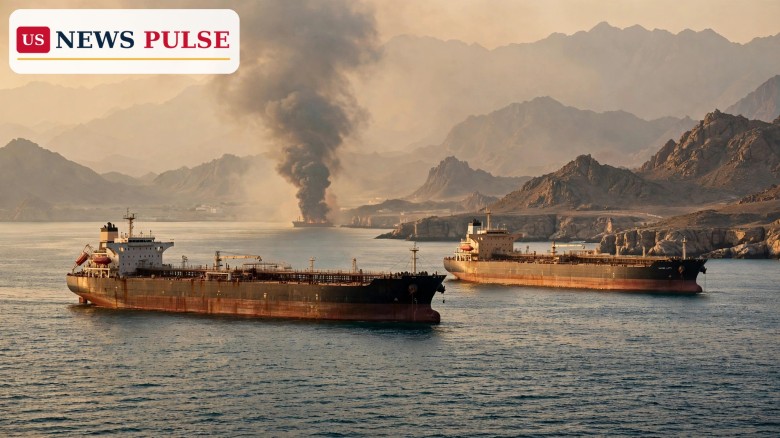
Iran's Revolutionary Guards said on Thursday, October 29, 2026, that three oil tankers exploded and caught fire after hitting sea mines in the Strait of Hormuz, in the latest alarming claim from the world's most important oil shipping chokepoint. The Guards said the tankers were trying to use an unauthorised southern route through the strait, had switched off their radar and navigation systems, and had ignored warnings from its navy before striking mines and being abandoned on the southern shores of the waterway.
The claim, carried by Iranian state media on Thursday, has not been independently confirmed. No flags, no casualty figures and no exact times for the three reported incidents were given, and it was not immediately clear whether a separate British maritime report of a ship on fire in the strait referred to one of the same vessels. But the statement landed at a moment of maximum sensitivity: the United States and Iran are still at war, the strait carries about one-fifth of the world's oil and gas consumption under normal conditions, and Washington and Tehran have spent recent days publicly disagreeing over whether the waterway's main transit routes are safe.
The IRGC Navy statement, published on Thursday and reported by Iran's IRNA and ISNA news agencies as well as Reuters, said: "Over the past 24 hours, three violating oil tankers exploded and caught fire after striking mines while attempting to pass through the unauthorised southern route of the Strait of Hormuz." The statement said the vessels had switched off all their radar and navigation systems and ignored warnings from the IRGC Navy as they tried to leave the strait by the southern route.
According to the Guards, the tankers were subsequently abandoned along the southern coast of the strait. The statement did not name the ships, say which countries' flags they flew, identify their owners, or say whether anyone was hurt. Those gaps matter, because in a war zone where both sides have strong incentives to shape the narrative, the difference between a confirmed incident and a claimed one is significant, and outside verification had not emerged in the reporting reviewed for this article.
Earlier on Thursday, the United Kingdom Maritime Trade Operations agency, UKMTO, said it had received a report of a ship on fire in the strait. UKMTO said the report came from the master of another vessel, and placed the burning ship nine nautical miles, about 17 kilometres, north of Khasab, the Omani town that sits just off the strait. UKMTO gave no details about the cause of the blaze or any casualties, and it was not immediately clear whether the vessel it described was one of the three ships referred to by the Guards.
That single confirmed element, a ship reported on fire, is therefore not the same as confirmation of the Guards' full account. What can be said with confidence is narrower: Iran's military says three tankers hit mines, a British maritime agency says a ship was reported on fire in the same waterway on the same day, and neither account, on its own, closes the gap between the two.
The Strait of Hormuz is a narrow waterway between Iran and Oman at the mouth of the Persian Gulf. Under normal conditions it carries about one-fifth of global oil and gas consumption, which is why any threat to shipping there moves oil markets and alarms governments far beyond the region. Since the war began on February 28, 2026, Iran has severely restricted traffic through the strait and has attacked ships it accuses of passing through unauthorised, while the United States has responded with a counterblockade of Iranian ports and has helped tankers transit the waterway.
Mines are central to that contest. In recent weeks Iran has reported multiple vessels striking sea mines, and those reports prompted US Central Command, which runs American military operations in the region, to reaffirm on social media its insistence that all mines in the strait's primary transit routes have been cleared. On Sunday, CENTCOM said it had helped Gulf countries export 1.5 billion barrels of oil through Hormuz since the summer, a figure presented as evidence that the main routes were working.
Thursday's IRGC statement directly challenged that picture. The Guards said the unauthorised route through the strait was mined, and warned vessel owners and crews that they were responsible for using such routes and should not rely on what it called CENTCOM's delusions on social media. The statement concluded with a warning that any provocative action backed by what it called the aggressive and terrorist US military, and in disregard of the regulations governing the strait, would be met with a firm response.
Iran considers ships using the southern corridor near the Omani coast unauthorised. That distinction is at the heart of the dispute: CENTCOM's assurance covers primary transit routes, while the Guards' claim concerns a southern route it says is mined and off-limits. The two positions are not necessarily contradictory in every detail, but they point in opposite directions for any shipowner deciding which passage to trust, and Thursday's events will sharpen that dilemma rather than resolve it.
The sharpest exchange on Thursday came not from the statement itself but from an IRGC spokesman, Hossein Mohebi, who took the argument directly to CENTCOM on X. "Prove your Hormuz mine-clearing claim with independent evidence, not statements!" Mohebi wrote, challenging Washington to back its assurance with something verifiable rather than another social media post.
The demand captures a wider problem for shipping in the strait. Mine clearance is difficult to prove from a distance, and commercial operators, insurers and crews must make decisions on incomplete information. If the main routes are clear but a southern route is mined, as Tehran claims, then the safety of a transit depends heavily on exactly which corridor a ship uses, and on whether it is following the route that Washington says is safe or the one Tehran says is not.
For its part, the Guards' statement placed responsibility squarely on the ships themselves, saying the vessels had switched off their radar and navigation systems and disregarded warnings. Ships sometimes go dark, switching off automatic identification systems, to avoid detection in dangerous waters, but doing so also removes a layer of safety and makes it harder for rescuers, insurers and other vessels to know where they are. Tehran's framing turns that practice into a violation that justifies what followed; shipowners and maritime lawyers are likely to dispute that characterisation, particularly while the identities of the vessels remain unknown.
What is not in dispute is the economic exposure. With about a fifth of the world's oil and gas normally moving through Hormuz, even an unconfirmed mine claim can raise insurance costs, slow transits and push some operators to reroute, adding days to voyages. Previous reporting in this war has put war-risk insurance costs at up to 10 percent of a vessel's hull value in the worst-affected trades, and reroutes around the region can add 10 to 14 days to a journey. Those costs eventually feed into fuel prices, which is why a claim about three tankers in a narrow strait is watched well beyond the Gulf.
Oil markets on Thursday told a more complicated story than the tanker claim alone might suggest. Prices fell during the day, with traders weighing hopes for diplomacy against the risk of further escalation, according to market reporting. That reaction suggests that, for now, investors are placing at least as much weight on the possibility of a negotiated pause as on the latest incident at sea.
The diplomatic backdrop is genuinely active. US Vice President JD Vance has written to Iran's top security official, Mohsen Rezaei, in an effort to restart negotiations, according to the Wall Street Journal, which reported that the letter was sent at President Donald Trump's direction. Trump himself has described the contact in narrower terms, saying Iran needs help with medical supplies and various things, while Iranian Foreign Minister Abbas Araghchi has said Iran continues to give diplomacy a chance and is in contact with intermediaries on a seven-day plan to end the war and reopen Hormuz, which he said could be carried out in even less than a week.
At the same time, US officials have warned Middle East allies to prepare for possible renewed military action against Iran shortly after the November 3 midterm elections if a last-minute deal is not made, according to reporting by Axios and others. That warning, and the Iranian leadership's own recent shift away from a posture of neither war nor peace, mean that diplomacy and escalation are running in parallel, and Thursday's tanker claim sits uneasily between the two tracks.
In a separate statement on Thursday, the Guards also said they had captured a US reconnaissance drone during an operation in the western Strait of Hormuz. That claim, like the tanker claim, came from Tehran without independent confirmation in the reporting reviewed, and it underlines how many competing claims are now emerging from the strait on a single day.
For American readers, the stakes of a Hormuz incident are not abstract. The war has already pushed US petrol prices higher, with the national average standing at $4.24 a gallon in recent AAA data, and diesel prices sharply above year-ago levels. A prolonged disruption to Hormuz shipping would not just affect Gulf exporters; it would tighten global oil supply, lift crude prices and, over time, feed through to the petrol pump, heating costs and the price of goods moved by truck, ship and plane.
The incident also matters because it tests the credibility of the competing safety assurances in the strait. If three tankers really did hit mines on a southern route while CENTCOM says primary routes are clear, shipowners face a practical question with no easy answer: which route, and whose assurance, do you trust with a crew, a cargo and a hull worth hundreds of millions of dollars? If, on the other hand, the claim cannot be corroborated, it will feed a different problem, a loss of trust in wartime claims from all sides, which makes the next real incident harder to assess quickly.
There is a third reason this story matters, and it is political. The war is now a domestic American issue as well as a foreign one, with the November 3 midterms days away and the administration's handling of the conflict under scrutiny. Any Hormuz incident that raises petrol prices or puts American forces and shipping at greater risk will be read in Washington through that lens, just as any diplomatic opening will be read as a chance to lower the temperature before voters go to the polls.
The immediate questions are factual, and they should be answerable in the coming days: the names and flags of the three tankers, if they can be identified; whether any crew members were hurt; whether satellite imagery, insurer records or independent maritime trackers corroborate a fire or a sinking in the locations described; and whether UKMTO or another maritime authority links its burning-ship report to the Guards' account.
Watch also for a CENTCOM response. The US military has previously used social media to reaffirm its mine-clearing claim, and Mohebi's public challenge invites a reply, whether in the form of new evidence, a fresh assurance or silence. A detailed American response, with positions, dates or imagery, would carry more weight than a repeat of the existing assurance; silence, by contrast, would leave Tehran's claim standing largely unchallenged in public.
Beyond the incident itself, the next test is diplomatic. Araghchi's seven-day plan, the Vance letter and the warnings about post-midterm action all point to a window in which talks either produce something concrete or give way to renewed fighting. If a pause or a reopening of Hormuz follows, Thursday's tanker claim may come to look like a final warning shot before a deal. If fighting resumes, it may look like an early sign of a new phase in which shipping, rather than land targets, becomes the main pressure point.
For now, the honest summary is this: Iran says three tankers hit mines and caught fire, a British agency says a ship was reported on fire, the United States says its main routes are clear, and the full picture remains unconfirmed. In a war where the strait itself is a weapon, that uncertainty is itself part of the story.
Iran's Revolutionary Guards said three tankers exploded and caught fire after striking mines on an unauthorised southern route in the Strait of Hormuz over the past 24 hours.
No. No flags, casualty figures or exact incident times were given, and outside confirmation had not emerged in the reporting reviewed. UKMTO separately reported a ship on fire in the strait, but did not give a cause and did not say whether it was one of the three vessels.
US Central Command has insisted that all mines in the strait's primary transit routes have been cleared, and said on Sunday it had helped Gulf countries export 1.5 billion barrels of oil through Hormuz since the summer. An IRGC spokesman challenged that claim on Thursday and asked for independent evidence.
The strait normally carries about one-fifth of global oil and gas consumption. Disruption there can raise insurance costs, slow shipping, tighten supply and push up crude and petrol prices around the world, including in the United States.
Watch for the identities and flags of the vessels, any casualty reports, independent corroboration from trackers or insurers, a CENTCOM response to the IRGC challenge, and any progress on the diplomatic contacts aimed at ending the war and reopening the strait.
Related coverage on US News Pulse: Vance Iran letter: Trump confirms secret peace overture to Tehran hardliner, Khamenei ends neither war nor peace as Iran seeks way out of US standoff and US MQ-1 drone downed near Strait of Hormuz, Iran claims its 14th kill.
Leave a Comment



 | Today's Date: