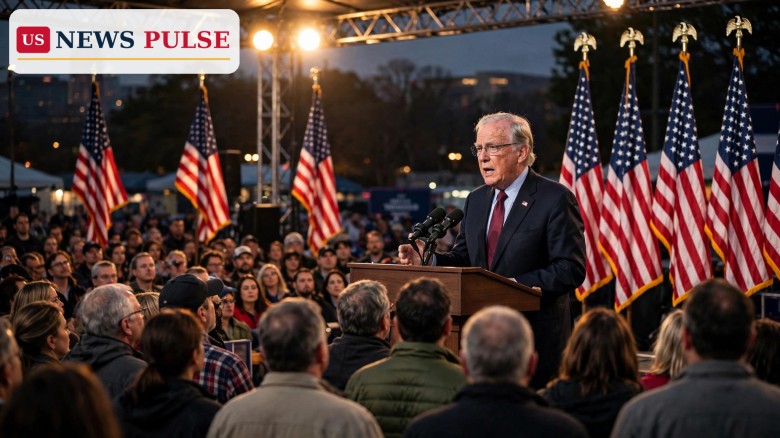
Former President Barack Obama brought his sharpest closing message of the midterm campaign to suburban Atlanta on Wednesday, October 28, 2026, telling a packed rally for Georgia Democrats that President Donald Trump and his party are "not serious people" and that ordinary Americans are paying the price for it. The Obama Atlanta rally, held at the Discovery Center of Clayton County just south of Atlanta, was the Democratic counterweight to Trump's own rally the same night in Chillicothe, Ohio, and it gave Georgia's marquee candidates their biggest national stage yet with six days to go before Election Day on November 3.
Obama took the stage in Clayton County on Wednesday evening as part of a travel-heavy closing tour that has leaned harder than usual into direct criticism of Trump and his allies. The rally backed Ossoff, Bottoms and an array of down-ballot Democrats, and it landed at a moment when Georgia's early-voting numbers were already telling their own story: according to the Georgia Secretary of State's Office, 2,000,452 people had voted early in person as of 4:30 p.m. Tuesday, with another 97,382 absentee ballots accepted, a combined total of nearly 2.1 million. That in-person figure alone had already passed the 1,640,652 ballots cast during the entire early-voting period in the 2022 midterm election, with early voting continuing through Friday, October 30.
The former president's message was built around a single phrase, repeated and sharpened through the speech: "These are not serious people." He applied it to Trump and the Republican Party, then tied it to the cost-of-living pressures he said voters feel every day. "And we're all paying the price for their lack of seriousness," he said, framing the midterm choice as one between a government that solves problems and one that manufactures distractions. It was, by the account of multiple outlets covering the rally, a notably combative turn for a former president who has spent much of his post-presidency avoiding this kind of direct confrontation.
At the same time Obama was speaking in Georgia, Trump was on stage in Chillicothe, Ohio, campaigning for Senator Jon Husted and gubernatorial candidate Vivek Ramaswamy. Trump dismissed the idea that Obama's involvement should worry Republicans. "I always worry when he campaigns against me," Trump said sarcastically, adding: "He got involved with Hillary Clinton ... and he lost. He then got involved with Kamala [Harris] and he lost." The duelling rallies, staged hours apart in two of the cycle's most watched states, captured the final-week dynamic of the 2026 midterms: both parties deploying their biggest names to drive turnout in races that could shape control of Congress and state government.
Georgia has been a central battleground of the 2026 cycle. Ossoff is defending his Senate seat against Collins, while Bottoms, the former Atlanta mayor, is running for governor against Jackson in the race to succeed Republican Governor Brian Kemp. Trump has visited Georgia three times this year to support statewide Republican candidates, including stops in Dalton on October 16 and Perry on October 24, and former Vice President Kamala Harris was also expected to visit Georgia later in the week. Obama's Atlanta appearance on October 28 was the Democrats' highest-profile Georgia event of the closing stretch, and it came after his October 24 rally in Cleveland, Ohio, where the joke that would dominate the week was born.
That joke compared Trump's White House renovations to former Iraqi dictator Saddam Hussein decorating a Cheesecake Factory. It drew a furious response from the White House and conservative commentators, some of whom characterised the reference as elitist. Treasury Secretary Scott Bessent visited a Cheesecake Factory for lunch on October 26, telling reporters: "I had a great meal, always have a great meal, and I would tell the Martha's Vineyard set to give it a try," referring to the Obamas, who own a home on the exclusive New England island. Trump said the same day that the joke showed why Obama was "a lousy president." In Chillicothe, Trump defended the renovation itself, calling the White House "the No. 1 symbol of our country" and saying: "It looked terrible, and I fixed it very inexpensively." Former President Bill Clinton added his own viral jab on Saturday, saying Trump had made the Rose Garden look like "the entrance to Liberace's bathroom."
Bottoms has campaigned on affordability, including expanding Medicaid, strengthening rural hospitals, allowing communities to eliminate grocery taxes and guaranteeing pre-K for every 4-year-old. Ossoff has hammered rising household expenses and healthcare costs as he defends his seat. Both messages dovetailed with Obama's closing argument in Atlanta: that voters' bills, not the week's viral arguments, are what the election is actually about.
The most replayed passage of the night was Obama's return to the Cheesecake Factory joke, delivered with a grin and a deliberate escalation. "The Saddam Hussein thing didn't bother him. But he was very upset about the Cheesecake Factory," Obama said. "I mean, it's all crazy, but this is the crazy part: they mobilized a whole government response to that joke." He said the White House had even called the Treasury secretary and told him he should hold a press conference in front of the restaurant chain, noting that Bessent is a former hedge fund manager worth half a billion dollars who was sent out to explain how he ordered what Obama called a delicious French dipped cheeseburger.
Then came the personal punchline that undercut the elitism charge. "I am the father of two daughters. Do you think I could have survived their childhood without going to the Cheesecake Factory?" Obama asked the crowd. "That was my jam for about a decade." He added a comparison from his own presidency: "I inherited this major financial crisis. I never called my Treasury Secretary and said, 'You've got to go to Arby's. Order roast beef. No cheese, though. That may look elitist.'" The point, he said, was not the restaurant at all. "They don't have solutions to actual problems, so they'd rather have the media and you talking about the Cheesecake Factory," he said. "Just keep throwing distractions out there ... and hope that you won't notice your bills are higher and your life is tougher."
Obama also noted that the administration had not disputed the substance behind the joke: his allegations of corruption, the effect of tariffs on consumer costs, and his comparison of the White House's appearance to something built by Saddam Hussein. "That part didn't bother him," he said of the dictator comparison, "but he was very upset about the Cheesecake Factory comment." The White House did not immediately respond to requests for comment on Obama's Atlanta remarks.
Obama's sharpest policy attack of the night concerned the war with Iran. "The current president chose to make a series of bad decisions, the most important of which was to start an unnecessary war that nobody asked for," he said. He defended the Joint Comprehensive Plan of Action, the Iran nuclear deal he negotiated and Trump scrapped in his first term: "I put in place a deal that everybody acknowledged, kept them from getting nukes." Trump, in Chillicothe, touted having "terminated" that deal, describing it as "the road to a nuclear weapon for Iran, and one of the dumbest deals I've ever seen in my life."
On corruption, Obama accused Trump of using the presidency to enrich himself, saying no modern president had so openly sold favours while in office. The charge formed the second half of his closing argument alongside the cost-of-living message: a government that serves itself, he argued, cannot serve voters whose bills keep rising. "These are not serious people," he said again, "and we're all paying the price for their lack of seriousness."
The crowd response, by the reports from the room, was enthusiastic, with the Cheesecake Factory passages drawing the loudest reactions of the night. The rally's setting mattered too: Clayton County, just south of Atlanta, sits in the metropolitan region where Georgia's elections are increasingly decided, and a crowd of 3,500 to 4,000 in a single venue, days before early voting closed, was a visible show of Democratic energy in a state Trump won in the 2024 presidential election.
The Atlanta rally matters for three reasons. First, it gave Georgia Democrats a closing message that ties together their two strongest issues, the cost of living and corruption, in a single memorable frame, and it did so through a joke that had already travelled further than any policy speech of the cycle. Second, it tested whether Obama, still the Democratic Party's most popular national figure, can move turnout in a state where early voting is already running ahead of 2022, and where the Senate and governor's races will help decide the national balance of power. Third, it sharpened the contrast the party wants voters to carry into the booth: a former president arguing that his successors govern by distraction, against a sitting president who spent the same evening in Ohio arguing that his predecessor's endorsements are a curse.
That contrast is also a risk for Democrats. Obama's combative tone, including the corruption charge and the Iran war attack, invites an equally sharp Republican response, and Trump has already shown he is happy to supply one. But with early voting ending Friday and Election Day on Tuesday, November 3, both parties have made the same calculation: the final days are about base turnout, and base voters respond to a fight.
Georgia's early-voting period ends Friday, October 30, and the campaigns will spend the final weekend chasing the remaining early voters and preparing Election Day operations. Harris is expected in Georgia later in the week, while Trump is scheduled to campaign in Iowa on Sunday after his Ohio stop. Vance headlines a Texas rally in Weatherford on Thursday, October 29. The Georgia results to watch on November 3 are Ossoff versus Collins for the Senate and Bottoms versus Jackson for governor, along with the down-ballot races Obama name-checked in Atlanta. If the early-voting surge holds, Georgia could again be among the last states called, and among the most consequential for control of the Senate.
He told Georgia Democrats that Trump and Republicans are "not serious people," revisited his Cheesecake Factory joke about Trump's White House renovations, attacked the Iran war as "an unnecessary war that nobody asked for," and urged votes for Senator Jon Ossoff and gubernatorial nominee Keisha Lance Bottoms.
It was held at the Discovery Center of Clayton County, just south of Atlanta, before an estimated 3,500 to 4,000 supporters, as part of the Democrats' "United for Georgia" campaign effort.
At an October 24 rally in Cleveland, Obama compared Trump's White House renovations to Saddam Hussein decorating a Cheesecake Factory. The White House and conservative commentators attacked the joke, and Treasury Secretary Scott Bessent had lunch at a Cheesecake Factory on October 26 in response.
Senator Jon Ossoff is seeking re-election against Republican Representative Mike Collins, and Keisha Lance Bottoms, the former Atlanta mayor, is running for governor against Republican Rick Jackson.
Early in-person voting ends Friday, October 30, 2026, and Election Day is Tuesday, November 3, 2026. Nearly 2.1 million Georgians had already voted early or by accepted absentee ballot by Tuesday afternoon.
Related coverage: Trump Chillicothe rally defends Ramaswamy ad and backs Husted in Ohio's final week; Trump fires back at Obama over Cheesecake Factory White House renovation jibe; Midterm elections 2026: Trump and Obama duel in Ohio and Georgia in final week.
Leave a Comment



 | Today's Date: