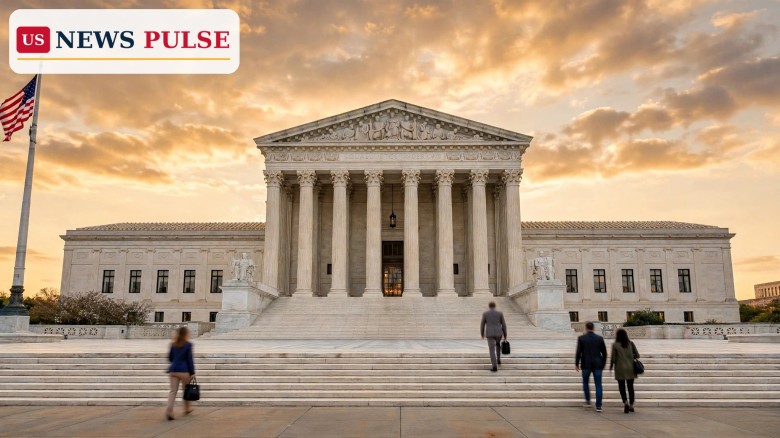
The US Supreme Court has refused to restore a power that immigration judges used for decades to manage their crowded dockets. Supreme Court immigration judges can no longer temporarily pause deportation cases, after the justices declined on Tuesday, October 27, to block an agreement between President Donald Trump's administration and Texas that ended the practice known as administrative closure.
The decision came in a brief, one-sentence order with no explanation, as is common for emergency requests. No justice publicly dissented. The ruling does not end the underlying lawsuit, but it leaves the ban in place while that litigation continues — a practical win for the administration's hardline immigration approach and a setback for the cities and advocacy group that challenged the deal.
The justices were asked to halt, for now, the agreement that ended administrative closure. Baltimore and the other litigants argued that the federal government had improperly worked with Texas to invalidate a federal rule, rather than defending it or changing it through the normal process. They wanted the old practice restored while the courts decided whether the agreement was lawful.
The Supreme Court said no, at least at this emergency stage. The order was a single sentence, with no reasoning and no recorded dissent. That silence is normal for the court's emergency docket, but it still matters: it means the challengers failed to clear the high bar for emergency relief, and the status quo — no administrative closure — continues.
The practical effect is immediate for immigration courts. Judges can no longer take a deportation case off their active docket and set it aside while a related matter plays out elsewhere. Instead, cases must proceed, even when a separate proceeding involving the same person could change the outcome, such as a pending visa petition or an appeal against a criminal conviction.
Administrative closure was a docket-management tool, not a grant of legal status. A judge could administratively close a case — removing it from the active calendar without dismissing it — when another process needed time to resolve. The case could later be reopened. Judges used it for decades, and Reuters reports that it was applied in hundreds of thousands of deportation cases over the years.
The tool became a political flashpoint. In 2024, President Joe Biden's administration adopted a regulation that formally codified administrative closure, concluding that it let judges manage caseloads efficiently and treat immigrants fairly. That rule replaced a 2020 regulation from Trump's first term that had restricted the practice and had itself been blocked by the courts.
After Trump returned to office in 2025, the Justice Department office that oversees immigration courts, the Executive Office for Immigration Review, said it would not defend the Biden rule against a legal challenge. Texas sued, arguing that the rule let immigration judges effectively grant indefinite amnesty to people illegally present in the country. The administration and Texas then jointly asked US District Judge Reed O'Connor in Wichita Falls to approve an agreement declaring the Biden rule unlawful. O'Connor did so on June 22 — the same day Texas filed its suit — blocking the rule permanently and nationwide.
That same-day sequence is at the heart of the challengers' complaint. They say a friendly lawsuit and a swift settlement let the government dismantle a federal policy without meaningful public participation or judicial scrutiny. The administration and Texas, by contrast, have presented the agreement as a lawful resolution of a rule they say was wrong from the start. Representatives of the Justice Department and the Texas attorney general's office did not immediately respond to requests for comment when Reuters reported the Supreme Court's decision.
The dispute turns on a simple question: should an immigration judge be able to pause a case, or must every case march forward to a decision? Supporters of administrative closure say pausing is common sense. If a person is waiting for a visa decision that could make them eligible to stay, or appealing a conviction that underpins the removal case, deciding the deportation first could produce a removal that a later decision would have prevented.
Critics, including Texas and the Trump administration, argue the opposite. They say closure let people without legal status remain in the United States indefinitely, because a closed case could sit untouched for years. In their framing, the practice acted in effect like an amnesty, bypassing Congress and the normal immigration system. Ending it, they argue, restores order to a system with a vast backlog and forces cases to a conclusion.
The litigants and their lawyers from the liberal legal group Democracy Forward expressed disappointment in the decision. In a statement, they said: "Eliminating these protections puts vulnerable people at greater risk of deportation and undermines public safety in communities across the country."
They went further, attacking the process that produced the ban: "This dangerous abuse of the judicial process threatens the rule of law and sets a troubling precedent for dismantling federal policies without meaningful public participation or judicial scrutiny."
For people facing removal, the loss of administrative closure narrows the options. A person whose visa petition is pending, or whose criminal appeal is unresolved, may now face a deportation decision before those parallel processes conclude. Advocates warn that this increases the risk of wrongful or premature removals, and that it may discourage people from cooperating with authorities or seeking legal help if they fear a fast-tracked case.
For cities, the stakes are practical as well as legal. Baltimore and the other city challengers argued that abrupt removals disrupt families, workplaces and community trust, and make it harder for local police to work with immigrant communities. The administration's position is that consistent enforcement, without open-ended pauses, is itself a form of fairness — to the law, to legal immigrants waiting in line, and to communities that want cases resolved.
The underlying litigation continues. The Supreme Court's emergency order is not a final ruling on whether the Texas agreement was lawful, and the challengers can still press that argument in the lower courts. A future decision could restore administrative closure, limit the settlement, or uphold it — but none of that will happen quickly, and the ban remains in force in the meantime.
Watch whether the lower courts move the case forward, whether immigration judges receive new guidance on cases that would previously have been closed, and whether Congress or a future administration settles the question by statute or new regulation.
For now, the message from Washington is clear: a deportation case, once opened, is expected to proceed. People in proceedings should seek legal advice promptly, because the pause button that judges once used is, for the moment, gone.
Administrative closure is a procedure that let immigration judges temporarily remove a deportation case from their active docket without dismissing it. The case could be reopened later, often after a related visa petition, appeal or other proceeding had been resolved.
The court declined an emergency request to halt the agreement ending administrative closure. It issued a one-sentence order with no explanation and no public dissent. The ban therefore stays in place while the underlying lawsuit continues.
They argued that closure let people without legal status remain in the United States indefinitely, acting in effect like an amnesty. Texas said the Biden-era rule let judges effectively grant indefinite amnesty to people illegally present in the country.
No. The ruling removes a docket-management tool; it does not decide any individual case. People can still present defences, seek relief and appeal, but they can no longer rely on a judge pausing the case while a parallel matter is pending.
Yes, in principle. The emergency order is not a final ruling on the settlement's legality, and a future court decision, a new regulation or an act of Congress could restore the practice. For now, however, judges cannot use it.
Related coverage on US News Pulse: Washington Ballots Row: DOJ Demands 400 Suspected Noncitizen Votes Set Aside, China Visa-Free Travel Suspended for Northern Mariana Islands Over Security Fears, and Supreme Court SNAP Payments Block Extended as Shutdown Deal Heads to House Vote.
Leave a Comment



 | Today's Date: