Israel election results have left the country facing a political deadlock, with Prime Minister Benjamin Netanyahu's bloc ahead but short of a governing majority as counting continued on Wednesday, October 28, 2026. With 76.8% of ballot boxes counted, the Central Elections Committee gave Netanyahu's bloc 54 of the 120 seats in the Knesset, Gadi Eisenkot's opposition bloc 47 seats, and the Arab-led parties 19 seats — a result that puts the balance of power in the hands of parties both main camps have long treated as untouchable.
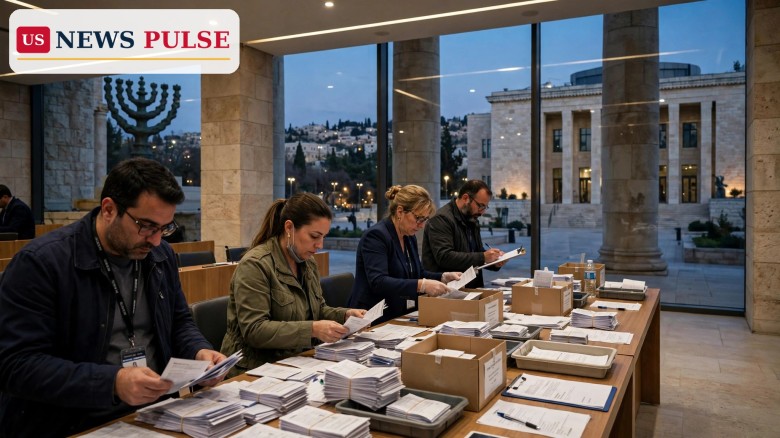
The partial count, published late on Wednesday morning Israel time, is not final. Results are still expected to change as more ballots are counted, and votes cast in double envelopes — including those of soldiers — are counted later. Full results are expected by Thursday evening or Friday morning. But the shape of the outcome is already clear: neither Netanyahu nor Eisenkot is close to the 61 seats needed to form a majority government, and the Arab parties, whose voters turned out in soaring numbers, have emerged as the decisive force in the next parliament.
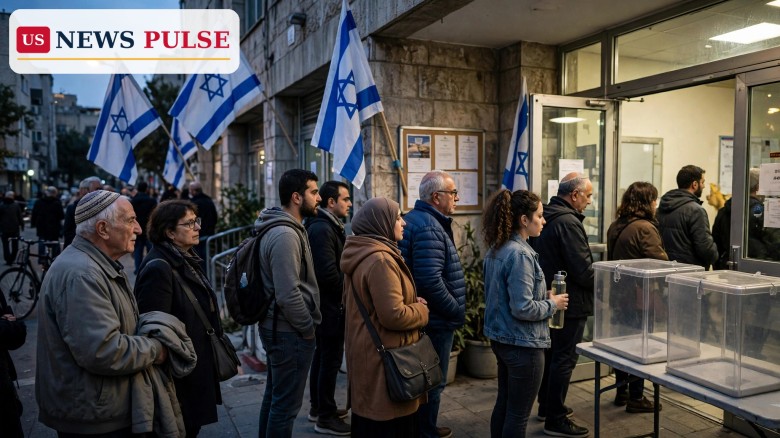
Israelis voted on Tuesday, October 27, in the first general election since the Hamas attack of October 7, 2023, in a contest widely seen as a referendum on Netanyahu, Israel's longest-serving prime minister. Polls closed on Tuesday evening, and the first exit polls put Netanyahu's hard-right camp and Eisenkot's opposition bloc neck and neck at about 51 seats each, with Arab-led parties on 18 or 19 seats.
As the official count advanced on Wednesday, Netanyahu's bloc edged ahead. After 51.8% of ballots were counted, his camp was shown with 55 seats, Eisenkot's bloc with 49, and the Arab parties with 16. At 57.3%, the figures were unchanged. By the time 76.8% of ballot boxes had been counted, at 10:58 a.m. local time, the Netanyahu bloc had slipped to 54, Eisenkot's bloc to 47, and the Arab parties had risen to 19 — the Joint List and Ra'am combined. Three smaller parties were below the 3.25% electoral threshold at that stage: Reservists on 2.6%, People of Israel on 1.7%, and Charedi Public on 0.2%.
Party-level figures told a similar story. With 60% of votes counted, Netanyahu's Likud had 21.4% of the vote and Eisenkot's Yashar had 16.2%, according to official election data. Likud is projected to remain the largest single party, but in Israel's proportional system that does not by itself deliver power: no party has ever won a parliamentary majority alone, and governments are built from coalitions.
The election came after three years in which Israel has been reshaped by war and by deep internal division. Netanyahu, 77, has governed on and off for nearly two decades and has pushed the country sharply to the right. His government launched wars in response to the October 7 attack, pursued a military campaign in Gaza that has reduced much of the territory to rubble, and presided over soaring settlement construction and violence against Palestinians in the occupied West Bank. The vote also took place as Israel looks increasingly isolated on the world stage, driven by the war with Iran as well as the Gaza campaign.
Eisenkot, 66, is a former military chief of staff and a political novice who leads the Yashar party. He shares many of Netanyahu's views on security and has backed the Gaza offensive, but he has promised a more inclusive atmosphere inside Israel and vowed to rein in violent West Bank settlers. That combination — hawkish on security, conciliatory at home — made him the rallying point for voters who wanted Netanyahu gone without a sharp turn on defence policy.
Turnout underlined how much was at stake. Nearly 78% of eligible voters cast ballots, the highest turnout since 1999. Among military personnel, final turnout reached 79.9%, up 6.2 percentage points from the 2022 election, after voting by conscripts, career service members and reservists began a week before election day at more than 890 polling stations, including at military positions in Gaza, Lebanon and Syria.
The strongest gains, however, came from Arab Israeli voters. Arab Israelis, also known as Palestinian citizens of Israel, account for about 21% of the country's population. Netanyahu spent much of election day warning his base that Arab citizens were voting in record numbers. He was right: exit polls showed the two Arab parties nearly doubling their representation to 18 or 19 seats, well ahead of forecasts, after party leaders rallied supporters to help oust the country's longest-serving leader.
The Israel election results have created a dilemma that neither main camp can easily escape. On paper, Eisenkot's bloc plus the Arab parties would command 66 seats — a comfortable majority. In practice, both Netanyahu and Eisenkot said during the campaign that they would not govern with Israeli Arab lawmakers, and Netanyahu has argued that a government relying on Arab votes would lack legitimacy. Eisenkot has since signalled he is ready to work with them under certain conditions, but that could risk alienating some of his own partners.
That tension was on full display on Wednesday. Yair Golan, head of Israel's main left-wing party, called on his opposition allies to work with Arab parties to unseat Netanyahu. "We must no longer accept Netanyahu's racist division between Jewish votes and Arab votes," he wrote on X. "We have a responsibility. And we have an opportunity to form a government of change in partnership with Israel's Arab citizens."
There is also a middle path that commentators have raised: a minority government, in which Arab lawmakers support a government in parliamentary votes without joining the coalition itself. Arab lawmakers could give Eisenkot support to survive confidence votes while staying outside the cabinet. And there is a more radical option still — a national unity government in which Netanyahu jettisoned his far-right allies and ultra-Orthodox partners and teamed up with Eisenkot, excluding the Arab parties altogether. Given Israel's extreme polarisation, that prospect looks fanciful, but Israeli commentators have often mused about it, and it would also exclude the Arab parties from power.
If no candidate manages to form a government, Israel will have to return to the polls. The country held four elections between April 2019 and March 2021 because politicians could not forge a lasting coalition, and the candidate designated by the president will in principle have 28 days to form a coalition, with a possible 14-day extension. A stalemate could in the immediate term benefit Netanyahu, who would remain caretaker prime minister until a new government is formed.
Netanyahu greeted cheering supporters at a Jerusalem convention centre after 3 a.m. on Wednesday morning, in a speech that was unusually brief by his standards. He did not directly claim victory, noting only that Likud was projected to be the largest single party, but he called for a "strong government of the right" and said the "Jewish and Zionist majority must unite". He added: "It is out of the question to have a government that is backed by Arab parties."
Eisenkot, speaking to exuberant supporters in Tel Aviv early on Wednesday, took the opposite line. "The public has voted for change," he said. "A worthy leader would accept the people's vote of no confidence and announce his retirement from political life today." He called Netanyahu "a caretaker prime minister, without a mandate or the people's trust", said it would be a mistake to hold a second election, and vowed to work "swiftly" to form a government. He also issued a veiled warning to Netanyahu, whom observers say could use a war to push for a unity government: "Netanyahu, don't you dare use Israel's security for your political needs."
From Washington, President Donald Trump told reporters aboard Air Force One on Wednesday that his endorsement of Netanyahu had helped the premier "a lot". Trump had renewed his backing for Netanyahu during the campaign, tying it to his push for a post-election campaign against Iran — a connection that makes the identity of Israel's next prime minister a matter of direct interest in Washington. France, meanwhile, said its course would not change whatever the outcome. Foreign Minister Jean-Noël Barrot told France 2 television that Paris would continue to push for a two-state solution, whether Netanyahu or Eisenkot forms the next government, after a strained relationship that deepened when President Emmanuel Macron recognised a Palestinian state a year ago and, more recently, announced France would cease trade with illegal Israeli settlements in the occupied West Bank.
The result matters well beyond Israel's borders because it will decide who leads the country through the next phase of the Iran confrontation and the Gaza aftermath. Netanyahu has told reporters this week that Israel has a "unique opportunity" with Trump to eliminate what he calls the existential threat from Iran, after days of brandishing threats of a new bombing campaign. Eisenkot offers a different style but not a different security doctrine, and his path to power runs through the very Arab parties whose votes Netanyahu has dismissed as illegitimate. How that contradiction is resolved will shape Israel's politics for years — and will determine whether the record Arab turnout of 2026 translates into real influence, or merely into a larger opposition bench.
It also matters as a test of Israeli democracy itself. A turnout of nearly 78%, the highest in more than a quarter of a century, is a mandate for a government that can actually govern. If weeks of haggling end in another election, that mandate will have been spent on stalemate. If, instead, one of the two camps finds a way across the line — through a coalition, a minority arrangement, or an unlikely unity deal — the 2026 election will be remembered as the moment Israel's Arab citizens became kingmakers.
Counting continues, with double-envelope ballots — including soldiers' votes — still to be tallied, and full results expected by Thursday evening or Friday morning. Once the final seat distribution is known, President Herzog will consult party leaders and name the candidate he judges most likely to assemble a majority. That candidate will have 28 days, extendable by 14, to do so. Watch three things: whether the final count moves the Arab parties up or down from 19 seats; whether Eisenkot publicly commits to governing with Arab support or keeps his distance to hold his own bloc together; and whether Netanyahu, as caretaker prime minister, uses the intervening weeks — and the looming Iran confrontation — to argue that only he can lead Israel through a security crisis.
Who won the Israel election? No one has won outright. With 76.8% counted, Netanyahu's bloc leads with 54 seats, Eisenkot's bloc has 47, and Arab parties have 19. A majority needs 61 seats in the 120-seat Knesset, so neither main bloc can govern alone.
When will the final results be known? Full results are expected by Thursday evening or Friday morning, after double-envelope ballots — including soldiers' votes — are counted. The results so far are partial and will change.
Could the Arab parties decide the next government? Yes. Eisenkot's bloc plus the Arab parties would hold 66 seats, a majority. But both main camps said during the campaign they would not govern with Arab lawmakers, and any deal would risk splitting Eisenkot's own bloc.
What happens if no one can form a government? President Isaac Herzog names the candidate most likely to succeed, who gets 28 days plus a possible 14-day extension. If that fails, Israel could face another election — it held four between April 2019 and March 2021 for the same reason.
Does Netanyahu stay prime minister meanwhile? Yes. Until a new government is formed, Netanyahu remains caretaker prime minister, which means a prolonged stalemate would, in the short term, work in his favour.
Related coverage on US News Pulse: Israel Election 2026: Netanyahu fights for survival as Israel votes today; US Iran war warning: Washington tells Gulf to brace for short, intense campaign; Putin-Zelensky meeting "very soon", Trump says progress made on Ukraine peace talks.
Leave a Comment



 | Today's Date: