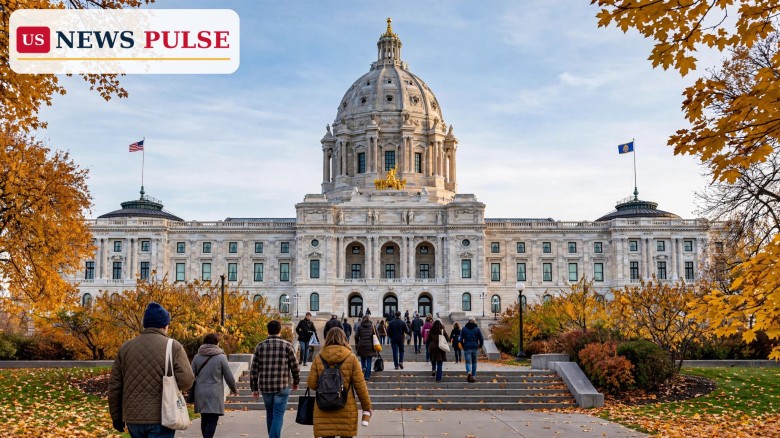
SAINT PAUL, Minnesota — One week before the midterm elections, the Minnesota Senate race has become one of the most closely watched contests in America, not because the state is usually competitive, but because a fraud scandal, a bitter fight over immigration enforcement and a federal investigation involving Representative Ilhan Omar have combined to put a Democratic-held seat genuinely in play. Democrat Peggy Flanagan, the state's lieutenant governor, still leads Republican Michele Tafoya in most polls, but the margin is only a few points, and the Cook Political Report has moved the race from "Likely Democratic" to "Lean Democratic". For a party that has not lost a Minnesota Senate race since 2002, that shift alone is a warning sign.
The race tightened in public view during October. Newsweek reported on October 26 that a flurry of recent polls showed a close contest between Flanagan and Tafoya, prompting the Cook Political Report's rating change. The numbers tell a consistent story: Flanagan leads, but narrowly, and the undecided vote remains large enough to matter. Rasmussen Reports surveyed 1,182 likely voters on October 20-21 and found Flanagan at 48 percent and Tafoya at 45 percent, with 7 percent undecided and a margin of error of plus or minus 3 points. Trafalgar Group, surveying 1,079 likely voters on October 13-15, produced the same 48-45 split. KSTP/SurveyUSA, polling 718 likely voters on October 8-12, had Flanagan at 45 percent and Tafoya at 42 percent, with 9 percent undecided. Mason-Dixon, for the Minnesota Star Tribune and KARE 11, surveyed 800 likely voters on October 5-7 and found a 47-43 split.
The fundraising picture sharpened the sense of a real contest. Tafoya's $4.3 million third quarter, against Flanagan's $3.8 million, made Minnesota the only competitive Senate race where a Republican outraised a Democrat in that period, according to Newsweek's reporting. That money matters most in the final week, when television, digital advertising and get-out-the-vote operations consume cash at their fastest rate. National groups, however, have so far been cautious: Minnesota Public Radio reported that little national money had flowed into the race, even after Senate Majority Leader John Thune campaigned for Tafoya at a farm in southern Minnesota about two weeks ago and declined to commit his Senate Leadership Fund to a funding boost.
The campaign's closing act brought in heavyweight help. Senator Bernie Sanders joined Flanagan and Attorney General Keith Ellison at a rally in Duluth over the weekend, attacking Trump and Republican policies as designed "to make the richest people in America richer, while working people have been devastated and hit so hard". Flanagan used the same rally to tie Tafoya to Trump, saying: "Let me be crystal clear: Michele Tafoya isn't running to stand up to Donald Trump. She's running to stand with him." Tafoya, in a statement on Friday, offered a different closing message: "My closing message to every Minnesotan is simple: you deserve leaders who put you first. You've seen what years of failed experiments have done to our state, and you know we can't afford more of the same."
The seat is open because Senator Tina Smith, a Democrat, is retiring at the end of her term, and the race will test whether Minnesota's long Democratic Senate streak can survive a difficult political environment for the party in the state. A Republican has not won a United States Senate seat in Minnesota since 2002, and in 2024 Kamala Harris carried the state by 4.2 percentage points. Yet the open seat gives Republicans a clearer opening than they would have had against an incumbent, and the polling averages reflect that: PollingSource put Flanagan ahead 47 percent to 44 percent, while Pollsmax, updated on October 27, gave Flanagan an 85.8 percent chance of winning with a projected 53.5 percent to 46.5 percent vote share. Forecast models, however, are not votes, and the same polling data show a race far closer than the models suggest.
Flanagan has served alongside Governor Tim Walz since 2018, and that proximity is precisely what Tafoya has exploited. At an October 16 debate, Tafoya challenged Flanagan's accountability as a senior member of the Walz administration, saying, "My goodness, she was second in charge in this state." Flanagan responded by pointing to her support for an independent Office of Inspector General, telling CBS Minnesota: "I have supported the independent Office of Inspector General." The exchange captures the central dynamic of the race: Tafoya runs as a political outsider promising common-sense solutions and an independent voice, while Flanagan runs as an experienced governing partner who argues that the state's problems require steady hands, not a break with its leadership.
The fraud issue at the heart of that argument is the Feeding Our Future case, a COVID-era scheme involving fraudulent claims for child nutrition programmes. Federal prosecutors say at least $250 million was stolen, while estimates of the total cost to taxpayers have ranged as high as $1 billion. The investigation began under the Biden administration and has produced dozens of indictments, including members of Minnesota's Somali community. Republicans accuse the Walz administration of failing to prevent the fraud. Walz's office has previously said he worked to combat fraud and sought additional powers from the state legislature. No criminal wrongdoing by Flanagan herself is established in the reporting on the case, a distinction her campaign has stressed, but the political damage has been harder to contain: University of Minnesota political scientist Larry Jacobs told Newsweek there was "no doubt" the race is competitive, because Flanagan has had a difficult time shaking the fraud backlash.
Immigration enforcement is the race's second fault line. A month-long federal enforcement surge in Minnesota, known as Operation Metro Surge, saw thousands arrested and two United States citizens killed: Renee Good, shot by an ICE agent in Minneapolis on January 7, and Alex Pretti, shot by a Border Patrol agent on January 24. The deaths sparked large protests, and Flanagan has commended those protests and called for ICE to be dismantled. Tafoya has criticised the rollout of the surge and called the shootings devastating, but she has also criticised the protests and said local leaders encouraged them. Minnesota Public Radio's Peter Cox noted that the surge has recently been eclipsed by the economy and the cost of living, but that it is "definitely still resonating" with voters.
The third issue arrived in October, when federal agents searched Omar's Washington home on October 12 under a court-approved warrant as part of an investigation into possible false statements and fraud in her family's immigration paperwork. A Minnesota grand jury has issued more than a dozen subpoenas, including to some of Omar's relatives, and the New York Times reported that the warrant listed several potential immigration offences plus a general conspiracy charge. Omar, who became a United States citizen in 2000, has not been charged with any crime, denies wrongdoing and calls the search "political intimidation". Trump escalated the row on October 22, calling for Omar's resignation and claiming she used a false name when sworn into office, an allegation her office denied, saying: "This is completely false. Ilhan Omar is her real name." A Justice Department filing on October 21 had identified her as "Ilhan Nur Said Elmi, a/k/a Ilhan Abdullahi Omar", without explaining the alternative name or establishing fraud. Omar is seeking re-election in Minnesota's 5th District, where she won 74.4 percent of the vote in 2024, but the investigation's timing, three weeks before the midterms, has made it a statewide talking point.
Democrats have sought to nationalise Tafoya, painting her as a Trump loyalist, while Republicans have sought to localise Flanagan, tying her to the fraud scandal and to Walz. Senate Democrats' campaign spokeswoman Maddy McDaniel said Republicans "haven't won a Minnesota Senate race in more than 20 years and that losing streak will continue in 2026 when Minnesotans elect Democrat Peggy Flanagan", calling Tafoya "a Trump loyalist and a wealthy Republican activist". Former Minnesota Democratic Party chair Mike Erlandson offered a blunter internal assessment, saying the fraud "hangs over the state of Minnesota" and is "a bit of a drag for Democrats", while arguing that the Trump administration is a bigger drag on Republicans. That tension, between a state-level liability and a national-level advantage, is the race in miniature.
Tafoya's side, by contrast, argues that the polls themselves prove the old assumptions no longer hold. Pollster Matt Towery, discussing a September InsiderAdvantage survey that put Flanagan at 46 percent and Tafoya at 45 percent, tied the closeness to Walz's falling popularity and "growing evidence of fraud in the state". National Review noted recent polls showing Flanagan up by one point, then tied, then up by one again, and argued that the National Republican Senatorial Committee could justify extra resources if the race stays this tight. With early voting already under way, and about 202,252 Minnesotans, or 5 percent of the state's 3.91 million registered voters, having already voted as of October 20 according to an NBC News tracker, the final week is less about persuasion than about turnout.
Control of the Senate may not hinge on Minnesota alone, but the race matters as a test of two competing theories of the 2026 midterms. If Flanagan wins comfortably, Democrats will argue that even a fraud scandal and a federal investigation of a prominent progressive cannot break a blue state's habits, and that Trump remains the bigger liability for Republicans. If Tafoya wins, or even comes within a point or two, Republicans will claim that accountability, affordability and immigration enforcement can flip seats that forecasters wrote off, and the result will be read as a warning for Democrats in other states where state-level scandals overlap with national politics. Either way, the race will shape how both parties spend money, choose candidates and frame the final days of the campaign in the closest Senate contests elsewhere.
It also matters for what comes after November 3. A Senator Flanagan would arrive in Washington as a defender of the Walz record, with a mandate to push back against the Trump administration's immigration enforcement and to argue for stronger, independent fraud oversight. A Senator Tafoya would arrive as the first Republican to win a Minnesota Senate seat in 24 years, with a mandate to break with the state's Democratic establishment and to align with the Republican Senate majority. The difference between those two senators, on immigration, on federal spending and on oversight of the executive branch, is the difference the voters of Minnesota will decide.
The final week will be dominated by turnout. Flanagan's campaign, backed by Sanders and the state's Democratic establishment, will try to mobilise the Twin Cities, where SurveyUSA found her leading by 23 points, and to hold her advantage among younger and moderate voters. Tafoya's campaign will try to maximise its rural strength, where she leads, and to win over older voters, where she also leads, while using her fundraising edge to dominate the airwaves. Both campaigns will watch the undecided vote, which stood at 7 to 9 percent in the most recent polls, and the early-vote returns, which so far show registered Democrats at 43 percent of early voters, Republicans at 18 percent and others at 39 percent.
Trump has also said he might visit Minnesota, which would put the race further into the national spotlight and could accelerate the outside spending that has so far been slow to arrive. If that visit happens, and if national groups follow with money, the race could tighten further. If it does not, Flanagan's polling lead, her party's turnout machine and Minnesota's Democratic history may be enough. Polls close on Tuesday, November 3, and the first results from Minnesota, one of the earliest-closing competitive Senate states, will be among the first signals of whether the midterm map is breaking as forecasters expected, or whether Minnesota is about to surprise America again.
Peggy Flanagan leads in most recent polls, by three to five points, including 48 percent to 45 percent in the October 20-21 Rasmussen Reports survey, though the undecided vote of 7 to 9 percent means the race is not settled.
It is a COVID-era scheme involving fraudulent claims for child nutrition programmes, with federal prosecutors alleging at least $250 million stolen and estimates ranging as high as $1 billion. Dozens of people have been indicted, but no criminal wrongdoing by Flanagan herself is established in the reporting.
No. Federal agents searched her Washington home on October 12 as part of an investigation into her family's immigration paperwork, and a grand jury has subpoenaed relatives, but Omar has not been charged, denies wrongdoing and calls the search political intimidation.
Voters decide on Tuesday, November 3, 2026. The seat is open because Senator Tina Smith is retiring, and the winner will help shape the Senate's balance, its oversight of immigration enforcement and its approach to federal spending.
It would be the first Republican Senate win in Minnesota since 2002, and forecasters still favour Flanagan, but the Cook Political Report's move to "Lean Democratic", Tafoya's fundraising edge and polls within a few points show why Republicans believe the seat is in play.
Related coverage on US News Pulse: the deadlocked Maine Senate race, Trump's Texas rallies and the Talarico surge, and tens of thousands of election observers heading to the polls.
Leave a Comment



 | Today's Date: