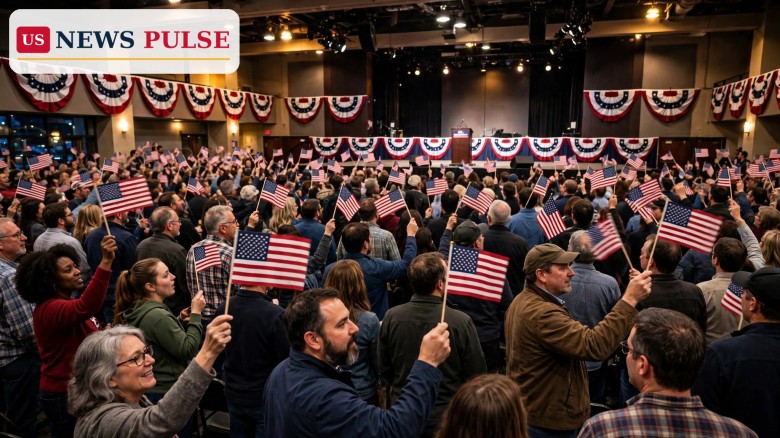
Vote Republican or else. That, in essence, is the message President Donald Trump has carried from rally stage to rally stage in the final days of the 2026 midterm campaign: elect Republicans, and the federal government will be ready to help your state. Elect Democrats, and it may not. With four days to go before voters decide control of Congress on Tuesday, November 3, the Associated Press reported on Friday, October 30, that the president has repeatedly tied disaster aid, veterans' settlements and state-specific perks to Republican victories — a pattern that has injected open partisanship into programmes that have traditionally been handled without regard to which party wins.
The pattern runs from North Carolina to Ohio to Kansas to Georgia. In each state, Trump has paired an announcement of something voters want — money, a settlement, a waiver, an investment — with a warning about what happens if his party loses. The White House says the president is simply committed to keeping a Republican majority so he can keep delivering his agenda. Democrats say he is threatening voters and holding public help hostage to an election result.
The AP's account, published on Friday, October 30, pulls together remarks Trump has made at rallies across the country this month. The through-line is unmistakable: federal help follows political loyalty. At a rally last week in Perry, Georgia, Trump drew a sharp contrast between the state's Republican Senate candidate, Mike Collins, and the Democratic incumbent, Jon Ossoff. Collins, Trump said, can call him whenever he wants to ask for help for Georgia. Ossoff, whom Trump mocked with the nickname "Pee-wee Herman," would get a different reception.
Trump even acted out the hypothetical scene for the crowd: Ossoff calling to ask for money for his state, and Trump answering, "I don't give a damn what he wants." At the same rally, Trump made clear he was not joking. "People don't realize what a big difference it makes," he said, adding that "having people that you like call you as opposed to people that you can't stand" makes a big difference — and acknowledging that critics would say "this is not appropriate."
The Georgia race is one of the marquee Senate contests of the midterms. Republicans hold 53 of the Senate's 100 seats, and Democrats need a net gain of four to take the majority; all 435 House seats are also on the ballot, with Republicans holding 218. With the margins that tight, the AP notes, Trump's closing strategy has been to make the election a referendum on himself — and to make the stakes tangible, in dollars and decisions, for voters in the states he visits.
The remarks are part of a broader closing argument Trump has built rally by rally through October. He has travelled almost daily, announcing state-specific goodies as he goes: new semiconductor investments here, a submarine repair centre there, fewer limits on a certain type of diesel somewhere else. The message to each audience is that an all-Republican Washington keeps delivering, and that a Democratic win puts the flow at risk.
What makes the latest remarks stand out, the AP argues, is that they reach beyond ordinary campaign promises into processes that have traditionally stayed apolitical: disaster relief and veterans' benefits. Disaster aid has long been distributed on the basis of need and damage, not on how a state voted. Veterans' compensation claims are adjudicated through the courts and the Justice Department, not traded at rallies. Trump's remarks blur those lines in public, on camera, in front of cheering crowds.
The timing matters. Early voting is already under way in much of the country, and Election Day is Tuesday, November 3. Trump has also scaled back his own travel in the final stretch, cancelling in-person rallies in Kansas and Iowa in favour of telephone rallies broadcast to nearly 20 states, with his final in-person rally set for Daytona Beach, Florida, on Friday. The AP report lands as that sprint reaches its climax.
In North Carolina, the warning landed on one of the most sensitive subjects in American public life: veterans sickened by contaminated water at Camp Lejeune. A sweeping 2022 law signed by then-President Joe Biden allowed people facing health conditions linked to the Marine Corps base's water to file for compensation. Earlier this month in Greenville, Trump announced that $1 billion in cash settlements had been delivered to veterans and their families affected by the contamination, and that he would direct the Justice Department to settle all remaining legitimate claims expeditiously — "if we win the House and the Senate."
"So, if we don't win, there's no money," Trump said. "If we do win, you're getting it." Questioned afterward at the White House, he said that if Republicans are not in power, "somebody else is going to have to settle" the claims, and he "can't speak for another administration" — even though his own Justice Department is handling them.
It was not the first time Trump had made that kind of remark in North Carolina, where his chosen Senate candidate, Michael Whatley, has struggled to gain traction against Democrat Roy Cooper, a well-known former governor. During a September rally in Gastonia, Trump said North Carolina was still waiting on more Hurricane Helene recovery money and added: "Now, if Michael loses, I'm not sending it" — though he immediately said he was kidding.
In Kansas, the lever was ethanol. Visiting the state to shore up Republican Senator Roger Marshall, Trump noted that he had granted a waiver temporarily allowing year-round sales of E15, an ethanol-blended fuel usually restricted during the summer. "With Roger Marshall in the Senate, we will make year-round E15 permanent," Trump told a rally in Park City. "But if Adam Hamilton is in, I'm not doing it. That's it. I'm only doing it for him." Permanent year-round E15 can also be achieved through legislation in Congress, or at an administration's discretion through temporary waivers from the Environmental Protection Agency.
In Ohio, the remarks were more personal than programmatic. In Vandalia this month, Trump noted that Republican officeholders in the state were pushing him on disaster relief, then added that "when you are president, you have a lot of power over states." If Democratic gubernatorial candidate Amy Acton won, he continued: "I don't know anything about her. She's never gonna call me. I'm never probably gonna work the same way. You just can't. It's just human nature. But I'm not gonna help her probably."
The reaction from Democrats has been furious, and in some cases the remarks have handed their candidates ready-made attack lines. Ossoff responded directly to the AP about Trump's Perry comments. "It's a losing strategy for the failed president to insult and threaten voters while he's in town reminding them he made everything more expensive," Ossoff said.
In North Carolina, Cooper has described Trump's Camp Lejeune threats as "insulting and frustrating," and his campaign has gone after Whatley for refusing to denounce them. Whatley, asked in a local television interview about the president's comments, said caring for affected veterans and families is a priority — without condemning the linkage itself.
The anger has been sharpest among the veterans' families themselves. Jill Steen Dilgard, whose father and other relatives served at Camp Lejeune and were subsequently diagnosed with cancer and other health issues, told the AP that conditioning care for those who served on the midterm results was "totally unacceptable." "It made me physically sick, and it infuriated me," she said. "You're playing politics and trying to bribe for a vote. So many hundreds of thousands have already lost their lives, and hundreds of thousands are suffering, and many have been given a death sentence."
The Hamilton campaign in Kansas chose a different tone, declining to criticise Trump directly. "Kansans are tired of our broken politics that treats public service like it's all about opposing teams," the campaign said. Spokesman Tyson Brody added that Marshall "has been in Congress for 10 years and never passed year-round E15," and that Hamilton "will look forward to working with anyone — including President Trump — to finally deliver on this and other important priorities for Kansas."
Acton's campaign in Ohio struck a similar note. Spokesperson Addie Bullock said the candidate is "committed to working with anyone, Democrat or Republican, to make life better for working Ohioans."
The White House, asked to elaborate on the pattern, defended the president's approach. Trump is committed to keeping a Republican majority in Congress so "he can continue to deliver on his winning, commonsense agenda," the White House said. Spokesman Davis Ingle cited the president's policies on taxes, prescription drugs and immigration, adding: "Democrats have made it clear that they have no agenda to improve the lives of the American people."
The stakes here go beyond any single race. If voters come to believe that disaster aid, veterans' settlements and regulatory decisions depend on how their state votes, the damage is to trust in the machinery of government itself — and that trust is hard to rebuild after an election, whichever party wins. The AP's report captures a shift from the familiar transactional language of campaigns — vote for us and we will pass good laws — to something more direct: vote for us and the help keeps flowing; vote against us and it stops.
There is also a practical question the remarks raise. Many of the things Trump is dangling are not actually his alone to give or withhold. Camp Lejeune claims move through the Justice Department and the courts. E15 can be made permanent by Congress. Disaster aid is appropriated by Congress and administered under law. A future administration of either party would inherit the same statutes, the same courts and the same obligations. The rally-stage version is simpler than the governing reality — but the rally-stage version is what voters hear.
Politically, the gamble cuts both ways. The remarks energise the base Trump needs to turn out in an election where his party is defending narrow majorities, and they give his candidates a tangible pitch: re-elect us and the money follows. But they also give opponents, in Cooper's words, ammunition — moments of video that can be replayed in Democratic ads in the final days, in states where the races are decided by a few points. In North Carolina, where Helene recovery is still a lived reality, the "I'm not sending it" line may travel further than the joke that followed it.
The final sprint is now measured in hours. Trump is due to hold his last in-person rally of the campaign in Daytona Beach, Florida, on Friday evening, after a day of telephone rallies to battleground states. Democrats, meanwhile, will keep replaying the AP's catalogue of remarks in the states where they sting most — North Carolina, Georgia, Kansas and Ohio — hoping the contrast between help offered and help threatened moves undecided voters.
On Tuesday, November 3, voters will settle the question the rallies have posed. If Republicans hold Congress, Trump will claim the strategy worked and the flow of announcements will continue. If Democrats take one or both chambers, the test of his words will come quickly: the next disaster, the next settlement, the next waiver — and whether the help arrives regardless of who won.
At rallies in Georgia, North Carolina, Kansas and Ohio, Trump suggested that states electing Democrats could receive less federal help — from Camp Lejeune settlements to disaster aid to ethanol waivers — while states electing Republicans would keep receiving it.
In Perry, Georgia, Trump said Republican Mike Collins can call him any time for state help, but if Democrat Jon Ossoff is re-elected, Ossoff's request would be met with: "I don't give a damn what he wants."
In Greenville, North Carolina, Trump said he would direct the Justice Department to settle all remaining legitimate Camp Lejeune claims expeditiously "if we win the House and the Senate," adding: "If we don't win, there's no money."
Election Day is Tuesday, November 3, 2026. All 435 House seats and a third of Senate seats are on the ballot, with Republicans defending a 53-47 Senate majority and a 218-seat House majority.
The White House said Trump is committed to keeping a Republican majority so he can continue delivering his agenda, and spokesman Davis Ingle cited policies on taxes, prescription drugs and immigration.
Related coverage on US News Pulse: Trump's Daytona rally ends the sprint, Trump cancels Iowa and Kansas rallies, switches to tele-rallies, and Trump's $5,000 dividend promise back in the spotlight.
Leave a Comment



 | Today's Date: