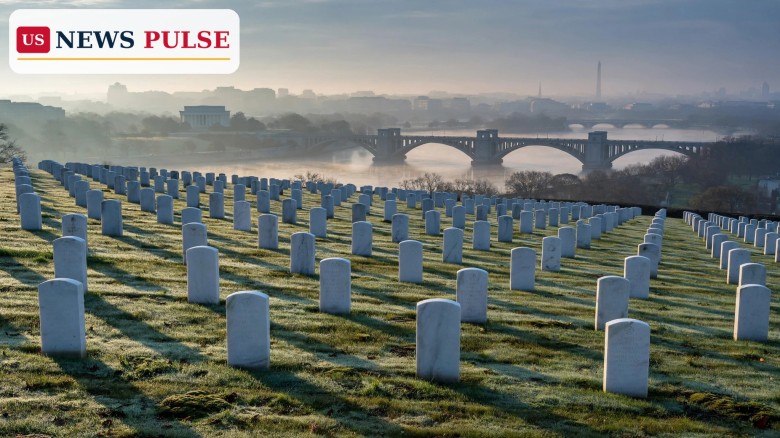
The Trump arch shadow would fall across Arlington National Cemetery on 284 days of the year, touching more than 75,000 graves, according to a three-dimensional computer model published by The Washington Post on Tuesday, October 27, 2026. The finding turns a long-running argument about a proposed 250-foot triumphal arch at Memorial Circle into a strikingly concrete image: as the sun rises over the Potomac, a moving band of shade would slide across the burial ground of America's war dead, reaching the grave of President John F. Kennedy and the eternal flame that has burned there since his funeral.
President Donald Trump first announced the arch in October 2025 as a monument for the 250th anniversary of American independence. Supporters describe it as a ceremonial gateway that would complete the vista between the Lincoln Memorial and Arlington. Critics, including veterans groups and preservationists, have called it a vanity project imposed on sacred ground without Congress ever authorising it. The new shadow analysis, built from the government's own August 2026 site plans and the Army's public grave-location data, gives those critics their most vivid evidence yet, even as the administration disputes how much of it ordinary visitors would ever see.
The Washington Post published its analysis on October 27, 2026, based on a geospatial study commissioned by VoteVets, a progressive veterans organisation, which the newspaper then checked with its own independent modelling. The study placed the arch, as drawn in the government's August 2026 site plans, on federal terrain at Memorial Circle, at the Virginia end of Arlington Memorial Bridge, and calculated where its shadow would fall against the real position of the sun for every morning of the year. It then laid that shadow over the Army's grave-location data for Arlington.
The headline numbers are stark. On 284 days a year, the arch's shadow would touch at least one burial site in the cemetery. Across the whole year, it would pass over more than 75,000 graves, including the resting places of veterans of the Civil War, the Spanish-American War, both World Wars, Korea and Vietnam, as well as the headstones of formerly enslaved people. On one modelled morning, the shadow lingered on cemetery grounds for more than an hour and passed over more than 2,000 graves. VoteVets, using a stricter test that counted a grave only if the arch blocked the entire disk of the rising sun there on at least one morning, still counted more than 50,000 mapped grave locations across 29 sections of the cemetery and two memorial areas.
The most symbolically charged finding concerns Kennedy. The Post found that the arch's shadow would slide over Kennedy's grave and eternal flame on 18 days a year. VoteVets calculated that the full disk of the rising sun would be blocked at the flame for about 29 minutes a year in total, spread across 17 dawns in mid-May and late July, and that Robert F. Kennedy and Edward M. Kennedy lie in the same shadow. One report noted that one of those dates could be July 28, Jacqueline Kennedy's birthday. The flame was lit by Jacqueline Kennedy at her husband's funeral in November 1963, and she later said of it, "I care about that flame." Under the Interior Department's plans, the arch itself would carry its own "eternal flame" in the form of a gold statue holding a torch.
At dusk, the shadow would travel in the other direction, reaching across Arlington Memorial Bridge toward the monuments of the National Mall. The Post's model found it would cut across the Lincoln Memorial in autumn and winter, touch a memorial to an assassinated president on 110 days, and loom over parts of the Martin Luther King Jr. Memorial and the Reflecting Pool on more than 30 days. The Military Women's Memorial, which honours the women who have served in the armed forces, would be darkened on 109 days, while Kennedy's memorial would be shrouded on 50 days.
Related: Trump fires back at Obama over Cheesecake Factory White House renovation jibe, Judge blocks Trump East Potomac golf course renovation after 400 trees felled and Trump Texas rallies, Paxton methane plan and a Talarico surge on Oct. 27.
The arch has been controversial since Trump unveiled it. At 250 feet, it would be far taller than Paris's Arc de Triomphe, which it is modelled on, and critics have taken to calling it the "Arc de Trump." Design renderings show a statue of Lady Liberty on top and the words "One Nation Under God" in gold. Trump has said of the design that it "will be like the one in Paris but to be honest with you it blows it away," and has argued that Washington is the only great capital without a triumphal arch. He has also said, when asked who the arch was for, "Me," according to VoteVets. At another point he suggested the structure could double as a military stronghold stocked with drones, sniper positions and ammunition, although blueprints published in recent weeks describe it simply as a "ceremonial gateway."
The project is estimated to cost at least $100 million, according to Axios and USA TODAY reporting, although the White House has not confirmed a final price and early reports said it would be privately funded. The administration says Congress approved a similar project a century ago, a pair of 166-foot columns ratified in 1925 that was never built, and that this covers the arch, so it has not sought fresh congressional authorisation. Opponents dispute that reading. Three military veterans and a retired architectural historian sued in February 2026, arguing the arch requires congressional approval and that the administration has skipped required procedures. The Arlington County Board filed a separate lawsuit in October 2026 accusing federal agencies of ignoring environmental and safety standards in the rush to build.
The National Park Service's own assessment, published on August 3, 2026, identified 37 sites that the proposed arch would negatively affect, mostly by obstructing their views. The Commission of Fine Arts approved a revised design on May 21, 2026, eliminating an eight-foot base and four golden lions that the commission noted were "not native to the United States," while keeping the arch at 250 feet. A scaled-down model was displayed at the Great American State Fair on the National Mall in June 2026.
Public opinion has run against the project. An April 2026 Washington Post-ABC News-Ipsos survey found 52 percent of Americans opposed the arch, 21 percent favoured it and 26 percent were unsure, with strong opposition at 41 percent outweighing strong support at 9 percent by more than four to one.
The dispute over the new findings is, in large part, a dispute about method. The Post analysed the shadow on every day of the year, including times when the cemetery is closed to the public. The Interior Department said it studied the shadow at 8 a.m., when the cemetery opens, 9 a.m., noon and 3 p.m. on a handful of days through the year. On that basis, it said the shadow would fall over a portion of the cemetery while it is open only at the beginning of daylight saving time, for less than two weeks a year, and that the affected shadows are "very lengthened and distorted, and are mingled with the long shadows of trees."
That narrower claim does not contradict the Post's central numbers so much as reframe them. The Post itself reported that the shadow would recede from the cemetery before it opens most days, but would linger during operating hours on 26 days. The Interior Department called the Post's analysis "flawed," but the 23 pages of simulations it provided did not explain its methods, and its shadows largely matched the Post's, according to reporting on the study. The difference, then, is not whether a shadow falls on the graves, but whether a shadow that mostly arrives before the gates open should count, and whether 26 days of shadow during visiting hours, plus the symbolic weight of the flame itself, is a price worth paying.
That question matters because of how the capital was designed. Neil Flanagan, an architect and historian focused on Washington's design, told the Post that the city's original designers understood that the open space between significant structures was as important as the landmarks themselves. The vista from the Lincoln Memorial across Memorial Bridge to Arlington House, and from the cemetery back toward the Mall, was deliberately kept open. A 250-foot arch at Memorial Circle would break that open air, not only with its shadow but with its mass, changing the sightline that has framed the cemetery for a century.
The Kennedy connection adds a further layer. Trump has already reshaped parts of the Kennedy legacy in his second term: he cleared Jacqueline Kennedy's garden on the White House's South Lawn to make way for a new ballroom, and he put his own name on the Kennedy Center, a renaming a federal judge subsequently halted, noting that Congress had created the institution to honour Kennedy. Against that background, critics say, a shadow falling on the eternal flame, even briefly, carries a meaning no spreadsheet of minutes can capture.
Retired Army Major General Paul Eaton, whose parents are buried at Arlington, called the projected shadow "a sacrilege." He warned that families visiting their loved ones' graves could encounter what he described as a vanity project looming over the cemetery, a phrase that has become the critics' shorthand for the whole scheme.
The White House pushed back in different terms. Spokesman Davis Ingle insisted the arch would "enhance the visitor experience" at the cemetery and become "one of the most iconic landmarks" not only in Washington but throughout the world. The Interior Department, for its part, said its own internal modelling was more reliable than the Post's and dismissed the newspaper's analysis as flawed, without publishing a competing day-by-day model.
Veterans groups have been among the most organised opponents. VoteVets, which commissioned the geospatial study, said the results shocked its researchers, and its report stressed that the Post's independent analysis reached the same overall conclusions. Vietnam Veterans of America and three other veterans groups have declared themselves neutral on the arch, according to reporting on the project, a position that leaves the most vocal veterans' voices on the opposition side. Preservationists and local officials in Arlington County, which has sued separately, have argued that the federal review has been rushed and that environmental and safety standards have been short-circuited.
The shadow row matters for three reasons. First, Arlington is not an ordinary building site. It is the resting place of more than 400,000 service members and their families, and its landscape, the ordered rows of white headstones on the hillside above the Potomac, is itself a memorial. A monument that alters that landscape, even with light and shade rather than concrete, touches something Americans treat as set apart from ordinary politics.
Second, the fight is a test of how the capital's monuments get made. If a president can build a 250-foot arch at the ceremonial gateway to the national cemetery on the strength of a 1925 approval for a different structure, without a fresh vote in Congress and over the objections of the county where it would stand, then the procedural guardrails around the Mall are thinner than many assumed. The courts will now decide that question, but the November 5 timetable means construction could begin before they have finished.
Third, the timing is political. The National Capital Planning Commission meets on November 5, two days after the November 3 midterm elections, and Trump's lawyers have said in court that construction could start that day if the commission and the Interior Department sign off. That puts the arch, like so much else in this campaign season, on the ballot in a different sense: voters will have had their say before the first shovel hits the ground, but the decision itself will be taken by a commission stacked with the president's own appointees, according to critics.
The immediate next step is the National Capital Planning Commission meeting on November 5, 2026, where final site and building plans will be considered. If the commission clears them and the Interior Department issues its final decision, Trump's lawyers have said construction could commence as early as that same day. Opponents will be watching for an emergency court application to freeze the project while the lawsuits proceed, and the Friday filing deadlines in the veterans' case will shape the next round of that fight.
Beyond November 5, three tracks will run in parallel. The courts will weigh whether congressional authorisation is required and whether environmental and safety reviews were adequate. The planning bodies will weigh the design itself, including the shadow and view impacts the Park Service has already flagged at 37 sites. And the public debate, already running 52 percent against in the April poll, will be tested again as the arch moves from rendering to reality. If construction does begin in November, the shadow that the Post modelled will remain theoretical for a while, since the arch itself will take time to rise, but the political shadow over the project is already here.
How many Arlington graves would the Trump arch shadow touch? The Washington Post's 3D model found the shadow would pass over more than 75,000 graves across the year, touching burial sites on 284 days. VoteVets, using a stricter test, counted more than 50,000 mapped grave locations.
Would the shadow fall on John F. Kennedy's eternal flame? Yes, on 18 days a year according to the Post, for up to about nine minutes on those mornings. VoteVets calculated about 29 minutes a year in total when the full disk of the rising sun would be blocked at the flame.
What does the Trump administration say? The White House says the arch would enhance the visitor experience and become an iconic landmark. The Interior Department calls the Post's analysis flawed and says its own models show only a small part of the cemetery affected while it is open, for less than two weeks a year.
When could construction start? As early as November 5, 2026, according to Trump's lawyers in an October 21 court filing, if the National Capital Planning Commission approves final plans that day and the Interior Department signs off.
Has Congress approved the arch? The administration says a 1925 approval for a pair of columns covers it and it has not sought fresh approval. Veterans suing the administration argue congressional authorisation is required and has not been given.
Leave a Comment



 | Today's Date: