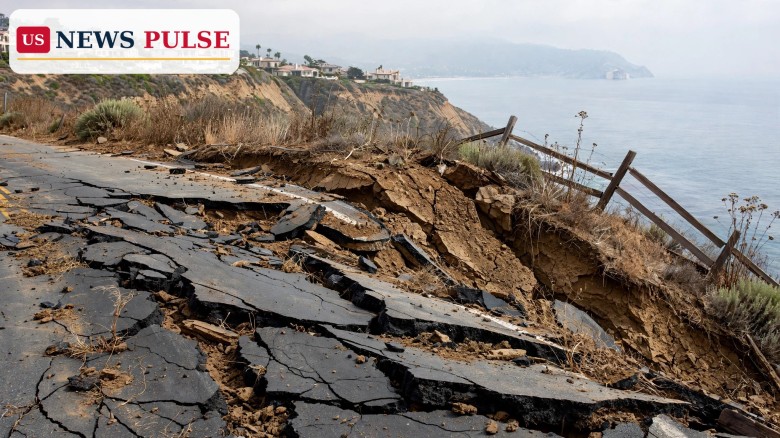
The Portuguese Bend landslide in Rancho Palos Verdes is moving faster again, with the ground in one of Los Angeles County's most expensive coastal enclaves now shifting more than an inch a week, just as a potentially soaking winter closes in on Southern California. The fresh acceleration, reported on October 29, 2026, has put officials, homeowners and engineers back on alert in a neighbourhood where the hillside has already torn roads apart, opened chasms in the earth and left cliff-edge mansions creeping toward the Pacific.
For residents of Portuguese Bend, the latest reading is a worrying reversal. After years in which above-average rainfall sent the hillside into a dramatic slide, city-installed dewatering wells had helped slow the movement. Now, following a mid-October pounding from tropical storm-fuelled waves that chewed away at the Southern California coast, the land is moving faster than it was in August. City officials are watching the battered coastline closely as another round of heavy rain looms, and there is, by their own account, no permanent fix in sight.
The new warning comes from the latest land-movement update for the Portuguese Bend area, reported on October 29. The headline figure is stark in its simplicity: more than an inch a week. That is still far below the foot-a-week rates seen at the worst point of the slide, but the direction of travel matters. After months in which the pace had eased, thanks in part to wells installed by the city to pump water out of the ground, the hillside has sped up again.
The timing could hardly be worse. A super El Nino is expected to drench Southern California in the coming weeks, and the same storm system now sweeping across the country is already bringing soaking rain to the region. In Portuguese Bend, water is the enemy: trapped groundwater lubricates the ancient slide plane beneath the neighbourhood, and every wet winter risks waking the hill again. City officials have been preparing for that test, filling large fissures before the rains, and there was one encouraging sign in the latest update. Those winter preparations, officials said, "fared well" during recent rainfall.
Palos Verdes Drive South, the road that cuts through the slide zone and typically floods when rainy weather rolls in, also avoided the need for pump trucks during the recent rainfall. It is a small reprieve, but in a community that has lived with buckling roads and broken utilities for years, small reprieves are noted carefully. Officials stressed, however, that a brief reprieve is a long way from an all-clear.
The Portuguese Bend landslide is not a new phenomenon. The slide complex, part of a larger landslide system on the Palos Verdes Peninsula, has been moving slowly for decades, with its modern reactivation traced to the 1950s. For most of that time the movement was minimal, measured in inches a year rather than inches a week. Then came a run of wetter-than-average winters, and the hillside changed character.
Above-average rainfall in recent years sent the slide into a far more dramatic phase. Roads buckled and split, with stretches of Dauntless Drive suffering severe damage that left the street closed and scarred. Gaping chasms opened in the landscape, some cracks plunging 20 feet deep or stretching a dozen feet across. In the worst-affected areas the ground was shifting as much as a foot a week, a pace that threatened homes, severed infrastructure and forced utility shutoffs in the slide zone.
The city's response has been a major engineering effort centred on water. Deep dewatering wells were installed to draw groundwater out of the hill and send it to the ocean, removing the water that drives the slide. City surveys showed the approach working: by August 2026 the Portuguese Bend slide was moving at under an inch a week on average, the first time below that mark since October 2023, with about three-quarters of the slide inside its historical boundary moving at less than an inch a week. Even that slower pace adds up to roughly three and a half feet a year, but it was a dramatic improvement on the 2024 peak, when the same arithmetic implied more than 40 feet a year.
The wells, however, are not a cure. The underlying instability remains, and the machines themselves take punishment from the moving ground, with wells sheared off as the earth shifts around them. On October 6, 2026, the City Council declared a local emergency so it could buy and stage equipment before the storms, a sign of how seriously officials take the coming winter.
The Portuguese Bend landslide matters because it sits at the intersection of geology, climate and extraordinary wealth. This is a place prized for its postcard views of the Pacific Ocean and Catalina Island, and the scenery remains spectacular. But the landscape itself has been ripped apart, and the stakes for homeowners are steep. Median listing prices in the neighbourhood range from roughly $1.99 million to $2.21 million, while larger luxury homes and unaffected coastal properties can command considerably more.
That wealth does not insulate the ground. Cliff-edge mansions sit on the verge of collapsing in places, and the slow-motion disaster has already cost the community dearly in damaged roads, broken pipes and disrupted services. The city has secured funding to fight back: Rancho Palos Verdes received $5 million in state funding and more than $54 million in federal FEMA grants to support landslide mitigation and a voluntary property-buyout programme targeting 27 preselected severely impacted homes, city manager Ara Mouradian told residents in October 2026. Buyouts are a recognition that some homes cannot be saved by engineering alone.
The climate backdrop makes the latest uptick harder to dismiss. On October 8, 2026, the National Oceanic and Atmospheric Administration's Climate Prediction Center put the chance of a historic El Nino, stronger than any since 1950, at 83 percent for October through December. NOAA also cautioned that stronger impacts are more likely but not guaranteed. For Portuguese Bend, even a normal wet winter would be a test; a super El Nino winter would be a severe one.
City officials have struck a careful balance in the latest update: acknowledging progress without claiming victory. Their assessment that winter preparations, including filling large fissures, "fared well" during recent rainfall is the most encouraging line in an otherwise sobering report. It suggests the pre-winter work did its job when the first rains arrived, at least for now.
At the same time, officials have been blunt that the underlying problem likely cannot be stopped altogether. That honesty matters for homeowners weighing whether to stay, sell or accept a buyout, and for buyers considering one of the most beautiful and most geologically complicated stretches of the California coast. The city's message, in effect, is that the hill can be managed and slowed, but not fixed.
Residents, meanwhile, face a familiar dilemma. The views that make Portuguese Bend desirable are the same views from a hillside that is, slowly and sometimes not so slowly, moving toward the sea. Every new survey reading is therefore read twice: once as a number, and once as a verdict on whether the neighbourhood's fragile truce with its own geology is holding.
Portuguese Bend is a preview of a wider California problem. As winters grow wetter in some years and drier in others, hillside communities built on ancient slide planes face a cycle of acceleration and repair that is expensive, disruptive and, in some cases, unwinnable. The Rancho Palos Verdes experience shows both what engineering can achieve, cutting movement from a foot a week to under an inch, and where its limits lie, with the hill speeding up again after a single stormy spell.
The story also matters for public money. Tens of millions of dollars in state and federal aid are now flowing into mitigation and buyouts in a single neighbourhood, a model other coastal communities will watch closely as sea levels rise and storm surges strengthen. If dewatering wells, fissure filling and selective buyouts can hold Portuguese Bend through a super El Nino winter, the approach gains credibility. If the hill accelerates sharply again, the case for managed retreat in the worst-affected pockets grows stronger.
For the rest of Southern California, the immediate lesson is practical. The cross-country storm system now moving through the region is already disrupting Halloween plans in Los Angeles and San Diego with soaking rain, and more rain is forecast in the weeks ahead. In slide-prone areas, that rain is not just an inconvenience; it is the force that moves the ground.
The next few weeks will be decisive. Survey crews will keep measuring the slide, and each new reading will show whether the move above an inch a week was a temporary response to the mid-October waves or the start of a winter-long acceleration. City crews will keep wells running, fissures filled and equipment staged under the local emergency declaration, ready for the heavier rain that El Nino may bring.
Homeowners in the worst-affected pockets will watch for news on the voluntary buyout programme, while the wider community watches Palos Verdes Drive South, the road whose flooding has become a barometer for the slide's mood. If pump trucks stay parked and the road stays passable through the next storms, the mitigation effort is holding. If the road floods and the survey numbers climb, the winter will be long.
Officials have not announced any new evacuation order in the October 29 update, and the latest figures remain far below the foot-a-week peak. But nobody involved is treating the current pace as safe. In Portuguese Bend, the ground has already shown just how fast things can go sideways, and the season that tests it most is only just beginning.
How fast is the Portuguese Bend landslide moving now? More than an inch a week, according to the latest update reported on October 29, 2026, faster than in August but far below the foot-a-week rates seen at the slide's peak.
Where is Portuguese Bend? It is a coastal neighbourhood in Rancho Palos Verdes, on the Palos Verdes Peninsula in Los Angeles County, Southern California, overlooking the Pacific Ocean and Catalina Island.
What caused the landslide to accelerate? Above-average rainfall in recent years, trapped groundwater beneath the neighbourhood, and, most recently, mid-October tropical storm-fuelled waves that battered the Southern California coast.
Can the landslide be stopped? City officials say the underlying instability likely cannot be stopped altogether, but dewatering wells and other mitigation have slowed it dramatically, from a foot a week at peak to under an inch a week by August 2026.
What is a super El Nino and why does it matter here? A very strong El Nino warming of the Pacific that typically brings heavy rain to Southern California; NOAA put the chance of a historic event at 83 percent for October to December 2026, which would test Portuguese Bend's defences.
Related coverage on US News Pulse: Cross-Country Storm to Blast 35 States With Flooding, Snow and Halloween Rain and King Tides Flood US Coasts With Record High Tides in Florida and California.
Leave a Comment



 | Today's Date: