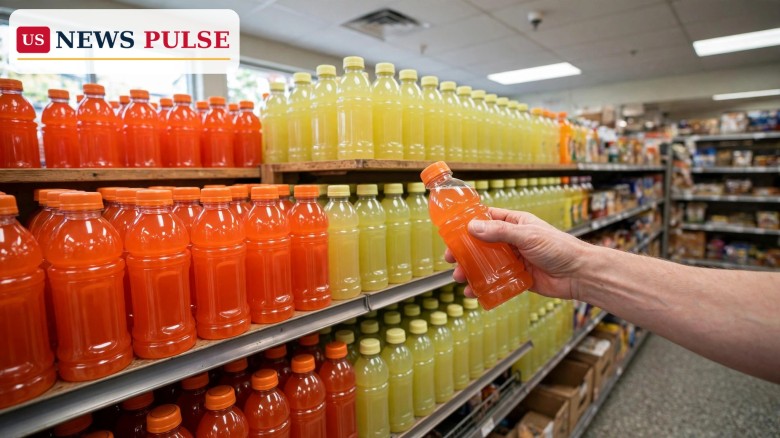
PepsiCo has recalled 122,021 cases of Gatorade in 37 states after bottles of America's best-selling sports drink shipped with food dyes that never made it onto the label, a labelling failure that matters most to the shoppers who read every ingredient line to stay safe. The Gatorade recall covers 28-ounce bottles of Lemon Lime, Lemon Lime Zero, Orange and Orange Zero, and it is still listed as ongoing, which means bottles covered by the action may still be sitting in fridges, gym bags and lunchboxes across more than two-thirds of the country.
The recall began voluntarily on September 25, 2026, and the US Food and Drug Administration (FDA) classified it as Class II on October 2, 2026. That middle tier of the FDA's three-level recall system applies, in the agency's own definition, to "a situation in which use of or exposure to a violative product may cause temporary or medically reversible adverse health consequences or where the probability of serious adverse health consequences is remote." In plain terms, most people who drink one of the affected bottles will notice nothing at all, but people with a sensitivity to the dyes involved can react, and they were given no warning on the bottle.
According to the FDA's enforcement record, the recalled Gatorade contains Yellow No. 5 and/or Yellow No. 6, two synthetic food colourings that are legal in food but must be named on the label under federal rules. Reports on the FDA notice add a useful detail for shoppers checking their own bottles: the lemon-lime labels left off Yellow No. 5, while the orange labels left off Yellow No. 6. The drinks themselves were not made or stored incorrectly. The problem is purely one of disclosure. A person who avoids these dyes reads the ingredient list to stay safe, and here that list did not warn them.
The recall is recorded under number H-0009-2027 in the FDA's enforcement report, which carries the full list of affected lot codes. PepsiCo, which owns Gatorade, initiated the recall voluntarily, and it is being conducted with the FDA's knowledge. As of early October, PepsiCo had not issued a public statement on the recall, and reporters who asked about refunds had not received answers. The recall record itself does not spell out return steps, so shoppers holding a matching bottle are advised to set it aside and ask the store where they bought it, or PepsiCo, what to do with it.
That silence on refunds is part of why the story keeps circulating weeks after the recall began. A recall that quietly enters an FDA enforcement report does not reach every shopper who bought a bottle in September, and the affected best-by dates run well into 2027, so the bottles have a long shelf life ahead of them. Anyone who breaks out in hives or itching after drinking one should call a doctor.
Yellow No. 5, also known as tartrazine or E102, and Yellow No. 6, also known as Sunset Yellow FCF or E110, are man-made colourings used to give foods and drinks their yellow and orange hues. Both are approved for use in food in the United States. Approval, however, is not the whole story. Federal labelling rules require colour additives to be declared, precisely because a small share of people react to them. The FDA says allergic-type reactions to colour additives are rare, but Yellow No. 5 can cause itching and hives in some people, and the agency's recall guidance notes that the dyes can cause potentially severe allergic reactions, including hives, wheezing and asthma attacks in sensitive people, although such reactions are rare.
The labelling question sits inside a much larger debate about synthetic dyes in American food. In April 2025, PepsiCo said it would move away from synthetic dyes toward natural alternatives. Around the same time, federal health officials announced a plan to work with industry to phase out certified colour additives, including the yellow dyes at the centre of this recall. That context does not change the facts of this recall, but it explains why a labelling slip involving exactly these two dyes has drawn attention: the dyes themselves are already on their way out of many products, and shoppers are paying closer attention to them than they did a few years ago.
Gatorade's scale is the other reason this recall travels so far. It is the country's most popular sports drink, sold in convenience stores, supermarkets, gyms and vending machines, and bought in bulk for teams, schools and workplaces. A recall counted in cases, rather than bottles, can therefore reach an enormous number of individual drinks. The FDA record counts 122,021 cases, and while the agency does not state a bottle total, a case of 28-ounce bottles plainly runs into the millions of individual drinks across the 37 states named.
Only one size is covered: the 28-ounce bottle. Only four flavours are covered: Lemon Lime, Lemon Lime Zero, Orange and Orange Zero. A bottle of another size, or another flavour, is not named in the recall figures, and shoppers do not need to throw out their whole sports-drink shelf on the basis of this action.
Each recalled bottle carries a lot code, a short string of numbers and letters stamped on the bottle that shows when and where it was filled, along with a best-by date. The recalled best-by dates run from April 18, 2027, to June 8, 2027, and the 15 lot codes are: 072226 DT (APR 18 27), 082126 OA (APR 18 27), 072426 TL (APR 20 27), 072726 TL (APR 23 27), 072926 TL (APR 25 27), 073026 TL (APR 25 27), 073126 TL (APR 27 27), 080126 DL (APR 28 27), 081026 TL (MAY 07 27), 082026 DL (MAY 17 27), 082526 KM (MAY 22 27), 090426 KM (JUN 01 27), 083126 DT (JUN 07 27), 091026 DL (JUN 07 27) and 091126 DL (JUN 08 27).
The bottles went to stores in 37 states: Alabama, Alaska, Arizona, Arkansas, California, Colorado, Florida, Georgia, Hawaii, Idaho, Illinois, Indiana, Iowa, Kansas, Kentucky, Louisiana, Michigan, Minnesota, Mississippi, Missouri, Nebraska, Nevada, New Jersey, New Mexico, New York, North Carolina, North Dakota, Ohio, Oklahoma, Pennsylvania, South Carolina, South Dakota, Tennessee, Texas, Utah, Washington and Wisconsin. If your bottle matches the size, one of the four flavours and one of the lot codes above, treat it as part of the recall even if you feel fine after drinking from it. The risk the recall addresses is about sensitivity, not about a drink that has gone bad.
The FDA's handling of this recall has been measured rather than alarming, and that tone is itself informative. A Class II classification is the middle of the agency's three levels. It signals real but limited risk: temporary or medically reversible health consequences are possible, while the probability of serious harm is remote. The agency has not ordered a Class I recall, its most serious level, and it has not reported any illnesses or reactions tied to these bottles as of October 4.
Consumer guidance around the recall is straightforward. If someone in your home is sensitive to food dyes, do not let them drink a bottle that matches the recall. Set it aside and ask the store where you bought it, or PepsiCo, what to do with it. Anyone who develops hives, itching, wheezing or other symptoms after drinking one should seek medical advice. For everyone else, the FDA's message is reassuring in its specifics: for most people who drink one of these bottles, the dyes will cause no problem at all, because the dyes are approved food ingredients whose only fault here is that they were not declared.
What remains unresolved is the consumer end of the process. No statement on refunds had been made as of October 8, and the recall record does not spell out return steps. That gap is worth watching, because recalls work best when shoppers know not only what to check but what to do next. Until PepsiCo or retailers publish that guidance, the practical advice stands: check the size, flavour and lot code, set matching bottles aside, and keep the bottle so the code can be verified.
This recall matters for a reason that goes beyond one sports drink. Ingredient labels are the main tool people with allergies and sensitivities have to protect themselves, and they only work if they are complete. When a label omits an ingredient, the shopper who did everything right, reading the bottle before drinking, is still exposed. That is why undeclared-ingredient recalls are treated seriously even when the ingredient itself is legal and widely used. The system depends on trust in the label, and every gap in that trust makes the next label harder to believe.
It also matters because of who drinks Gatorade. Sports drinks are marketed to athletes, children and teenagers, and bought for teams and schools, which means a labelling gap can reach people who never read the label themselves. Parents stocking a fridge for a youth team, coaches filling a cooler on a sideline, and workplaces buying in bulk all rely on the same ingredient list. A recall counted at 122,021 cases is not a niche product warning. It is a mainstream product in mainstream places, and the 37-state footprint covers most of the country.
Finally, the recall is a small window into the slow shift away from synthetic dyes. PepsiCo's April 2025 pledge to move toward natural colours, and the federal plan to phase out certified colour additives, suggest that the ingredient lists on drinks like these will keep changing. Shoppers who follow those changes will increasingly check labels for exactly the dyes named here. This recall shows why that habit is worth keeping, even for a familiar brand bought without a second thought.
The recall remains listed as ongoing, so the next development to watch is the FDA's enforcement report, which will show whether the action is expanded, narrowed or closed. Shoppers should also watch for refund or return guidance from PepsiCo or retailers, which had not been published as of early October. If new lot codes are added, the list in this article will no longer be complete, and the FDA record, under recall number H-0009-2027, will be the authoritative source.
Retailers in the 37 states named are expected to continue pulling affected stock, and anyone who finds a matching bottle at home should keep it aside rather than passing it on. Giving a recalled bottle to someone else does not remove the risk. It moves it to a person who may be more sensitive to the dyes than you are. If symptoms appear after drinking a matching bottle, medical advice should be sought promptly, and the bottle and its lot code kept for reference.
Longer term, the dyes question will not go away with this recall. As PepsiCo and other manufacturers shift toward natural colours, ingredient lists will change, and shoppers with dye sensitivities will need to re-check products they have bought for years. This recall is a reminder to do that checking now, while the lot codes are still easy to verify.
Only 28-ounce bottles of Lemon Lime, Lemon Lime Zero, Orange and Orange Zero, with best-by dates from April 18, 2027, to June 8, 2027, and one of the 15 lot codes listed in this article. Other sizes and flavours are not included.
They contain Yellow No. 5 and/or Yellow No. 6 food dyes that were not declared on the label. Both dyes are legal in food, but federal rules require them to be listed, because some people are sensitive to them.
Do not drink it if anyone in your home is sensitive to food dyes. Set it aside, keep the bottle so the lot code can be checked, and ask the store where you bought it, or PepsiCo, what to do with it. No refund steps had been published in the recall record as of early October.
No illnesses or reactions tied to these bottles had been reported as of October 4. The FDA classified the recall as Class II, meaning temporary or medically reversible effects are possible but serious harm is considered remote.
No. The recall covers only the four flavours and 28-ounce size named here, in the 37 states listed, with the specified lot codes. Other Gatorade products are not part of this action.
Related coverage on US News Pulse: Bodum recalls 5.9 million French press coffee makers over burn risk, FDA warns over Darwin's cat food after Salmonella hospitalisation, and GF Blends flour recall under FDA Class I warning.
Leave a Comment



 | Today's Date: