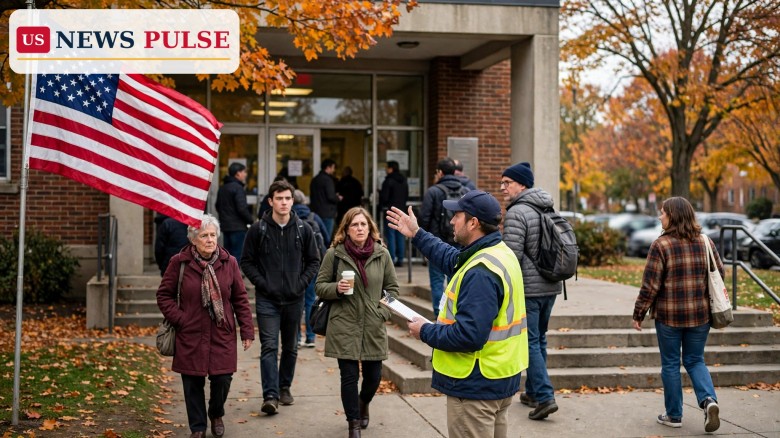
When Americans vote in the midterm elections on Tuesday, November 3, 2026, one familiar presence will be missing from the process for the first time in a generation: the election observers of the Organization for Security and Co-operation in Europe (OSCE). The United States has not invited the OSCE to observe the 2026 midterms, breaking a practice that has held for every federal election since 2002 — 12 elections in all, including six previous midterms. The OSCE election observers decision has become one of the most closely watched questions of the final days of the campaign, not because observers count votes, but because their absence changes how the rest of the world — and many Americans — will judge what happens on election night.
The break surfaced publicly on September 23, 2026, when ODIHR and the OSCE Parliamentary Assembly issued a joint statement confirming that no invitation had arrived from Washington for the November elections. The statement was blunt by the standards of election-observation diplomacy. The OSCE said the failure to issue an invitation was regrettable, particularly given the long-standing cooperation with the United States in the field of election observation, and added that observation would have provided a valuable independent analysis of developments in the legal and regulatory framework.
The numbers behind the statement explain why it landed so hard. The OSCE, a 57-member security body based in Vienna of which the United States is a member, has observed every US federal election since 2002. That run covers 12 federal elections, six of them midterms. On November 3, that run ends — unless an invitation arrives at a point far too late for a mission to be mounted professionally, a problem other countries have run into before. When Belarus kept the OSCE waiting and sent an invitation only at the last moment, the organisation judged it too late to prepare properly and, above all, too late to monitor the election campaign.
What the OSCE normally does in the United States is worth stating plainly, because much of the debate since September has been about what its absence means rather than what its presence involved. An ODIHR mission does not run polling stations, count ballots or certify results. It sends a needs-assessment team first, then long-term and short-term observers who watch the campaign, the legal framework, media coverage and election-day procedures, and it publishes findings and recommendations afterwards. Its reports on past US elections have been cited by media outlets across the political spectrum, and its 2020 report concluded that the vote was conducted correctly — a finding that matters to the story of why this invitation never came.
The OSCE's case against the decision rests on a commitment the United States itself signed. Under the 1990 Copenhagen Document, every OSCE participating state committed to invite observers from other participating states, ODIHR and other institutions to observe its elections. The September 23 statement said the US decision was not in line with those commitments. That framing matters because it turns the argument from one about courtesy into one about obligations: the United States is not being asked to accept a favour, the OSCE argues, but to honour a promise it made alongside 56 other states.
Pere Joan Pons, President of the OSCE Parliamentary Assembly, put it in the starkest terms used by any OSCE official so far, calling the decision a significant departure from established democratic practice. The Swiss OSCE Chairmanship, held by Swiss Foreign Minister Ignazio Cassis, also expressed regret. Nicolas Bideau, head of communications at the Swiss foreign ministry, said support for election observation missions is a priority for the Swiss chairmanship and that it would be regrettable if the United States were not to invite ODIHR to observe the forthcoming elections. Switzerland, it is understood, had already raised the matter with US authorities in bilateral discussions, urging that the mission proceed as usual.
For its part, Washington had, as of September 25, given no explanation for the non-invitation — neither from the administration nor from the US embassy to the OSCE in Vienna, according to SRF diplomatic correspondent Fredy Gsteiger. The embassy's website still says the United States is committed to the OSCE, Gsteiger noted, and after much hesitation Washington had re-accredited an ambassador to the organisation. A later reported White House explanation was brief: that American elections would be administered, conducted and observed by American citizens. That line, if it is the administration's settled position, reframes the question entirely — from an international commitment to a question of who gets to watch.
No single official reason has been published, but the reporting around the decision points to several overlapping pressures. The first is the 2020 report. According to Gsteiger, the United States spent months behind the scenes trying to persuade the OSCE to withdraw its report on the 2020 election, in which Joe Biden was elected president. Donald Trump still claims to this day that Biden was not elected at all, Gsteiger noted, while the OSCE came to the clear conclusion that the election was conducted correctly — a conclusion that, in Gsteiger's words, does not sit well with Trump and his supporters. That history is context, not proof of motive, but it is the context every European capital cites when asked why the invitation stopped.
The second pressure is financial. Portuguese reporting, summarised in the October 30 morning edition of the Rest of the World Report, says the United States demanded last December that the OSCE cut its annual budget by at least 15 million euros by the end of 2026. The United States has been putting financial pressure on the OSCE for some time, Gsteiger reported, even as it continued to cooperate with the organisation under President Trump. Budget leverage and the observation invitation are separate questions, but they arrived in the same diplomatic season.
The third strand is company the United States now keeps on this question. Until now, it has tended to be other countries — and not democratic ones — that have refused to admit OSCE observers, Gsteiger explained. Russia excluded OSCE observers for the third time ahead of and during its Duma elections in September 2026, and the OSCE had expressed grave concern about that decision in early August. Belarus, too, delayed its invitation until it was too late for a professional mission. The United States has not joined that group in any formal sense — it remains an OSCE member, its embassy still professes commitment to the organisation — but on the single question of the 2026 invitation, its position is now indistinguishable from theirs. That comparison, made in Swiss and European coverage, is the one Washington's critics repeat most.
The OSCE's own language has been measured but unusually direct. Its September statement called the decision regrettable and not in line with participating states' commitments, and said observation would have provided a valuable independent analysis of developments in the legal and regulatory framework. Pons's phrase — a significant departure from established democratic practice — has become the shorthand quote for the whole episode.
The Swiss chairmanship's regret added a second official voice. Bideau's statement that support for election observation missions is a priority for the Swiss OSCE Chairmanship, and that it would be regrettable if the United States were not to invite ODIHR, put the chairmanship on record before the September 23 joint statement. Cassis himself had not commented publicly as of late September.
Gsteiger's analysis, widely quoted in European coverage, goes further than the official statements and should be read as assessment rather than established fact. He judged it not implausible that the Trump administration wants to use the exclusion of OSCE observers to clear the way for manipulating the election results, and added that if Republicans lose, they could claim the elections were not conducted properly — something which would be much more difficult if the OSCE confirmed the election had been conducted fairly. He also called OSCE election observation the gold standard, noting that the vast majority of the media rely on its reports. Those are a correspondent's judgements, not findings of the OSCE, and the administration has not answered them directly.
The most concrete response so far has come not from governments but from Europe's election-observation community. On October 27, 2026, MEMO 98 and Election-Watch.EU, supported by the European Partnership for Democracy, launched an International Remote Election Assessment of the US congressional elections. Armin Rabitsch of Election-Watch.EU said independent scrutiny matters in every democracy, and that in the absence of an OSCE mission, the international election observation community has a responsibility to contribute an impartial, evidence-based assessment of these elections, while being clear about the scope and limitations of its work. MEMO 98 executive director Rasťo Kužel said the aim is to assess the context in which these elections are taking place and how it has evolved since 2024, drawing on previous ODIHR findings and recommendations.
The practical effect of the OSCE's absence is narrower than the symbolism, and both halves deserve attention. Practically, American elections are run by states and counties, watched by domestic partisan and nonpartisan observers, poll watchers, journalists and courts. Tens of thousands of domestic observers are expected at polling places on November 3, under rules that vary by state. The OSCE never replaced that machinery, and its absence does not leave polling places unwatched. Anyone claiming otherwise is overstating the case.
What the absence does remove is the one independent, international check whose findings both sides have historically been able to cite. In a midterm cycle already defined by legal fights over voter rolls — a report published on Wednesday said the Trump administration has issued more than 100 subpoenas demanding records on tens of thousands of voters in at least 13 states, and that the Justice Department has sued 30 states that refused to hand over voter rolls — and by court battles over ballots in California and Alaska, the credibility of the result will be argued over in public within hours of polls closing. An OSCE report, published weeks later, would not have settled those arguments on the night. But its absence removes a shared reference point for the argument afterwards, and that is precisely what Gsteiger warns could be exploited: a result one side dislikes becomes easier to call improper when the body that would have certified the process as fair was never invited to look.
There is also a precedent effect that reaches beyond November 3. The OSCE's observation system works on reciprocity: every member invites observers, so every member can demand them elsewhere. If the United States, the organisation's most prominent member, can decline an invitation without consequence, other governments facing awkward elections gain a ready-made example. The 2026 midterms will be read in capitals from Minsk to Moscow not only as an American election but as a test of whether the Copenhagen commitment still binds its signatories. That is why European officials, who otherwise expect little to change after Tuesday, have treated this as a story in its own right rather than a footnote to the campaign.
The immediate calendar is short. The MEMO 98 and Election-Watch.EU remote assessment will publish its pre-election report on November 2, the day before voting, covering the legal and institutional framework, electoral competition and redistricting, voter registration and participation, election administration, campaign finance and political advertising, the media and digital information environment, and safeguards for electoral integrity. A final report is planned after the elections. Both reports will be explicit about their limits: the assessment is conducted remotely, through documentary research, expert analysis and interviews with US stakeholders across the political spectrum, and it does not involve direct observation of polling or counting. It is institutionally independent of the OSCE and, in its own words, does not substitute for an OSCE election observation mission.
On November 3 itself, the machinery that remains will do the watching: state and local election officials, domestic observers, party poll watchers, journalists and, where disputes arise, courts. Early voting is already well advanced — more than 44 million Americans had voted by Thursday evening, according to the University of Florida Election Lab, under 2 million short of the entire 2022 midterm total — so much of the election the OSCE would have observed has already happened without it.
After the votes are counted, the question will be whether the absence matters in the argument that follows. If the results are decisive, the OSCE's absence may fade into a diplomatic footnote. If any race is close — and several Senate and House contests are polling within the margin of error — expect the invitation that never came to be cited, by one side or the other, as evidence about the process itself. The OSCE, for its part, will still publish nothing on the 2026 midterms, because there will have been no mission to report on. That silence, rather than any report, is the document this election will leave behind.
Has the US ever held a federal election without OSCE observers before? Not since the OSCE began observing US federal elections in 2002. The 2026 midterms are the first federal elections since then for which the OSCE has received no invitation.
What is the OSCE? The Organization for Security and Co-operation in Europe is a 57-member security body based in Vienna. The United States is a member. Its election-observation work is done mainly by ODIHR, together with the OSCE Parliamentary Assembly.
Do OSCE observers count votes or certify results? No. They observe the campaign, the legal framework, media coverage and election-day procedures, and publish findings and recommendations. Running elections and counting votes remain the job of US state and local officials.
Why does the OSCE say the decision breaches a commitment? Under the 1990 Copenhagen Document, all OSCE participating states, including the United States, committed to invite observers to their elections. The OSCE's September 23, 2026 statement said the US decision was not in line with those commitments.
Is anyone else watching the election internationally? MEMO 98 and Election-Watch.EU are running a remote assessment, with a pre-election report due November 2 and a final report after the election. It involves no direct observation of polling or counting and does not replace an OSCE mission. Domestic observers, journalists and courts will watch polling places on the day.
Related coverage on US News Pulse: Trump legal challenges escalate against states as election day nears, Trump election legal challenges escalate in Alaska and California before midterms, and Washington ballots held aside as DOJ flags 405 suspected noncitizen voters.
Leave a Comment



 | Today's Date: