
Supreme Court Backs Trump in Deportation Case as Immigration Judges Lose Pause Power
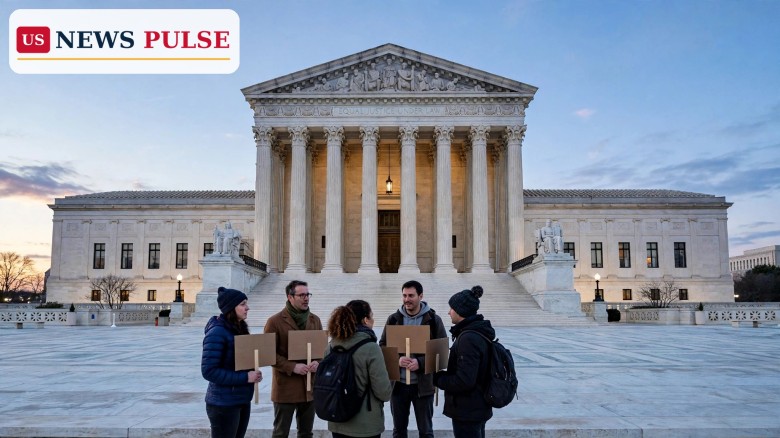
The United States Supreme Court on Tuesday, October 27, 2026, sided with the Trump administration in a fast-moving immigration dispute, refusing to restore a Biden-era rule that let immigration judges temporarily pause deportation cases. The Supreme Court deportation ruling, issued as a brief, unsigned, one-sentence order with no justice publicly dissenting, leaves in place an agreement between the administration and Texas that bars the long-used practice known as administrative closure.
The decision does not end the underlying lawsuit. It only refuses emergency relief while the case continues. But for hundreds of thousands of people whose cases were once shelved while they waited for a visa decision, a criminal-case outcome or another legal process to run its course, the practical effect is immediate: judges cannot, for now, put those proceedings back on hold under the 2024 rule.
Key Points
- The Supreme Court declined on October 27, 2026, to reinstate the 2024 rule allowing immigration judges to use administrative closure.
- The ruling keeps in place a June 22 agreement between the Trump administration and Texas, approved the same day by a federal judge in Wichita Falls, that declared the Biden-era rule unlawful and blocked it nationwide.
- Three cities — Baltimore, New Haven and Columbus — and legal-services provider Centro Legal de la Raza brought the emergency request, arguing the administration used a friendly lawsuit to erase a regulation without public comment.
- Administrative closure had been used for decades and covered hundreds of thousands of cases; Executive Office for Immigration Review figures cited in court analysis put inactive pending cases at 361,614 through the third quarter of fiscal 2025.
- The underlying fight over whether the cities may intervene to defend the rule continues in the lower courts, so the Supreme Court could be asked to look at the case again.
What Happened
In a brief order on Tuesday, the justices denied an emergency request from Baltimore, Maryland; New Haven, Connecticut; Columbus, Ohio; and Centro Legal de la Raza. The applicants had asked the court to halt, for now, the deal ending administrative closure while litigation over the rule continues. The court gave no explanation, as is common for emergency orders, and no justice recorded a dissent.
At the centre of the dispute is a regulation adopted by the Biden administration in 2024 that formally codified administrative closure procedures. The regulation concluded that letting judges manage their dockets in this way promoted efficiency and fair treatment. It replaced a 2020 rule adopted during President Donald Trump’s first term that had itself been blocked by the courts.
After Trump returned to office in 2025, the Justice Department office that oversees the immigration courts, the Executive Office for Immigration Review, said it would not defend the Biden rule against a legal challenge. Texas then sued, arguing that the rule lets immigration judges “effectively grant indefinite amnesty to aliens illegally present in this country.”
On June 22, the same day Texas filed its challenge, the administration and the state jointly asked US District Judge Reed O’Connor in Wichita Falls to approve an agreement declaring the Biden rule unlawful. O’Connor did so, blocking the rule permanently and nationwide. The three cities and Centro Legal de la Raza then sought to intervene in the case to defend the rule, but O’Connor rejected their bid, finding they lacked a legal right to take part. The New Orleans-based 5th US Circuit Court of Appeals then declined to put the agreement on hold pending an appeal of O’Connor’s decision.
The Supreme Court’s refusal to intervene at this stage therefore preserves the status quo created by that June agreement: the 2024 rule stays blocked, and immigration judges cannot rely on it to suspend cases while the intervention fight plays out.
Background and Context
Administrative closure is not a grant of legal status, and it is not the same as terminating a case. In practice, it removed a case from a judge’s active calendar without a final decision, often because another proceeding involving the same person was still pending. That might be a visa petition, an appeal of a criminal conviction, or cooperation with law enforcement as a crime victim or witness. The case could later be put back on the calendar.
Immigration judges relied on the tool for decades to clear space on crowded dockets. The practice has also been a political flashpoint for years. Supporters describe it as basic docket management in a system overwhelmed by volume. Critics, including Texas and the Trump administration, argue it allowed people without legal status to remain in the United States indefinitely, functioning in effect like an amnesty.
The scale is large. Figures from the Executive Office for Immigration Review, cited in analysis of the court filings, show inactive pending — that is, administratively closed — cases rising from 218,857 in fiscal 2015 to 319,182 in fiscal 2023 and 348,556 in fiscal 2024, reaching 361,614 through the third quarter of fiscal 2025. The two sides read that growth very differently: for Texas and the administration, a pool of more than 360,000 cases with no end date is the problem the June judgment was meant to fix; for the applicants, many of those cases belong to people waiting in line for a benefit Congress created.
The wider court backlog is far larger still. Texas’s own complaint, citing Executive Office for Immigration Review figures, put the immigration court backlog at more than 2.2 million cases as of July 2023. The Justice Department has since pointed to a sharp fall in pending cases under its backlog-reduction push, but the courts remain one of the most congested parts of the federal system, and any change to how cases are paused or revived ripples through thousands of individual lives.
The history of the rule itself shows how sharply policy has swung with each administration. The Biden regulation in 2024 was an attempt to settle the question after years of litigation over whether judges even had the power to close cases administratively. The Trump administration’s decision not to defend that rule, followed by the joint agreement with Texas, effectively reversed it without the usual notice-and-comment rulemaking process — the very shortcut the cities say was unlawful.
Supreme Court Deportation Ruling: What the One-Sentence Order Means
The most important thing to understand about Tuesday’s order is what it does not do. It does not decide whether administrative closure is lawful in the abstract, and it does not rule on whether the administration and Texas colluded. Emergency orders at this stage are about preserving or restoring the position while a case is litigated, not about final merits.
What it does do is leave the June judgment untouched for now. That means the 2024 regulation remains blocked, judges cannot use it to pause cases, and the cities’ attempt to step into the Texas case to defend the rule remains rejected unless an appeals court reverses that intervention ruling.
The Justice Department argued that the cities and Centro Legal de la Raza should not be allowed to leapfrog that question. Because a federal judge ruled they cannot defend the rule in court, the government said, they also cannot ask the Supreme Court to get involved before that ruling is potentially overturned on appeal. “This Court should not allow applicants to put the cart before the horse,” the government told the justices in a filing.
The government also disputed the scale of the harm claimed, calling the challengers’ assertions about how many immigrants will be affected without immediate intervention speculative. The cities, by contrast, said the abrupt policy change could affect hundreds of thousands of immigration cases, including those involving people eligible for lawful status.
Reactions and Quotes
The challengers framed the case as a test of whether an administration can erase a regulation it dislikes by finding a friendly plaintiff. “Rather than follow the law and allow the public to be heard, the Department of Justice colluded with Texas to erase longstanding immigration procedures in a single day, putting families, survivors of violence, and entire communities at risk,” said Skye Perryman, president and CEO of Democracy Forward, which is representing the challengers.
In their Supreme Court filing, the cities and Centro Legal de la Raza argued that the administration had circumvented the federal law governing agency procedures by using “manufactured litigation” with “ideologically aligned” Texas to eliminate a regulation. “The need for interim relief is underscored by the collusion that infected this suit from its inception,” they wrote.
The administration and Texas have rejected that characterisation. Their position, as set out in the Texas lawsuit and the June agreement, is that the rule itself was unlawful because it let judges grant what amounts to indefinite amnesty, and that a court judgment declaring it so is a legitimate way to resolve a live dispute — particularly when the government no longer defends the rule.
Local detail in the filings shows why the three cities say they have a direct stake. Baltimore said it has more than 600 pending or approved U visa applications connected to its work and has processed more than 440 U visa certifications since the start of 2025, a programme that depends on crime victims cooperating with police. Centro Legal said it has 80 to 100 clients with closed cases and at least 50 more whose terminated cases are likely to be reopened. Columbus and Baltimore both levy local income taxes, and the cities argue that pushing residents more quickly toward removal would hit their tax base and their ability to police their communities.
The ruling lands in the final week before the November 3 midterm elections, when immigration remains one of the most contested issues in American politics. The administration has made faster removals and a smaller court backlog central to its immigration message, while its critics argue that speed is being bought at the cost of due process for people with pending legal claims.
Why It Matters
For people in the immigration system, the difference between a paused case and an active one can be life-changing. A paused case meant time: time for a family petition to be decided, time for a U visa application from a crime victim to be processed, time for a criminal appeal to conclude. An active case means a hearing date, a possible removal order, and, for some, detention.
For the courts, the ruling removes a pressure valve at a moment when dockets are already under strain. Judges who once shelved cases awaiting another process must now either keep them moving or find another legal basis to pause them. That could mean more hearings, more orders and more appeals — or, as the administration hopes, faster final decisions and a smaller backlog.
For the wider legal system, the case raises a question that goes well beyond immigration: can an administration that dislikes a regulation simply agree with a challenger in court and have a judge strike it down, bypassing the public comment process that would normally be required to repeal a rule? The cities say that shortcut, if allowed to stand, could be used by any future administration, of either party, to erase rules without public input. The government says the cities lack standing to raise that complaint in the first place, because they were never parties to the Texas case.
That procedural question — who gets to defend a rule the government will not defend — may prove more durable than the immigration policy itself. If courts routinely refuse intervention by affected cities and advocacy groups, regulations could be dismantled in friendly settlements with little adversarial testing. If courts allow intervention more freely, administrations will find it harder to reverse a predecessor’s rules without going through formal rulemaking.
What Happens Next
The immediate next step is the appeal over intervention. The cities and Centro Legal de la Raza are appealing Judge O’Connor’s refusal to let them join the Texas case, and the 5th Circuit will decide whether that refusal was correct. If they win that appeal, they could then defend the 2024 rule on its merits and ask a court to lift the June judgment. If they lose, the judgment stands and the rule stays blocked unless the administration itself changes course or Congress acts.
Either side could also return to the Supreme Court. A loss at the 5th Circuit would give the cities a fresh basis to seek Supreme Court review, this time on the intervention question rather than emergency relief. The justices’ silence on Tuesday — no opinion, no dissent — gives no clue how they would view that fuller case.
In the immigration courts, meanwhile, judges and lawyers will be watching for guidance from the Executive Office for Immigration Review on how to handle cases that would previously have been closed. People with pending cases should check their case status, keep their address current with the court, and seek legal advice promptly if they receive a new hearing notice, because a case that was once dormant may now move quickly.
Politically, expect both parties to use the ruling in the final days before November 3. The administration can present it as a win for enforcement and for clearing the backlog. Its critics will present it as evidence that the courts are being used to shortcut democratic process. Neither framing changes the legal reality on Tuesday: the rule stays blocked, the case continues, and hundreds of thousands of individual cases hang in the balance.
Frequently Asked Questions
What is administrative closure?
Administrative closure is a tool immigration judges used to remove a case from their active calendar without deciding it, usually while another proceeding — such as a visa petition, a criminal appeal or cooperation with law enforcement — was still pending. The case could later be returned to the calendar.
Did the Supreme Court rule that administrative closure is illegal?
No. The court denied an emergency request to halt the agreement ending the practice while litigation continues. It issued a one-sentence order with no explanation and no public dissent, and it did not decide the merits of whether the 2024 rule was lawful.
Who brought the Supreme Court case?
Baltimore, New Haven and Columbus, together with legal-services provider Centro Legal de la Raza, asked the court to restore the rule temporarily. They had sought to intervene in the Texas case to defend the rule after the federal government declined to do so, but the district judge rejected their bid.
How many cases does this affect?
Administrative closure had been applied in hundreds of thousands of cases over the years. Executive Office for Immigration Review figures cited in court analysis put inactive pending cases at 361,614 through the third quarter of fiscal 2025, though the government disputes how many people will be harmed by the change.
What should people with a closed case do now?
They should confirm their case status through the immigration court system, make sure the court has their current address, and contact an immigration lawyer if they receive a new hearing notice. A previously paused case may now be scheduled for a hearing.
Related coverage on US News Pulse: the Supreme Court’s earlier action on SNAP payments as the shutdown deal headed to a House vote, the Justice Department’s charges over alleged illegal voting in five states, and the administration’s suspension of visa-free travel for Chinese nationals to the Northern Mariana Islands.
© 2026 US News Pulse. All rights reserved.
 Print
 Save