
Ohio Governor Race: Acton, Ramaswamy Make Final Pitch in Ugly Campaign
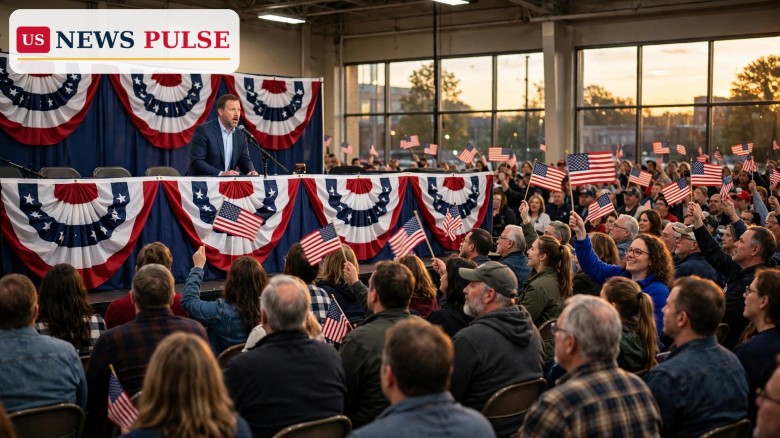
With four days left until Election Day, Democrat Amy Acton and Republican Vivek Ramaswamy have made their final pitches to Ohio voters in a governor race that has become one of the nastiest, and most closely watched, contests of the 2026 midterms. The Ohio governor race, once expected to stay safely Republican, now heads into its final weekend with the Democrat ahead in every major nonpartisan poll and forecasters moving the contest toward her.
Both candidates crisscrossed the state in the closing days, each claiming to be the true agent of change for Ohio. Acton, the former state health director under Republican Governor Mike DeWine, told supporters in Dayton that Ohio is longing for public servants who solve problems. Ramaswamy, the Trump-backed businessman, told supporters north of Columbus that voters face a choice between a businessman and a bureaucrat. Behind the competing slogans sits a campaign defined less by policy than by personality, an explosive attack advertisement, and a bitter argument about wealth, credibility and who understands ordinary Ohioans.
Key Points
- Acton and Ramaswamy delivered closing rallies in Dayton and north of Columbus days before the November 3 election.
- Every major nonpartisan October poll puts Acton ahead, by margins from one to seven points, and forecasters rate the race Lean Democratic.
- A Ramaswamy advertisement featuring Acton estranged mother, pulled from the air by October 29, drew a backlash that appears to have hurt his standing.
- Acton promises fully funded schools and tax breaks for working Ohioans; Ramaswamy promises to phase out the state income tax and roll back property taxes.
- Ohio polls open at 6:30 a.m. and close at 7:30 p.m. Eastern on Tuesday, November 3, with Libertarian Don Kissick also on the ballot.
What Happened
Acton closed her swing at Brightside Music and Events in Dayton, walking in to Florence and the Machine song "You've Got the Love" before telling the crowd: "It is time for change in Ohio. Isn't that what we are longing for? Public servants again, who actually solve problems instead of making problems." Democrats hope to capitalise on voter frustration with the direction of the state and the nation, and Acton pitch is built on breaking decades of Republican control of state government, fully funding public schools and offering tax breaks for working Ohioans.
Ramaswamy made his case at Pizza Cottage and Tipton Tavern, north of Columbus, telling supporters: "We have a choice in this race. We have the opportunity to elect a businessman, not a bureaucrat; to elect a creator, not a quitter; to elect a visionary who celebrates and appreciates success, not one who demonizes and tries to tear down success." His closing platform is a different kind of change: eliminating the state income tax over time, rolling back property taxes, taking a hard look at how Ohio runs its universities and eliminating sanctuary cities that hinder immigration enforcement. In the final days he also pledged to investigate every locality where property taxes have more than doubled since before the pandemic.
The two closing events capped a final push in which both candidates toured the state. Ramaswamy stood alongside President Donald Trump at a rally in Chillicothe, where he asked voters a simple question: "Who is actually going to make your life better?" At Acton Cincinnati event, The National, a rock band with Cincinnati roots, played "Bloodbuzz Ohio". The contrast captures the race: a Trump-endorsed billionaire businessman against a former public health official running as the underdog who cannot be bought.
Background and Context
The seat is open because Governor Mike DeWine, a Republican, is term-limited. An Acton victory would give Ohio its first Democratic governor since Ted Strickland left office in 2011, a striking result in a state Donald Trump won by 11.2 points in 2024 and where DeWine won re-election by 25 points in 2022. Ohio has about 11.9 million people, and the governor race is being read nationally as a test of whether Democratic momentum in the midterms can reach deep into Republican territory.
The polling picture is consistent, if not comfortable for either side. Marist put Acton ahead 50 to 43, Bowling Green State University and YouGov had her up 50 to 44, Fox News gave her a 50 to 48 edge and Verasight had her ahead 46 to 45. The polling averages compiled by 270toWin and RealClearPolling put Acton ahead by about three to four points. The Cook Political Report moved the race to Lean Democratic on October 23 and Sabato Crystal Ball did the same on October 22, while Inside Elections most recent rating, from October 1, remained Toss-Up. Prediction markets have gone further, giving Acton roughly an 82 to 83 percent chance of winning.
That lead has survived an extraordinary spending gap. Ramaswamy and his allies had spent about 101 million dollars on advertising by mid-October, roughly three times the Democratic side, including 36 million dollars of his own money. Ramaswamy himself has spent 41.3 million dollars of his own money on the campaign, including more than 1 million dollars on private jet travel, according to recently released campaign finance reports. Acton has held her own in fundraising and at times outraised Ramaswamy, but she has not loaned her campaign any money, and Republicans still outspend Democrats three to one on advertising, according to AdImpact. Her rallying cry to that disparity is blunt: "You can not buy Ohio, and you can not buy us."
Ohio Governor Race: Two Visions of Change
The policy divide is real, even if the headlines have been dominated by personal attacks. Acton says she is the candidate who best understands Ohioans struggles with gas prices, medical bills and property taxes, and she leans into her biography: a rough childhood in Youngstown, and today a 2018 Jeep Cherokee with the license plate "SOOOHIO". Ramaswamy, by contrast, has travelled the state in a private jet, and his estimated net worth of 2.3 billion dollars has become a central talking point. Acton told supporters in Dayton: "This guy is going to keep putting the wants of billionaires over the needs of the rest of us."
Ramaswamy rejects that framing. "She villainizes me for my success, and I remind her that I was not born a billionaire or a millionaire or any heir. I was born an heir to nothing, but I am grateful to have had the opportunities that this state gave to me and to my family," he told supporters in Westerville. He grew up in Evendale, a Cincinnati suburb, the son of Indian immigrants, before making his money in biotech investments. He remains one of the biggest investors in Strive, an anti-woke investment firm he founded in 2022 before running unsuccessfully for president. For supporters such as Aaron Baer, leader of the Center for Christian Virtue, his self-funding is a virtue: Ramaswamy is the biggest donor to his own campaign, Baer said, and does not care what teachers unions or deep-pocket lobbyists say.
On the substance, Ramaswamy proposes starting by eliminating the state tax on capital gains in his first two-year budget and then phasing out the broader income tax over eight to ten years, arguing that a zero-income-tax Ohio would attract businesses, investment and workers in the company of Florida and Texas. Critics say eliminating the capital gains tax would disproportionately benefit wealthier residents. He has also moved from calling for eliminating property taxes altogether to rolling them back to roughly pre-pandemic levels and then limiting future growth, and he has made aggressive pursuit of Medicaid fraud a prominent message in a programme covering more than three million Ohioans. Acton, meanwhile, argues that ordinary families need fully funded schools, lower everyday costs and tax relief aimed at working people, not at the top.
Affordability has forced both campaigns onto common ground at least once. Ohioans worry about the proliferation of data centres across the state, affordability struggles and high gas prices, driven by wars abroad. Both candidates called on lawmakers to temporarily eliminate the state gas tax, and Ramaswamy and fellow Republicans quickly passed a 90-day suspension of gas and diesel taxes. While the change is saving Ohioans money, gas prices in the state were on par with, if not higher than, the national average in the final days of the campaign, according to AAA.
Reactions and Quotes
The race has been defined, however, by an advertisement launched two weeks before Election Day featuring Acton estranged mother, Donna Arthur, calling her daughter a liar. It followed months of Republican attacks alleging Acton had a drinking problem, though they have offered no evidence to substantiate the claim. Ramaswamy defended the advertisement after entering a Columbus-area event to Sam Tinnesz song "Legends Are Made", saying: "Voters deserve to know what the truth is, and the truth is that this woman is a liar. So, we ran an ad that said she is a liar in this campaign and over the course of her record, now they do not want to answer for that."
Acton answered from the stage at Cleveland Public Auditorium at a rally headlined by former President Barack Obama, his first campaign stop in Ohio in eight years. "My opponent has chosen to exploit, intentionally, my childhood to save his struggling campaign, but it is not going to work," she told the crowd of thousands. "It is not going to work because compassion and decency still matter." Acton has said her childhood included neglect, abuse and homelessness, and she has been estranged from her mother since 1978, when her stepfather, Cledith Arthur, was indicted on a rape charge for sexually abusing Acton between ages 10 and 12, according to Mahoning County court records. He was never convicted, fled with Donna Arthur to Pennsylvania, and died in 2004.
The backlash was broad, including criticism from Governor DeWine himself, and a Suffolk University-USA TODAY Ohio poll found Ramaswamy favourability dropped from the month before. A Republican memo obtained by Axios had claimed the advertisement was having a significant effect on the race, but by October 29 the advertisement was no longer on Ohio airwaves, and Ramaswamy had stopped mentioning it in his stump speech. Polling suggests the advertisement, at best, did little to help Ramaswamy and, at worst, hurt his image with voters.
Voters themselves are split on what the episode reveals. Outside Trump Chillicothe rally on October 28, Robert Moore, 57, of Waverly, said he was not bothered by the advertisement and sees Ramaswamy as the better-qualified candidate. "The political ads are what they are, and they are disgusting on both sides," Moore said. "Do we want a person that has credibility running a business or a person that crawls under a desk?" Lisa Angell, 62, of Centerville, waiting in line for Acton Dayton rally with Springfield native John Legend, called the advertisement "just horrible" and said: "I hope he dug his own grave."
Democrats have hit back in kind, calling Ramaswamy a conman over a failed Alzheimer disease drug that was never marketed to patients, and poking fun at his baseball swing and his troubles lifting a child at a Trump rally. Ramaswamy has attacked Acton for not participating in a debate on CNN or Cincinnati WLWT, for her campaign policy of not allowing video recordings at certain events, and for her handling of the pandemic, despite DeWine insistence that the buck stopped with him. Republicans also accused her of lying on her medical board application, even when the facts showed otherwise, according to the Dispatch account.
Why It Matters
The Ohio governor race matters beyond Columbus because it tests three big midterm questions at once. First, whether a Democrat can win a statewide race in a state that has voted Republican by double digits for president, by running on affordability and competence rather than national ideology. Second, whether a flood of advertising money, three to one in Ramaswamy favour, can overcome a candidate whose personal story and polling lead have proved durable. And third, whether negative campaigning has a limit: the mother advertisement drew condemnation across party lines, and its apparent failure may become a cautionary tale for the next cycle.
There is also a warning for Democrats in the numbers. Ohio polls have overstated Democrats before: Sherrod Brown, who now leads the Ohio Senate race, led many 2024 polls and lost his own seat. Some Democratic strategists warn that late-deciding Republicans tend to come home, and that a four-point Acton lead could vanish if this year polls miss by as much as 2024 polls did. That is why forecasters rate the race only Lean Democratic rather than Likely, and why both campaigns are still fighting for every vote in the final days.
What Happens Next
Election Day is Tuesday, November 3. Ohio polls are open from 6:30 a.m. to 7:30 p.m. Eastern, and early and mail ballots are typically among the first results posted, with Democrats having led the early vote this year, so Acton may start strong. The real test comes as Election Day votes from rural and exurban counties report, and as results arrive from the big suburban counties around Columbus and Cincinnati, where Acton needs to run well ahead of Democratic performance in 2024. Libertarian Don Kissick and independent Timothy Grady are also on the ballot and could shake up a tight race.
Whatever the result, the winner takes over a state wrestling with data centre growth, property tax anger, gas prices and school funding, and inherits a campaign whose bitterness will not fade quickly. If Acton wins, Democrats will claim a historic flip in a red state. If Ramaswamy wins, Republicans will say their spending and Trump backing held the line. Either way, Ohio will have chosen its next governor after one of the ugliest races in the country.
Frequently Asked Questions
When is the Ohio governor election?
Election Day is Tuesday, November 3, 2026. Ohio polls are open from 6:30 a.m. to 7:30 p.m. Eastern.
Who is leading the Ohio governor race?
Amy Acton leads every major nonpartisan October poll, by margins from one to seven points, and polling averages put her ahead by about three to four points. Forecasters rate the race Lean Democratic.
What was the controversial Ramaswamy advertisement?
An advertisement featuring Amy Acton estranged mother calling her daughter a liar. It drew broad backlash, including from Governor Mike DeWine, and was off Ohio airwaves by October 29.
What are the candidates main policies?
Acton promises fully funded public schools and tax breaks for working Ohioans. Ramaswamy promises to phase out the state income tax, roll back property taxes and crack down on Medicaid fraud.
Who else is on the ballot for Ohio governor?
Libertarian Don Kissick and independent Timothy Grady are also running, and Kissick in particular could affect a tight race.
Read more on US News Pulse: Ohio Governor Race: Plain Dealer Breaks Policy to Back Amy Acton for Governor, Ohio Governor Polls: Acton and Ramaswamy Deadlocked as Trump Rallies Wednesday and Trump Chillicothe Rally Defends Ramaswamy Ad and Backs Husted in Ohio Final Week.
© 2026 US News Pulse. All rights reserved.
 Print
 Save