
Pennsylvania Measles Outbreak Nears 1,400 Cases as US Total Doubles
The Pennsylvania measles outbreak has climbed to 1,398 cases as of Wednesday, October 28, 2026, state health officials reported, putting the state within two cases of 1,400 and confirming Pennsylvania as the centre of the worst measles resurgence the United States has seen in decades. The new total is 38 cases higher than the state's last update on Monday, a rise that shows the outbreak is still spreading even as vaccination clinics report a surge in demand.
Measles-related hospitalisations in Pennsylvania now stand at 265 so far this year, according to the state health department. The state has reported five measles-related deaths in 2026, while the US Centers for Disease Control and Prevention (CDC) has confirmed three measles-linked fatalities nationally without specifying where they occurred. The gap between the two death counts is itself part of the story: state and federal agencies have not fully aligned on how the fatalities are classified, and health officials have urged the public to focus on the trend rather than a single disputed number — cases rising, hospitals filling, and a preventable disease spreading through communities with low vaccination coverage.
Key Points
- Pennsylvania measles outbreak: 1,398 cases as of Wednesday, October 28, 2026, up 38 from the state's last update on Monday.
- 265 people have been hospitalised with measles in Pennsylvania this year, and the state has reported five measles-related deaths.
- The CDC has confirmed three measles-linked deaths nationally, without saying where they occurred, while its data as of October 22 put the US total at 4,588 cases.
- Nationally, measles cases in 2026 have more than doubled the 2,289 cases recorded in all of 2025, with 96% of patients unvaccinated or of unknown vaccination status.
- Pennsylvania's cases span 44 counties, with Lancaster and Mifflin counties hit hardest, and more than 39,000 measles vaccines given in the first three weeks of October alone.
What Happened
The latest figures came in a Pennsylvania Department of Health update reported by Reuters on Wednesday, October 28, 2026. The department put the statewide total at 1,398 cases, up from 1,360 at its previous update on Monday. The 38-case jump in two days is in line with the pace seen earlier in the month: on Friday, October 23, the state reported at least 1,338 cases, including 21 new cases as of October 21, according to NPR's reporting of the department's data.
Hospitalisations have risen in step with cases. More than 250 people had already been hospitalised before this week's update; the new figure of 265 confirms that roughly one in five Pennsylvania patients has needed hospital care. That is a far higher hospitalisation rate than many people associate with a childhood illness, and it reflects who is getting sick: adults account for roughly two-thirds of Pennsylvania's cases, according to recent reporting on the outbreak, and adults with measles are more likely to develop serious complications, including pneumonia and brain swelling.
The CDC's national picture, last updated on October 22, recorded 4,588 measles cases across the United States this year, of which 1,327 were in Pennsylvania at that point. Pennsylvania's share has therefore grown since then, and the state now accounts for close to a third of all US cases. The CDC has previously said it would deploy additional support to Pennsylvania to help investigate the outbreak, and other reporting has described a CDC Epidemic Intelligence Service investigator being sent to assist state authorities.
For context, the national total has already more than doubled the 2,289 cases confirmed in the whole of 2025. The CDC's data also show that 96% of people who contracted measles in 2026 were either completely unvaccinated or had an unknown vaccination status. Two doses of the measles, mumps and rubella (MMR) vaccine are about 97% effective against measles, according to the CDC, while a single dose is about 93% effective.
Background and Context
Measles is one of the most contagious viruses known. It spreads through the air when an infected person coughs or sneezes, and the virus can linger in the air for up to two hours after the person has left a room. Symptoms typically begin with a high fever, cough, runny nose and red, watery eyes, followed by a rash that spreads across the body. Most people recover, but measles can cause pneumonia, brain inflammation known as encephalitis, and death — particularly in young children, pregnant women and people with weakened immune systems.
The United States declared measles eliminated in 2000, meaning the virus was no longer continuously spreading within the country, thanks largely to widespread childhood vaccination. Elimination does not mean zero cases: travellers bring measles in from abroad, and outbreaks can take hold wherever vaccination coverage has fallen. Public health officials have warned for years that slipping kindergarten vaccination rates were leaving hundreds of thousands of children vulnerable, and the 2026 resurgence is the result those warnings predicted.
Pennsylvania's outbreak has been concentrated in 44 counties, but two stand out: Lancaster and Mifflin counties, where local Amish communities with low vaccination rates have been hit hardest. Three of the state's five reported deaths were in Lancaster County, according to the state health department's data reported by NPR. The social structure of Amish life — large families, close-knit church gatherings and communal activities — creates conditions in which a virus as contagious as measles spreads rapidly once it arrives, and some community members remain sceptical of modern medicine, which has made outreach harder.
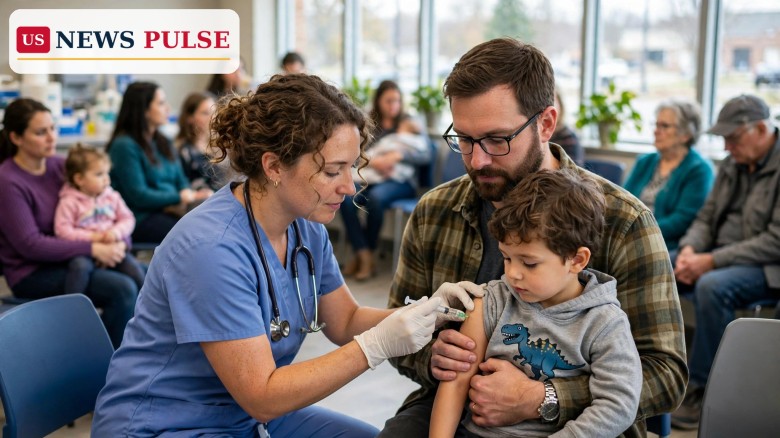
State health officials have responded with pop-up clinics and targeted outreach. A sign outside a Pennsylvania Department of Health measles vaccination clinic in Peach Bottom, Lancaster County, photographed on October 20, became one of the defining images of the outbreak. The demand is now visible in the numbers: providers across Pennsylvania administered more than 39,000 measles vaccines during the first three weeks of October, well above the typical monthly average of about 25,000 doses, the health department said.
Pennsylvania is not alone. New York Governor Kathy Hochul declared a disaster emergency earlier in October after rising measles cases, with more than 160 confirmed cases in New York State as of October 20. Utah has recorded more than 700 measles cases this year, although the state health department said no new diagnoses had been recorded there for three weeks as of October 20. South Carolina dealt with an outbreak earlier in the year that reached at least 997 cases in 2026 before ending in April. Together, the state outbreaks explain why the national total has surged past 4,500 cases.
Pennsylvania Measles Outbreak: Where It Is Worst
Lancaster County, in south-central Pennsylvania, is the epicentre of the state's outbreak. It is home to one of the largest Amish populations in the United States, and it accounts for three of the five deaths the state has attributed to measles this year. Mifflin County, in central Pennsylvania, is the other major hotspot, and it was there that Pennsylvania Secretary of Health Dr Debra Bogen held a roundtable with healthcare providers to assess what frontline clinics need.
The geography matters because measles does not respect county lines. Cases have now been confirmed in 44 of Pennsylvania's 67 counties, and the steady two-day increase of 38 cases suggests transmission is continuing in multiple communities at once rather than in a single contained cluster. Health officials have not published a county-by-county breakdown in the latest update, but the breadth of the spread is why the CDC offered additional investigative support and why neighbouring states are watching their own case counts closely.
The demographic pattern is also unusual for a disease many Americans still think of as a childhood illness. In Pennsylvania, adults make up roughly two-thirds of cases, a shift that reflects gaps in adult immunity as well as childhood vaccination shortfalls. Adults who were never vaccinated, or who received only one dose decades ago, can still catch and spread measles, and they are more likely to be hospitalised when they do.
Reactions and Quotes
Pennsylvania health officials have framed the response as a listening exercise as much as a vaccination campaign. After the Mifflin County roundtable, Dr Bogen said in a statement: "Our state metrics and data tell part of the story of the measles outbreak in Pennsylvania, but listening to the people on the ground caring for people in affected communities like Mifflin County is essential to refining our public health response."
That emphasis on local providers reflects a hard lesson from the outbreak: statewide numbers do not persuade a hesitant family on their own. Clinicians in Lancaster and Mifflin counties have described doing the work case by case — answering questions, arranging transport to clinics, and building trust over repeated visits — while the state supplies vaccines, staffing and public messaging.
At the federal level, the CDC's decision to send additional support signals that Pennsylvania's outbreak is now a national concern, not just a state one. The agency has not publicly detailed the full scope of its assistance, and it has not resolved the discrepancy between its three confirmed measles-linked deaths and Pennsylvania's five reported deaths. Health agencies have previously noted that confirming a measles death requires detailed medical review, which can lag behind a state's initial report, and that the two counts may converge as reviews are completed.
Public health advocates have used the outbreak to renew calls for routine vaccination checks. Because the MMR vaccine cannot be given during pregnancy — it contains a weakened live virus — officials have stressed that the time to close immunity gaps is before pregnancy, and that anyone unsure of their vaccination status should check their records or speak to a clinician rather than assume they are protected.
Why It Matters
The Pennsylvania measles outbreak matters for three reasons. First, it is a test of whether the United States can hold on to its measles elimination status. Elimination is not a trophy on a shelf; it is a status that depends on keeping transmission interrupted. A year with more than 4,500 cases, driven by large state outbreaks, puts that status under real strain and raises the risk that measles becomes endemic again — continuously circulating, year after year, as it does in many countries.
Second, the outbreak is a warning about what happens when vaccination coverage slips in specific communities. Measles needs about 95% population immunity to stop spreading. When coverage falls below that threshold in a close-knit community, a single imported case can ignite hundreds of infections, as Lancaster and Mifflin counties have shown. The same arithmetic applies to schools, workplaces and towns everywhere, which is why officials track kindergarten vaccination rates so closely.
Third, the human cost is already severe and still rising. With 265 hospitalisations and five reported deaths in Pennsylvania alone, the outbreak has caused more serious illness in one state this year than many Americans would have thought possible from a disease declared eliminated a quarter of a century ago. Every hospitalisation is also a strain on local hospitals, which must isolate measles patients to prevent airborne spread to other vulnerable patients.
What Happens Next
The immediate question is whether the 38-case rise between Monday and Wednesday continues, slows, or accelerates. Health officials will watch the next state update closely: a sustained rise would suggest transmission is still outpacing the vaccination surge, while a plateau would be the first sign that the October vaccination push — 39,000 doses in three weeks — is starting to bite.
The CDC's additional support is expected to focus on case investigation and contact tracing, the painstaking work of finding everyone an infectious person may have exposed and checking their immunity. That work is hardest in communities where people are reluctant to engage with authorities, which is why the state's roundtables with local providers matter as much as its clinics.
Neighbouring states will also be watching. New York's disaster emergency remains in force, Utah's three-week pause in new diagnoses could end at any time, and any new importation into a low-coverage community could start the cycle again. For Pennsylvania residents, the practical advice from health officials is unchanged: check your MMR vaccination status, get vaccinated if you are not fully protected, and seek medical advice promptly if you develop fever and a rash after a possible exposure — calling ahead so clinics can take airborne precautions.
Longer term, the outbreak is likely to feed into a national debate about childhood vaccination requirements, school exemption policies and the funding of local public health departments. Those debates will not be settled this week, but the numbers — 1,398 cases, 265 hospitalisations, five deaths — will be cited in every one of them.
Frequently Asked Questions
How many measles cases are there in Pennsylvania? Pennsylvania reported 1,398 measles cases as of Wednesday, October 28, 2026, up 38 from its last update on Monday. Cases have been confirmed in 44 counties.
How many people have been hospitalised or died? The state health department reports 265 measles-related hospitalisations and five measles-related deaths in Pennsylvania this year. The CDC has confirmed three measles-linked deaths nationally, without specifying where they occurred.
How many measles cases are there in the United States? The CDC recorded 4,588 measles cases nationally as of October 22, 2026 — more than double the 2,289 cases recorded in all of 2025. Pennsylvania accounted for 1,327 of the national total at that point.
Where is the Pennsylvania outbreak worst? Lancaster and Mifflin counties are the hardest hit, with Lancaster County accounting for three of the state's five reported deaths. Local Amish communities with low vaccination rates have been most affected.
How effective is the MMR vaccine? Two doses of the MMR vaccine are about 97% effective against measles, according to the CDC, and one dose is about 93% effective. About 96% of people who caught measles in the US in 2026 were unvaccinated or had unknown vaccination status.
Related coverage on US News Pulse: ValuHealth acetaminophen recall: 100,134 bottles pulled over wrong label, US peptides policy lets pharmacies make six unapproved peptides, and Kayem Foods recall: 1.58 million pounds of meat pulled in Class I alert.
© 2026 US News Pulse. All rights reserved.
 Print
 Save