
Wall Street Rally: Nasdaq Jumps 1.18% as Chip Stocks Lift Markets Ahead of Fed
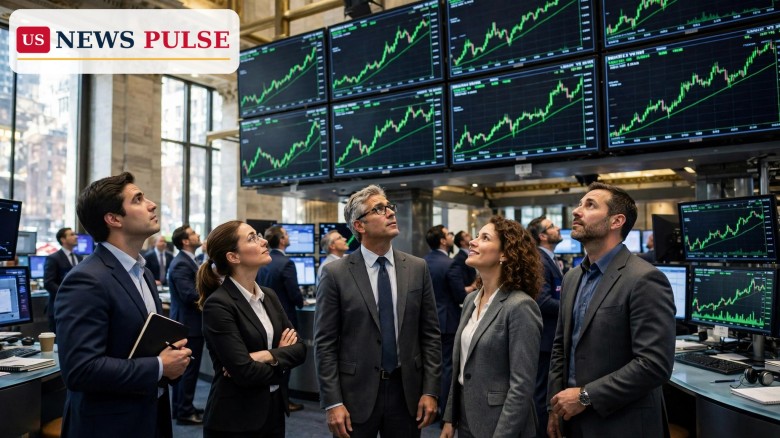
Wall Street rallied on Tuesday, October 27, 2026, as a surge in semiconductor shares lifted the Nasdaq Composite 1.18 percent and carried US stocks to a second straight day of gains, with investors looking past a sharp fall in Boeing and turning their attention to the Federal Reserve's interest-rate decision and a heavy slate of Big Tech earnings. The S&P 500 added 0.60 percent to close at 7,722.60, the Nasdaq jumped 308.43 points to 26,477.81, and the Dow Jones Industrial Average edged up 15.99 points to 52,377.57, while smaller companies joined the advance and oil prices fell back from multimonth highs.
Key Points
- The Nasdaq Composite rose 1.18 percent to 26,477.81 and the S&P 500 gained 0.60 percent to 7,722.60 on Tuesday, October 27, 2026, while the Dow inched up 0.03 percent to 52,377.57.
- Chip stocks led the rally after Broadcom announced 63 billion dollars in bank financing for technology that will be leased to Anthropic, sending Broadcom up 4 percent, AMD up 5.5 percent and Micron up 2.8 percent.
- Oil prices fell nearly 2 dollars a barrel on reports of talks between Iran's top security official and its supreme leader about terms for a settlement, easing one of the market's recent headwinds.
- Boeing plunged about 11 percent to 168.18 dollars, its worst day in months, after warning it will miss its 2026 delivery target and delaying its 737 production ramp to early 2027.
- Attention now turns to Wednesday: the Federal Reserve is widely expected to hold rates at 3.75 to 4.00 percent, and Alphabet and Microsoft report earnings after the closing bell.
What Happened
US stocks closed higher for a second consecutive session on Tuesday, with technology shares doing most of the work. The Nasdaq's 1.18 percent gain was its strongest in days, the S&P 500's 0.60 percent rise extended Monday's advance, and the Russell 2000 index of smaller companies climbed 1.2 percent for a second straight day, a sign that buying was broadening beyond the largest names. Stock index futures were little changed in Tuesday evening trading, suggesting a calm open ahead of Wednesday's news.
The semiconductor sector was the engine of the day. Broadcom rose 4 percent after a consortium of banks led by Bank of America, Citi and Morgan Stanley announced 63 billion dollars in financing to buy Broadcom chips and networking equipment that will then be leased to Anthropic, the artificial intelligence company behind the Claude chatbot. Advanced Micro Devices jumped 5.5 percent, Micron Technology gained 2.8 percent, and Nvidia added 0.91 percent. The strength spread across the AI hardware trade: Astera Labs surged 10.47 percent, CoreWeave rose 7.94 percent, Dell gained 7.47 percent, Tempus AI climbed 7.43 percent and Super Micro added 7.34 percent, while Oracle rose 3.56 percent and Intel 3.6 percent.
Not every giant joined the rally. Meta Platforms fell 1.6 percent, extending Monday's decline, even though its 25 billion dollar share sale drew about five times the available subscription. Boeing was the Dow's biggest drag, plunging 10.69 percent to 168.18 dollars on heavy volume of 46.8 million shares, nearly six times its three-month average, after chief executive Kelly Ortberg said the planemaker will not reach its 737 production rate target of 47 jets a month until early 2027 and will miss its target of delivering 500 jets this year. Tesla, by contrast, rose 4.04 percent, and JetBlue soared 19 percent despite a larger-than-expected quarterly loss, after projecting further margin expansion in the fourth quarter. UPS rose more than 5 percent on better-than-expected quarterly results.
Energy markets gave stocks an additional lift. West Texas Intermediate crude for December delivery fell 1.86 dollars, or 1.83 percent, to 99.90 dollars a barrel, and Brent crude fell 1.93 dollars, or 1.67 percent, to 113.88 dollars, after reports that Iran's top security official, Mohsen Rezaei, had held talks with Supreme Leader Mojtaba Khamenei about Tehran's terms for a settlement of its war with the United States. Crude remained close to multimonth highs because shipping disruptions persist, but the pullback eased pressure on consumers and on companies' fuel costs alike.
Background and Context
Tuesday's rally followed a choppy stretch for markets. Only a day earlier, on Monday, October 26, the S&P 500 had risen 0.70 percent to 7,676.77, the Dow had gained 0.28 percent to 52,361.58 and the Nasdaq had climbed 0.82 percent to 26,169.38, as AI stocks rebounded and oil eased. The two-day advance therefore looks less like a single-day spike and more like a market finding its footing after two weeks in which worries about AI spending had repeatedly knocked technology shares lower.
The AI spending debate is the thread running through the whole week. Anthropic filed for an initial public offering on Monday, October 26, seeking a Nasdaq listing under the ticker ANT, and Meta has launched a 95 billion dollar equity raise, while SpaceX and Broadcom have unveiled tens of billions in AI-related financing. Together, Amazon, Microsoft and Alphabet hold nearly 1.7 trillion dollars in contracted backlog, against planned 2026 spending of up to 600 billion dollars, according to Reuters reporting ahead of this week's results. Hyperscalers as a group were expected to spend more than 750 billion dollars on capital expenditure in 2026, roughly double their 2025 spending. The question investors keep asking is whether that spending turns into revenue fast enough to justify it.
That question reaches its first big test on Wednesday. Alphabet and Microsoft both report third-quarter results after the market closes, with Alphabet expected to post revenue of about 128 billion dollars and Google Cloud revenue of roughly 29.15 to 29.57 billion dollars, up more than 90 percent from a year earlier, after an 82 percent jump in the second quarter to 24.77 billion dollars. Alphabet's full-year capital spending guidance stands at 195 to 205 billion dollars. Amazon reports on Thursday, October 29, along with Apple, according to the earnings calendar previewed earlier this week.
Wall Street Rally: Chip Stocks Lead the Charge
The chip rally mattered because it answered, at least for a day, the worry that had weighed on markets for two weeks: that AI infrastructure spending has run ahead of returns. Broadcom's financing deal is not a vague promise of future demand; it is banks putting up 63 billion dollars against equipment that a named customer, Anthropic, will use. When lenders commit at that scale, it signals that the AI buildout still has willing funders, and chip stocks repriced accordingly.
The breadth of the move reinforced the point. It was not one stock or one subsector: memory, processors, networking, servers and AI application names all rose together, and the Russell 2000's second straight 1.2 percent gain showed smaller companies participating too. Even Boeing's plunge, dramatic as it was, did not derail the wider market, because the Dow's flat finish masked strength elsewhere. In a week dominated by macro and earnings headlines, Tuesday was a day when company-level AI news set the tone.
The oil decline played a supporting role. Falling crude acts as a tax cut for households and businesses, and it arrived alongside reports of possible diplomatic movement on Iran, where a naval blockade and shipping disruptions have kept prices elevated. Traders treated the combination as a modest tailwind rather than a breakthrough, but in a market hunting for reasons to buy, modest tailwinds were enough.
Reactions and Quotes
Sahak Manuelian, managing director for global equities sales and trading at Wedbush Securities, tied the two stories together. "There seems to be more noise around coming up with some kind of solution in the Middle East," Manuelian told Reuters, adding that falling crude is "a tailwind for stocks."
Jed Ellerbrook, portfolio manager at Argent Capital Management, described a market mood shift. "The market goes through these cyclical lulls where it worries about AI spending, and then technology stocks tend to lift us higher again," Ellerbrook said. "The light switch had been off for the past two weeks, but the first two days of this week look like it has been switched back on."
Morgan Stanley strategist Mike Wilson, speaking on CNBC, suggested the recent tech slump may be running its course. "Most of the correction is already over," Wilson said, a view that Tuesday's chip-led advance appeared to support, at least for now.
Boeing's management struck a more cautious note. "We are ramping up aircraft, and we're doing that in the right way," Ortberg said on CNBC, defending a slower production increase after years in which rushing output was blamed for quality problems. The market's verdict was harsh all the same: shares fell to lows not seen since April 2025, and the company now expects free cash flow of only about 3 billion dollars next year and 6 billion dollars in 2028, against Wall Street consensus of 5.6 billion and 9.6 billion dollars respectively, according to LSEG data.
Why It Matters
Tuesday's session matters because it sets the starting point for the two events that will define the rest of the week. The Federal Reserve wraps up its two-day meeting on Wednesday and is widely expected to hold its benchmark rate in a range of 3.75 to 4.00 percent, after raising it by a quarter point in September. CME's FedWatch tool put the odds of no move at roughly 90 to 92 percent, but investors will scrutinise Chairman Kevin Warsh's comments for clues about borrowing costs, with traders pricing in a possible increase in December. Central banks in Europe and Japan are also due to announce decisions in the coming days.
The earnings test is just as consequential. If Alphabet and Microsoft show cloud growth strong enough to justify their spending, the chip rally could extend into a broader technology recovery and support appetite for Anthropic's planned listing and Meta's equity raise. If they disappoint, Tuesday's gains could unwind quickly, as they did during the recent two-week pullback. The market's direction into the final week before the November 3 midterm elections may be decided in a single Wednesday evening.
For ordinary savers, the stakes are less abstract. Pension funds and retirement accounts hold these same index funds and technology shares, and the S&P 500's two-day climb has repaired some of the damage from the recent slide. Oil's retreat, if it lasts, would also feed through to petrol prices and household budgets, though crude remains near multimonth highs and a settlement in the Middle East is far from assured.
What Happens Next
Wednesday brings the week's main events in quick succession. The Federal Reserve announces its decision at 2 p.m. Eastern Time, followed by Chairman Warsh's press conference, and Alphabet and Microsoft report after the closing bell, with Alphabet's call scheduled for 4:30 p.m. Eastern Time. Traders will watch three things above all: whether the Fed signals a December move, whether Google Cloud growth stays near the expected 90 percent-plus pace, and whether either company raises its capital spending guidance again.
Thursday adds the next layer. Amazon and Apple report, third-quarter gross domestic product data and September personal consumption expenditure inflation figures are due, and the European Central Bank and Bank of Japan decisions will show whether the world's other major central banks are moving in step with Washington. Any surprise in that run of data could shift the market's read on rates, and therefore on the technology stocks that led Tuesday's rally.
Boeing's story will also keep running. The planemaker still holds a record backlog of about 745 billion dollars, its defence unit earned nearly 500 million dollars in the quarter, and net debt fell to 25.2 billion dollars from 30.4 billion a year earlier. Whether investors forgive the delayed production ramp will depend on evidence, in the coming quarters, that the slower approach produces jets faster in practice, not just on paper.
Frequently Asked Questions
How much did US stocks rise on Tuesday, October 27, 2026?
The Nasdaq Composite rose 1.18 percent to 26,477.81, the S&P 500 gained 0.60 percent to 7,722.60, and the Dow Jones Industrial Average edged up 0.03 percent to 52,377.57. The Russell 2000 rose 1.2 percent for a second straight session.
Why did chip stocks rally?
Broadcom announced 63 billion dollars in bank financing for chips and networking equipment to be leased to Anthropic, which lifted Broadcom 4 percent and pulled AMD, Micron, Nvidia and other AI hardware names higher with it.
Why did Boeing shares fall so sharply?
Boeing warned it will miss its 2026 delivery target of 500 jets and will not reach a 737 production rate of 47 a month until early 2027, and it cut its free cash flow outlook well below Wall Street expectations. Shares fell about 11 percent to 168.18 dollars.
What is the Federal Reserve expected to do on Wednesday?
Markets widely expect the Fed to hold its benchmark rate at 3.75 to 4.00 percent, with CME's FedWatch tool putting the odds of no move at roughly 90 to 92 percent, while traders price in a possible increase in December.
Which Big Tech companies report earnings this week?
Alphabet and Microsoft report after the close on Wednesday, October 28, and Amazon and Apple are due on Thursday, October 29. Investors are watching cloud growth and capital spending guidance above all.
Related coverage on US News Pulse: Big Tech earnings test: Alphabet, Amazon and Apple face AI spending verdict; Meta 95 billion dollar AI raise leads a 198 billion dollar day of AI spending; Fed rate decision October 2026: why a pause looks likely despite high inflation.
© 2026 US News Pulse. All rights reserved.
 Print
 Save