
Trump Venezuela 51st State: President Floats Idea at Corpus Christi Rally
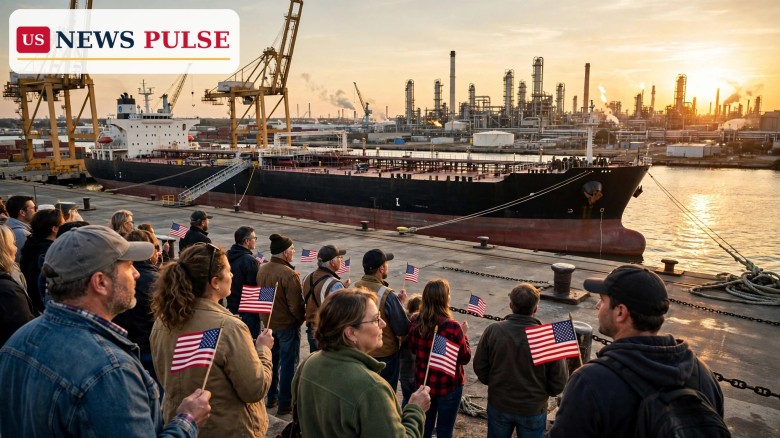
President Donald Trump floated the idea of making Venezuela the 51st state of the United States on Tuesday, telling a rally crowd in Corpus Christi, Texas, that the South American country could one day join the union instead of electing a president. The Trump Venezuela 51st state remark, delivered with a tanker carrying Venezuelan crude as his backdrop, instantly became the most talked-about moment of a Texas campaign swing aimed at saving a Senate seat Republicans once considered safe.
Trump was in Corpus Christi to campaign for Republican Senate nominee Ken Paxton, who faces Democrat James Talarico in a race that polls show as a dead heat one week before the November 3 midterms. He opened his remarks by pointing to a ship in the nearby port, telling supporters it carried one million barrels of oil from Venezuela and describing the cargo as a triumph of his Venezuela policy.
Key Points
- Trump told the Corpus Christi crowd on October 27: “Let’s make it the 51st state,” adding that Venezuela would elect a governor instead of a president.
- His backdrop was a tanker carrying one million barrels of Venezuelan crude, which Trump said was provided at zero cost to the American taxpayer.
- USA TODAY characterised the line as a joke; other outlets reported it as a floated idea. No formal statehood proposal, legislation or timetable was announced.
- The remark came after the United States seized Venezuelan leader Nicolás Maduro in a January military operation and struck an August oil deal giving the Pentagon a stake in a company overseeing Venezuelan reserves.
- Trump then travelled to Lubbock for a second rally the same evening, as the Texas Senate race heads into its final week with control of the Senate at stake.
What Happened
Trump spoke at the Port of Corpus Christi on Tuesday afternoon, his fourth trip to Texas in two months, according to USA TODAY’s live coverage of the day. Facing criticism over high petrol and diesel prices, he opened by pointing to the ship in the distance and telling the crowd it would be refined locally.
“The oil in the ship outside is being provided to the United States at zero cost to the American taxpayer,” Trump said, according to USA TODAY. “The Democrats will attack us. ‘What kind of a deal is that?’”
He tied the shipment to the removal of Maduro, who was seized by the United States military in January to face drug trafficking charges. Trump has repeatedly presented Venezuela’s oil as a prize of that operation, and on Tuesday he went further, turning the energy argument into a territorial one.
“I want to thank Venezuela, where our relationship has become very, very good — a great one,” Trump told supporters, according to reports of the rally. “Billions and billions of dollars now are being invested, many which come from Texas, all over the world, and jobs are happening in Venezuela that nobody even thought possible just one year ago. And we’re bringing out a lot of oil for ourselves. A lot of oil.”
He then added the line that dominated coverage of the rally: “It will become a prosperous country and who knows, maybe one some day soon it will become a prosperous 51st state. Let’s make it the 51st state! And instead of a president, we’ll have an election for a governor. How about that?” The crowd cheered, according to reports from the event.
USA TODAY’s live blog recorded the moment differently, reporting that Trump “joked that Venezuela could become the 51st state, a moniker he has also proposed for Canada and Greenland,” and that he addressed the line to oil industrialist Harold Hamm in the audience. “Let’s make it the 51st state,” USA TODAY quoted Trump as saying. “This historic win gives us control over the massive part, the biggest part of the world’s oil supply.”
The rally was not only about Venezuela. Trump criticised Talarico over guns, meat and oil, telling the crowd: “If you’re running in Texas and if you don’t like guns, and if you don’t like meat and if you don’t like oil, I think you should be losing by a lot.” Talarico has denied Trump’s claim that he is a vegan, joking that he has eaten barbecue for years, and says he supports the Second Amendment while backing measures to keep guns from dangerous criminals, and an “all of the above” energy strategy that includes renewables.
Trump also pledged further federal flood aid for the Texas Hill Country after July and August flooding, despite the Federal Emergency Management Agency having rejected a state request in September, and he brought Alexis Nungaray, the mother of 12-year-old Jocelyn Nungaray, who was killed outside Houston in 2024, onto the stage to speak about her daughter.
Hours later, Trump took the stage in Lubbock at 7:27 p.m. Eastern time, tossing his signature red hats into the crowd as Lee Greenwood’s “God Bless the USA” played. “Hello Texas, I’ve been all over the place all day long,” he said. “There’s one week left. I did more rallies than I’ve ever done for myself.” Talarico held a rival rally in Lubbock the same evening.
Background and Context
The Corpus Christi moment cannot be understood without the year that preceded it. In January, the United States military seized Maduro, Venezuela’s leader, in an operation Trump has described as a victory in a war with Venezuela. Maduro was brought to face drug trafficking charges, and Washington has since exercised operational control over aspects of Venezuela’s oil sector, with interim leader Delcy Rodríguez in place in Caracas.
In August, the Trump administration announced a deal giving the Pentagon a 35 percent stake in North America Blue Energy Partners, a new company overseeing 65 billion barrels of proven Venezuelan oil reserves, according to Al Jazeera’s reporting. The White House said in September that the first shipment under that deal would probably reach United States reserves in November, although experts quoted by Al Jazeera cast doubt on whether the arrangement would have any short-term effect on prices.
Tuesday’s one-million-barrel shipment was presented by Trump as the first fruit of that arrangement and as a “gift” from Venezuela. Al Jazeera cautioned, however, that it was not immediately clear under what pretext the oil had been shipped or whether the details Trump gave were correct, and that Rodríguez had not commented on the specific shipment. The United States had received Venezuelan crude before Maduro’s seizure in January, but those transfers have increased this year, Al Jazeera reported.
The energy pitch lands in a difficult moment for the White House on prices. USA TODAY and Al Jazeera both noted that petrol and diesel prices have been driven higher by the war with Iran, a central issue in the midterm campaign. Trump argued on Tuesday that the United States was steering energy buyers to Texas, Louisiana and Alaska, and that the country itself was profiting even as households felt the squeeze.
“Your country is making an absolute fortune because of the situation in the Middle East,” Trump said in Corpus Christi. “We’re steering them all to Texas. We’re steering them to Louisiana. Alaska is a big beneficiary.” He then mocked critics who say he has forgotten pump prices: “No, your price is going to come down, but your country’s making a fortune, and that’s really good, right?”
The “51st state” label is also not new in Trump’s vocabulary. USA TODAY noted that he has used the same moniker for Canada and Greenland, two places he has also talked about absorbing in different ways. In Venezuela’s case, the line takes that rhetorical habit a step further, because it follows an actual military intervention and an oil deal rather than a trade dispute.
Trump Venezuela 51st State: What He Actually Said
It is worth being precise about what happened in Corpus Christi, because the coverage itself splits on tone. Trump did not read out a statehood plan, name a governor, set a date, or ask Congress for anything. He offered a slogan, in rally language, to a cheering crowd, with a tanker as a prop.
That distinction matters for two reasons. First, admitting a new state is not something a president can do alone: under the United States Constitution, Congress admits new states, and no such legislation has been introduced or debated for Venezuela. Second, the remark was delivered as part of a campaign argument — that Venezuela’s oil is now an American asset — rather than as a diplomatic announcement to Caracas.
At the same time, it would be wrong to dismiss the line as meaningless. Presidents’ rally jokes have a way of becoming policy signals, especially when they repeat a theme. Trump has now linked Venezuela, Canada and Greenland under the same “51st state” label, and in Venezuela’s case he paired the label with a concrete claim of control over “the biggest part of the world’s oil supply.” Supporters heard a promise of dominance; critics heard a threat to another country’s sovereignty. Neither side, in the coverage reviewed for this article, pointed to a formal document behind the words.
What is also missing is any reported response from Caracas to the statehood remark itself. Al Jazeera reported that Rodríguez had not commented on the specific oil shipment. No Venezuelan government statement on the “51st state” line was reported in the coverage reviewed, and the White House had not, in that coverage, issued a clarification treating the remark as either a joke or a policy.
Reactions and Quotes
The immediate reaction in Corpus Christi was enthusiasm. Reports from the rally describe cheers when Trump proposed the “51st state” line and when he described the oil shipment as the greatest oil victory in history. “We are celebrating the greatest oil-related victory in history,” Trump said, according to the Korea Herald’s report. “To the victor go the spoils.”
The press reaction was more divided. USA TODAY’s framing — that Trump “joked” — sits alongside the Korea Herald’s straighter account, which reported that Trump “called for making Venezuela the 51st state” during his fourth visit to Texas in two months. Al Jazeera took a third path, reporting simply that Trump “floated making Venezuela the ‘51st state’” while showcasing the oil shipment.
Talarico’s campaign did not, in the coverage reviewed, issue a direct response to the Venezuela statehood line on Tuesday night. His counter-argument at the dueling Lubbock rally was broader: that Texas voters are being squeezed by prices and by immigration enforcement, and that the Senate race is about who will fight for them in Washington. Trump, for his part, framed the race in opposite terms, telling Lubbock supporters: “So on election night, Texas is going to prove that America does not belong to those who hate it. America belongs to those who love it.”
Paxton, who trails Talarico in most recent polls according to USA TODAY, thanked Trump on stage in Lubbock. “You are making a difference, not just for Texas, but he’s traveling the country,” Paxton said. “I’ve never seen anybody work harder, and I am so appreciative. We are going to win.”
Why It Matters
The remark matters first as midterm messaging. Texas has not elected a Democrat statewide since 1994, yet this Senate race is a dead heat in polling averages, with the Emerson College poll released on October 22 putting Talarico ahead 48 percent to 46 percent, inside the margin of error. Republicans hold the Senate 53-47, so a Democratic win in Texas would transform the battle for control of the chamber and Trump’s ability to confirm nominees and advance his agenda.
Trump’s answer to that danger, on Tuesday, was energy. By standing next to Venezuelan oil and promising lower prices, he tried to turn a foreign intervention into a household argument: the war and the oil deal, he suggested, will eventually pay at the pump. Whether that argument works depends on prices voters actually see in the next seven days, not on the size of a tanker.
It matters second as foreign policy signalling. The United States has moved, in less than a year, from seizing Venezuela’s leader to taking a stake in its oil company to musing aloud about absorbing the country as a state. Even as a joke, that sequence will be read in Caracas, in Latin America and by American allies as a statement about how Washington now thinks about sovereignty and resources. The absence of any Venezuelan response so far leaves that reading open, and open readings tend to harden quickly in an election week.
It matters third because it tests the limits of rally rhetoric. Trump has used the “51st state” line before without consequence, but Venezuela is different: the United States is already deeply involved there, American companies and troops are part of the story, and oil money is at stake. A line that sounds like a punchline in Texas can sound like a plan in Caracas.
What Happens Next
Three things will show whether Tuesday’s remark was a one-night slogan or the start of a theme. The first is whether Trump repeats it. He is campaigning almost daily in the final week, and his Lubbock speech already returned to Venezuela’s oil and to Iran, which he said would end “whenever I want” but must end properly, with a total statement that Iran will never have a nuclear weapon.
The second is whether Caracas or Washington clarifies it. A statement from Rodríguez, from the White House, or from the State Department would settle the joke-versus-policy question that the coverage has left open. Silence, by contrast, would let both supporters and critics keep their own version of the story through Election Day.
The third is the calendar. The House is expected to vote on Wednesday evening on the funding bill to end the 42-day government shutdown, the Federal Reserve announces its interest-rate decision on Wednesday afternoon, and voters go to the polls on November 3. If petrol prices move, or if the Texas race tightens further, expect Venezuela — and the “51st state” line — to come back on the trail.
Frequently Asked Questions
Did Trump formally propose making Venezuela a US state? No. He floated the idea at a campaign rally in Corpus Christi, saying “Let’s make it the 51st state.” No legislation, executive order or timetable was announced, and USA TODAY characterised the line as a joke.
What was the oil tanker behind him? Trump said the ship carried one million barrels of Venezuelan crude for local refineries, which he described as provided at zero cost to the American taxpayer. Al Jazeera cautioned that the pretext and details of the shipment were not immediately clear.
Why was Trump in Corpus Christi? He was campaigning for Republican Senate nominee Ken Paxton against Democrat James Talarico, in a race polls show as a dead heat, with a second rally the same evening in Lubbock.
Has Trump used the “51st state” line before? Yes. USA TODAY noted he has also proposed the moniker for Canada and Greenland. The Venezuela version is notable because it follows a military intervention and an oil deal.
What has Venezuela said about the remark? No Venezuelan government response to the statehood line was reported in the coverage reviewed for this article, and interim leader Delcy Rodríguez had not commented on the specific oil shipment, according to Al Jazeera.
Related coverage on US News Pulse: Trump and Rubio’s Venezuelan oil tanker visit in Port Arthur, Trump’s Texas rallies for Paxton and the Talarico surge, and Trump’s “honest elections” remark before the Texas trip.
Sources: USA TODAY live coverage of the October 27 Texas rallies; Al Jazeera’s report on Trump showcasing Venezuelan oil in Texas; Korea Herald report on the Corpus Christi rally. Quotes are as reported by those outlets.
© 2026 US News Pulse. All rights reserved.
 Print
 Save