
Cowboys Cheerleaders Win Uniform Battle as My Chemical Romance Drops Costumes
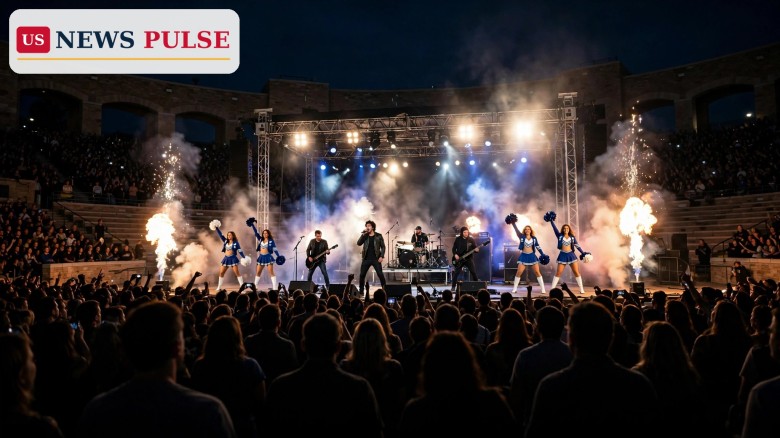
The Dallas Cowboys Cheerleaders have won their uniform battle with My Chemical Romance. The band has agreed to drop the blue-and-white cheerleader-style costumes that sparked a trademark lawsuit at its Hollywood Bowl shows, after the Dallas Cowboys Cheerleaders' owners argued the outfits fooled fans and degraded one of the most recognisable uniforms in American sports.
Key Points
- My Chemical Romance has agreed not to perform its remaining shows on its current tour with dancers in the cheerleader costumes the Dallas Cowboys Cheerleaders object to, according to a legal filing.
- The dispute began at the Hollywood Bowl on October 21, 2026, when dancers in blue-and-white uniforms took part in a staged shootout during the band's theatrical Black Parade show.
- Pro Silver Star Ltd., which owns the Dallas Cowboys Cheerleaders brand, filed for a temporary restraining order and preliminary injunction, claiming trademark infringement, false endorsement and dilution by tarnishment.
- The band's remaining Hollywood Bowl shows are on October 30 and October 31, and the costumes will not appear at either, under the agreement reported on October 26.
- The case revives a 47-year-old legal precedent: the cheerleaders won an injunction in 1979 against the film Debbie Does Dallas over a strikingly similar uniform.
What Happened
My Chemical Romance staged The Black Parade, a theatrical concert set in a fictional dictatorship featuring pyrotechnics and simulated gun battles, at the Hollywood Bowl in Los Angeles on October 21, 2026. During the performance, female dancers dressed in blue-and-white uniforms similar to those of the Dallas Cowboys Cheerleaders appeared on stage carrying rifles, before being gunned down in a staged shootout, according to the complaint filed by celebrity litigator Alex Spiro for Pro Silver Star.
The filing said the costumed performers armed themselves with semi-automatic rifles, joined a staged firefight, and were then depicted being shot and crawling off the stage. It included a side-by-side comparison of an official cheerleader uniform and one worn during the concert, along with social media screenshots of fans who appeared to mistake the performers for real Cowboys cheerleaders. One cited TikTok post had about 21,600 likes and 1,863 shares, and cheerleader Kylie Dickson addressed the performance in a TikTok that was later made private, calling it extremely bizarre and saying it was not the real squad.
Pro Silver Star sent a cease-and-desist letter on October 22. When footage from the October 23 show still showed dancers in the same blue-and-white outfits, the company filed for a temporary restraining order and a preliminary injunction on Friday in Dallas County district court, also naming concert promoter Live Nation and seeking unspecified damages. Then, on October 26, came the concession that ended the fight: an email from David Byrnes stating that My Chemical Romance will not be performing any remaining shows on its current tour with dancers in the cheerleader costumes the cheerleaders object to. The agreement was reached before a court hearing on the restraining order that had been scheduled for Tuesday morning in Texas.
Background and Context
The Dallas Cowboys Cheerleaders uniform is no ordinary costume. White boots, white shorts, a white belt with blue stars, a vest with three blue stars on each side and fringe around the waist have made it one of the most instantly recognised outfits in American popular culture, and one of the most fiercely guarded trademarks in sports. The National Museum of American History keeps a Dallas Cowboys Cheerleader Barbie in its collection, and its catalogue calls the uniform a carefully guarded trademark and cheerleading a decidedly American invention.
That reputation was built in court as much as on the sideline. In November 1978, Manhattan's Pussycat Cinema began showing Debbie Does Dallas, a film whose plot follows a high school cheerleader trying to make a team called the Texas Cowgirls and ends with roughly 12 minutes of her in a uniform strikingly similar to the cheerleaders'. The marquee billed star Bambi Woods as an ex-Dallas Cowgirl Cheerleader, though the court found that to be untrue. The cheerleaders won an injunction, and the 1979 opinion took a detailed inventory of the uniform: white boots, white shorts, white fringe, a star-studded belt, and a vest with three blue stars on each side.
The current dispute is the first time in decades that the uniform has been at the centre of a case this public. My Chemical Romance's Hollywood Bowl engagement is a five-night stand, with the band added to the venue's history as the first act scheduled to play five nights during a single run. The Used is scheduled to support the October 30 performance, while Thrice will open the Halloween show on October 31. The band itself had not publicly commented on the dispute in the coverage reviewed, and was contacted by the press for comment.
Cowboys Cheerleaders My Chemical Romance: The Trademark Fight
At the heart of the case is a deceptively simple question: is it enough that people recognise the uniform, or do they have to believe the Cowboys signed off on the show? Silver Star's filing argues both confusion and something broader. It claims fans believed the real cheerleaders had shown up to cheer on the song Teenagers, right up until the dancers picked up prop rifles, and it also claims trademark dilution, a protection reserved for famous marks that does not require anyone to be confused at all, only that the mark be damaged through an unflattering, unsavoury or low-quality association. A staged gunfight, the filing argues, is exactly that kind of association.
The band's best argument, legal experts say, is artistic. The Black Parade show is a rock opera that draws on American iconography, and the law has drifted toward protecting artists who borrow famous imagery since 1979. A decade after the Debbie Does Dallas case, the same appeals court heard Ginger Rogers' lawsuit over the film Ginger and Fred, and set the Rogers test: a creative work can borrow a famous name or mark unless the borrowing has no artistic relevance, or explicitly misleads people about who made or backed it. In 2023, the Supreme Court clarified in Jack Daniel's v. VIP Products that the Rogers test does not protect someone using another company's look as the brand for their own product, a distinction that leaves a costume in a rock opera arguably closer to Aqua's Barbie Girl, which survived a Mattel lawsuit in 2002, than to a dog toy dressed as a whiskey bottle.
Reactions and Quotes
Silver Star's filing stresses how narrow its demand is. It says the company takes no issue with the band's music, its artistic ambitions, or any message the band seeks to convey, and that it does not ask the band to change its setlist, narrative, politics or choreography, or even its decision to put gun-toting performers on stage. It asks only that those performers not wear the Dallas Cowboys Cheerleaders uniform while doing it, adding that the universe of alternative costume designs is effectively unlimited.
Legal experts are split on how the case would have gone had it reached a verdict. Kirk A. Sigmon, a Washington-area intellectual property attorney, told Consequence that the 1979 ruling probably bodes poorly for the band and that this is going to be a tough case for My Chemical Romance, though he doubts the case ever reaches a verdict, saying chances are high the parties settle for an undisclosed amount with the band promising to stop using the costumes. Alan Heimlich, president of a San Jose intellectual property firm, said it is vital to understand the difference between acknowledging and endorsing, and that he would need to look at how the event was put together and promoted. His colleague Nick Heimlich added that just because someone recognises the cheerleaders does not mean they will believe the squad is endorsing the show.
John Gilbertson, a trademark litigator, took the opposite view, arguing that recognition may be enough, because the more brands engage in high-profile lawsuits, the more the public assumes any use was licensed. That makes even an obvious spoof look like an official partnership, he said, a feedback loop with no obvious brake that means the Cowboys will probably prevail. The filing also points to a line from the stage: as the dancers cheered, it says, Gerard Way told the crowd, Thank you, Dallas.
Why It Matters
The settlement matters beyond one band and one residency because it draws a line, in practice if not in a court judgment, around one of America's most famous uniforms. Trademark law has always balanced two ideas: that famous brands deserve protection, and that artists deserve room to borrow the shared language of popular culture. Every time a case like this settles on the brand owner's terms, the balance tips a little further toward protection, and the next artist thinking about borrowing an iconic look has one more reason to think twice.
It also matters because of how the dispute played out in public. The cheerleaders' case was built substantially from social media: Instagram Reels, an X post tagging the real squad, and TikTok fans who thought they had seen the real thing. In an era when a concert moment can circle the world before the encore ends, the court of public opinion now supplies the evidence for the court of law, and a single viral clip can do what a cease-and-desist letter cannot.
For the cheerleaders themselves, the win protects a brand built over more than five decades of sideline performances, calendars, television specials and a reality show that turned the squad into celebrities in their own right. For My Chemical Romance, the cost is small: the band keeps its show, its setlist, its choreography and its staged firefight, and loses only the costumes. That asymmetry is precisely why Silver Star framed its demand as narrow, and why the band, faced with a restraining-order hearing days before its final two shows, chose to give the costumes up rather than fight for them.
What Happens Next
The immediate test comes on October 30 and 31, when My Chemical Romance plays its final two Hollywood Bowl shows. Fans, and no doubt the cheerleaders' lawyers, will be watching to see what the dancers wear instead. The band could dress them in generic cheerleading outfits without the star-spangled details, or drop the cheerleader element of the staging altogether. Either way, the agreement covers the remaining shows on the current tour, so the costumes should not return at later dates either.
The longer question is whether the settlement holds as the final word, or whether either side says more. No financial terms have been disclosed, and the band has not publicly commented. If the remaining shows pass without incident, the dispute will likely fade into the long list of trademark fights the cheerleaders have won without a trial, from Debbie Does Dallas in 1979 to the Hollywood Bowl in 2026. If the costumes reappear in any form, expect Silver Star's lawyers to move fast: they have already shown they can go from cease-and-desist to court filing in a single day.
Frequently Asked Questions
What did My Chemical Romance agree to?
The band agreed it will not perform any remaining shows on its current tour with dancers in the cheerleader costumes the Dallas Cowboys Cheerleaders object to, according to an October 26 email quoted in a legal filing.
What started the dispute?
At the Hollywood Bowl on October 21, 2026, dancers in blue-and-white uniforms similar to the Dallas Cowboys Cheerleaders' took part in a staged shootout during the band's Black Parade show, carrying prop rifles before being depicted as shot and crawling off stage.
Who sued whom?
Pro Silver Star Ltd., which owns the Dallas Cowboys Cheerleaders brand, sought a temporary restraining order and preliminary injunction against My Chemical Romance and concert promoter Live Nation in Dallas County district court, claiming trademark infringement, false endorsement and dilution by tarnishment.
Are the Hollywood Bowl shows cancelled?
No. The remaining shows on October 30 and 31 go ahead as scheduled, with The Used supporting on October 30 and Thrice opening on October 31. Only the disputed costumes are gone.
Why is the 1979 Debbie Does Dallas case relevant?
The cheerleaders won an injunction in 1979 against the film Debbie Does Dallas, whose star wore a uniform strikingly similar to theirs. Legal experts say that precedent bodes poorly for any act arguing it can freely use the uniform, though modern artistic-expression defences are stronger than they were in 1979.
Related coverage on US News Pulse: Jay-Z to headline Super Bowl LXI halftime show at SoFi Stadium on Feb. 14, 2027 and Cowboys beat Eagles 38-21 as Barkley suffers new injury in Monday night rout.
© 2026 US News Pulse. All rights reserved.
 Print
 Save