
Washington Ballots Held Aside as DOJ Flags 405 Suspected Noncitizen Voters
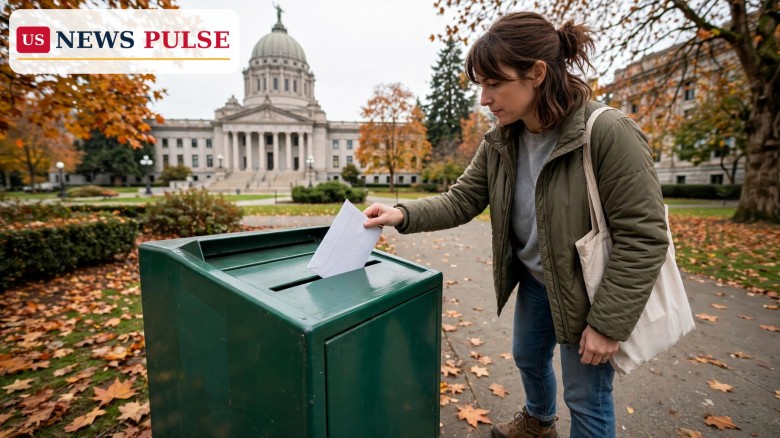
Washington ballots cast by 405 people the Justice Department suspects are not United States citizens must be set aside until their eligibility can be confirmed, federal officials demanded on Monday, October 26, 2026, just seven days before the November 3 midterm elections. The request, sent in a letter to Washington Secretary of State Steve Hobbs, is the latest federal challenge to voting in a state whose races could help decide control of Congress.
The Justice Department says the 405 people together cast about 1,500 votes in earlier elections. It has asked Washington to separate any ballots they cast in next month's election until state officials can verify that each person is legally entitled to vote. Washington has more than five million registered voters, and the state sends a mail ballot to every one of them, so the named group is a tiny fraction of the electorate. But the timing, the method and the politics of the demand have already turned a list of 405 names into a national argument about who gets to vote, who gets to check, and what counts as proof.
Key Points
- The Justice Department asked Washington to set aside ballots from 405 people it says may have registered without United States citizenship.
- Federal officials say those people cast about 1,500 votes in prior elections, with one person's last recorded vote dating back to 1994.
- Acting U.S. Attorney Neil Floyd called the 405 "the tip of the iceberg" and said more names could follow before Election Day.
- Secretary of State Steve Hobbs said he is reviewing the request but criticised its timing, one week before the general election.
- The Washington demand follows similar federal moves in California, where up to 20,000 ballots were at issue, and Alaska, where certification was challenged.
What Happened
On Monday, the Trump administration, acting through the Justice Department, formally asked Washington to hold aside any ballots received from the 405 people named in its letter. The request is not, on its face, a demand that the ballots be thrown out. It is a demand that they be segregated — kept apart, uncounted for now — until citizenship and eligibility can be verified. That distinction matters, because segregation preserves the possibility that a ballot later shown to be lawful could still count, while also preserving the possibility that a ballot later shown to be unlawful will not.
At a news conference at the federal courthouse in Seattle, Acting U.S. Attorney for the Western District of Washington Neil Floyd and First Assistant U.S. Attorney Pete Serrano set out the department's case. Floyd said the identified cases represented only the beginning of a wider pattern. "We are asking the state to set aside those ballots until we can confirm they are legal voters," Floyd said, according to reports of the news conference. He added that, in his view, the 405 voters identified so far represented "the tip of the iceberg."
Floyd also explained how much of the list was built. Much of it, he said, came from "recent contacts" with suspected noncitizens, because federal officers are now routinely checking whether people they interact with are registered to vote. That method immediately raised questions from election officials and voting-rights advocates: a contact with a federal officer is not, by itself, proof of citizenship status, and a registration record is not, by itself, proof that a ballot was cast unlawfully.
The department told Washington it anticipates sending the state an additional list of people it suspects are not citizens before Election Day. It also acknowledged an important caveat: some of the people it suspects registered without citizenship may have since become naturalized citizens, in which case their votes would be lawful. That caveat sits at the heart of the dispute, because a list built from older records can easily include people whose status has changed.
Hobbs said his office was examining the request. His office noted that the material supplied by the department included the most recent election in which each named person voted, and that in one case that election was in 1994 — more than three decades ago. "The timing of this request — one week before the General Election — is no doubt intended to cast unfounded suspicion on the results," Hobbs said. In a separate emailed statement, he added: "We take our responsibility to protect voter information seriously and will only respond to requests that follow due process. We see what's happening in California and don't want Washingtonians to be harassed."
According to Hobbs's office, the Justice Department has sent about 60 subpoenas to the state since last month seeking information about voters. The department has demanded information including addresses, dates of birth, driver's license numbers and partial Social Security numbers. Floyd said that without access to state records, proving that someone voted illegally would be difficult — a frank admission that the federal case, as it stands, depends on records the state has so far limited.
Background and Context
Washington is one of a small number of states that conduct elections almost entirely by mail. Every registered voter receives a ballot, which can be returned by mail or dropped in an official drop box. That system is designed for access: no polling-place queues, no single-day bottleneck, and a paper trail for every vote. It also means that any demand to "set aside" ballots touches a system that is already in motion. Voting is under way, ballots are already being returned, and county election offices are processing them under rules set well before this week.
The Washington request is the third direct state challenge brought by the Justice Department this month while voting is under way. All three states — Washington, California and Alaska — have House or Senate races that will help determine the balance of power in Washington, D.C. In Washington, the race for the 3rd Congressional District is one of the most competitive in the country. Democrats are counting on Representative Maria Gluesenkamp Perez winning re-election as crucial to their strategy of retaking the House majority. She has won twice in a district that has also supported Donald Trump each time he has been on the ballot.
In California, the Justice Department sued as part of an attempt to require the state to set aside mail ballots from up to 20,000 people the federal government suspects may not be citizens. California challenged that demand, and during rare Sunday arguments a panel of federal appellate judges questioned the timing, constitutionality and authority of the department's request. On Monday, the panel declined to rule on the expedited timeline the department had sought and sent the case back to a lower court. The Elections Clause of the U.S. Constitution gives state legislatures the power to set the time, place and manner of congressional elections, a point that has featured heavily in the California litigation.
In Alaska, a lawsuit filed last week seeks to delay certification of the vote if the Republican incumbent does not win. Taken together, the three moves form a pattern that critics describe as an effort to sow doubt about the election or its outcome in competitive states, and that supporters describe as a long-overdue effort to enforce citizenship requirements that have been neglected.
The broader factual background is less dramatic than the rhetoric on either side. Noncitizen voting is exceptionally rare, according to election researchers and to the Justice Department's own record in earlier cases. Federal law already makes it a crime for a noncitizen to vote in a federal election, and states already have processes for removing ineligible voters from the rolls. The question in Washington is therefore not whether noncitizen voting is illegal — it is — but whether this particular list, built in this particular way, at this particular moment, reliably identifies people who voted unlawfully.
Earlier allegations offer a cautionary record. In Nevada, the Trump administration alleged there were 1,500 potential noncitizen voters on the rolls, but a subsequent investigation found zero. In Maricopa County, Arizona, which includes Phoenix, the county recorder, a Trump supporter, announced that there were 207 possible noncitizens on the county's rolls. The Republican county attorney determined there were actually eight. In Los Angeles County, Assistant Registrar-Recorder Monica Flores said in a court filing that her staff went through a sample of 200 records from the administration's California list. They found the sample included canceled or inactive registrations, people with no voting history, and voters who appeared to have been born in the United States.
Washington officials have also pointed to a different kind of disenfranchisement. They have noted that changes in U.S. Postal Service operations have disenfranchised thousands of legitimate voters, whose ballots were rejected for reasons such as late postmarks. That context does not answer the citizenship question, but it does underline why election officials are wary of any last-minute change to how ballots are handled: in a mail-ballot state, small procedural shifts can affect large numbers of lawful voters.
Washington Ballots and the Election-Integrity Fight
The Washington ballots dispute is best understood as two arguments running in parallel. The first is legal and administrative: can the federal government, a week before an election, require a state to segregate a defined set of ballots, and on what evidence? The second is political and perceptual: what does it do to public confidence when a federal prosecutor holds a news conference, a week before voting ends, and describes a list of 405 names as the tip of an iceberg?
Supporters of the federal action say the answer to the first question is straightforward. Citizenship is a basic qualification for voting in federal elections. If the Justice Department has identified people who appear to have registered without citizenship and to have voted, the state should not count their ballots until eligibility is confirmed. From that perspective, segregation is a modest, reversible precaution, not a purge. It does not remove anyone from the rolls permanently, and it does not decide the election. It simply pauses counting for a small, defined group while checks are carried out.
Critics say the second question is the one that matters most. A week before an election, they argue, voters are already casting ballots, campaigns are already making their closing arguments, and any suggestion that the rolls are full of unlawful voters — even if the number named is 405 out of more than five million — can shape how the result is received. Hobbs's charge that the timing is "no doubt intended to cast unfounded suspicion on the results" captures that concern in its sharpest form. The department's own acknowledgment that some named people may since have become citizens, and that a further list may arrive before Election Day, only deepens it: the list is, by the department's own account, provisional.
There is also a practical problem that neither side has fully solved. Verifying citizenship is not a matter of glancing at a single database. Citizenship records, naturalization records, state voter rolls and federal immigration records do not always agree, and they do not always update at the same speed. A person who registered years ago, became a citizen since, and voted lawfully in the most recent election could appear on an older list as a suspected noncitizen. A person who never became a citizen but was wrongly registered could appear on the same list for the opposite reason. Sorting one from the other takes time, documents and due process — all of which are in short supply seven days before an election.
The same day as the Washington announcement, President Donald Trump announced a $1 million reward for tips leading to an arrest and conviction for voter fraud, a move already covered in detail by US News Pulse. Supporters presented it as an incentive for whistleblowers. Critics presented it as another signal that the administration intends to contest the legitimacy of the result if it dislikes the outcome. Either way, it ensured that the Washington ballots story did not arrive in isolation. It arrived as part of a week in which voting, fraud and confidence in the result have dominated the political conversation.
Reactions and Quotes
"We are asking the state to set aside those ballots until we can confirm they are legal voters," Acting U.S. Attorney Neil Floyd said at the Seattle news conference, setting out the department's position in its simplest form.
"Because of limitations the state has placed on our investigation, we've only been able to uncover a fraction of the total number," Floyd added, explaining why he believes the 405 names are only the start. "The 405 voters identified so far represented 'the tip of the iceberg,'" he said, in the phrase that has since defined coverage of the announcement.
"The timing of this request — one week before the General Election — is no doubt intended to cast unfounded suspicion on the results," Washington Secretary of State Steve Hobbs said, in the state's sharpest response to the demand.
"We take our responsibility to protect voter information seriously and will only respond to requests that follow due process," Hobbs said in an emailed statement. "We see what's happening in California and don't want Washingtonians to be harassed."
No response from the White House to the Washington-specific demand was reported in the coverage reviewed for this article, beyond the administration's broader election-integrity statements. No court has yet ruled on whether Washington must comply with the segregation request, and no county in Washington had, at the time of writing, publicly announced that it had segregated ballots under the federal demand.
Why It Matters
The Washington case matters for three reasons that go beyond the 405 names. First, it tests the boundary between federal enforcement and state-run elections. The Constitution gives states the primary role in running congressional elections, but federal law sets citizenship qualifications and criminal penalties. When those two principles collide a week before voting ends, the courts — not press conferences — will have to draw the line. The California litigation, already under way, is likely to shape how judges approach the Washington request if it is challenged.
Second, it matters because of scale and perception. Four hundred and five voters out of more than five million is less than one-hundredth of one percent of the electorate. Even if every one of the 1,500 prior votes attributed to those people were unlawful, that number would not, on its own, decide a statewide race, let alone control of Congress. But elections are not only decided by votes; they are also accepted or rejected by losers and their supporters. A high-profile federal intervention in a competitive state, days before the count, can affect acceptance even when it cannot affect arithmetic.
Third, it matters because Washington's 3rd District is genuinely competitive, and because the House majority may hinge on a handful of seats. Gluesenkamp Perez's district has twice returned a Democrat while also backing Trump, a combination that makes it a bellwether for the national mood. Any dispute over ballots in that district, however small the number, will be read nationally as a dispute over the House itself. That is why a state-level administrative request has become a national story.
For voters in Washington, the practical message is narrower and more reassuring than the national argument suggests. The vast majority of ballots — those cast by citizens who are properly registered — are unaffected by the federal request. Voters who are citizens and who have received a mail ballot should return it as normal, by the state's deadline, and should not assume that a federal list they have not seen applies to them. Voters who have recently naturalized, or whose registration details have changed, should check their registration status with their county elections office if they have any doubt.
What Happens Next
The immediate question is whether Hobbs and Washington's county election officials will comply with the segregation request, challenge it, or seek a middle course — for example, by flagging the named ballots for later review without pausing the wider count. Hobbs said he is reviewing the request, which suggests no final decision had been made at the time of the announcement. County officials, who actually process ballots, will need clear guidance quickly, because ballots are already arriving.
The Justice Department has said it expects to send an additional list before Election Day. If that list arrives, it will test the state's review process a second time, and closer to the deadline. Any second list is likely to face the same questions as the first: how was it built, how current is it, and how many named people have since become citizens?
In California, the next step is a lower-court hearing after the appellate panel declined to fast-track the department's timeline. That hearing, scheduled for Tuesday, could produce a ruling that influences how other states, including Washington, handle similar demands. In Alaska, the certification challenge will also be watched closely, because it goes further than segregation: it asks a court to delay certifying a result.
After November 3, the focus will shift from segregation to verification. If Washington does set ballots aside, the state will need to determine, person by person, whether each named voter was a citizen at the time they voted. That process could take weeks, and its outcome — how many of the 405 were in fact citizens, how many were not, and how many had since naturalized — will be the real test of the federal claim. Until then, the Washington ballots story remains what it is today: a federal demand, a state objection, and a list whose accuracy has yet to be proved in court.
Frequently Asked Questions
What did the Justice Department ask Washington to do?
It asked the state to set aside, or segregate, any ballots cast in the November 3 midterm election by 405 people it suspects registered without United States citizenship, until their eligibility can be confirmed.
How many votes are involved?
The department says the 405 people cast about 1,500 votes in prior elections. Washington has more than five million registered voters, so the named group is a very small share of the electorate.
Has Washington agreed to the request?
Not at the time of writing. Secretary of State Steve Hobbs said his office is reviewing the request and criticised its timing, one week before the general election.
Could some of the 405 people actually be citizens now?
Yes. The Justice Department itself noted that some people it suspects registered without citizenship may have since become naturalized citizens, which would make their votes lawful.
Is this the same as the California case?
It is similar but smaller. In California, the department sought to set aside mail ballots from up to 20,000 people. A federal appeals panel questioned that demand and sent the case back to a lower court. The Washington demand involves 405 people.
Related coverage on US News Pulse: Trump's $1 million voter-fraud reward, the NPR/Marist poll giving Democrats an eight-point lead and the Justice Department's charges against 48 noncitizens accused of illegal voting.
© 2026 US News Pulse. All rights reserved.
 Print
 Save