
G20 Atlanta Meeting Opens as Rubio Hosts Divided Ministers on Iran and Ukraine
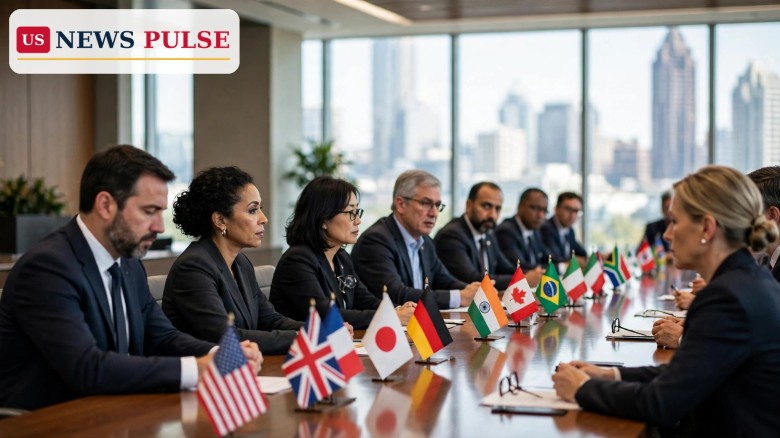
The G20 Atlanta meeting opens in Georgia on Friday, October 30, 2026, with US Secretary of State Marco Rubio hosting foreign ministers from the world's largest economies at a moment when the group can barely agree on what it is for. The two-day gathering in Atlanta, which runs through Saturday, is meant to set the agenda for the G20 leaders' summit in Miami in December, but diplomats arriving in Georgia are already warning that no joint declaration should be expected.
Instead, the fractures on display in Atlanta tell the story of the summit itself: Russia's foreign minister is at the table while South Africa has been left out, China has sent a deputy rather than its top diplomat, and the wars in Ukraine and Iran, together with soaring energy prices, are pulling every discussion about economics back into geopolitics. With the US midterm elections just four days away, on Tuesday, November 3, the meeting is also being watched at home for what it says about fuel prices and President Donald Trump's foreign policy.
Key Points
- US Secretary of State Marco Rubio hosts G20 foreign ministers in Atlanta on October 30-31, 2026, the final ministerial gathering under the US G20 presidency.
- Russia's Sergey Lavrov is attending despite Western sanctions, while China's Wang Yi is absent and has sent a deputy, and South Africa was not invited.
- No joint declaration is expected; the United States is expected to issue a chair's summary instead, reflecting deep divisions over Ukraine and Iran.
- Washington's stated priorities are energy security, supply chains and freedom of navigation through waterways including the Strait of Hormuz.
- The meeting sets the stage for the G20 leaders' summit on December 14-15 at President Donald Trump's Doral resort in Miami.
What Happened
Rubio opened the ministerial meeting in Atlanta on Friday morning, chairing sessions that the State Department said would focus on the group's core economic mission: growth, supply chains and economic security, and the effect of geopolitical crises on global prosperity. The department said the talks would give ministers a chance to discuss energy and supply chain challenges and to find ways of collectively addressing the impact of geopolitical tensions on economic security.
"Conversations in Atlanta will provide an opportunity to discuss energy and supply chain challenges as well as identify ways to collectively address the impact of geopolitical tensions on economic security," a State Department official said. The official added that the United States wanted a "shared resolve to confront urgent crises and keep critical sea lanes open to commerce without threats or tolls," and stressed that energy access matters for everything from household bills to the artificial intelligence boom. "Energy is foundational for economic growth around the world. Shared economic prosperity is tied to energy access, but it is also important that access is affordable and abundant," the official said.
Lavrov had already reached Atlanta before the meeting began, according to Russian state media, and Moscow said he would use his speech to argue against international sanctions and to promote what Foreign Ministry spokeswoman Maria Zakharova called Russian ideas "aimed at strengthening the foundations of a multipolar world." Lavrov, who remains under sanctions over Russia's war in Ukraine, has travelled only rarely to NATO member states since the full-scale invasion began in February 2022, which made his presence in Georgia a story in itself.
India's External Affairs Minister S. Jaishankar arrived in Atlanta late on Thursday evening and was due to take part in the two days of talks, beginning with Rubio's address on geopolitical issues and followed by a session on energy and economic growth. Jaishankar was also expected to join a meeting of the Quad foreign ministers - the United States, India, Japan and Australia - on the sidelines of the gathering, before travelling on to Antigua and Barbuda for the Commonwealth Heads of Government Meeting scheduled for November 1-4.
Several European foreign ministers were also in Atlanta, including Germany's Johann Wadephul, France's Jean-Noël Barrot, Poland's Radosław Sikorski and Turkey's Hakan Fidan, according to the State Department's delegation list. Saudi Foreign Minister Prince Faisal bin Farhan was attending, and Brazil's foreign minister was also present. The United Arab Emirates was not expected to attend in Atlanta, but is an invited guest at the Miami leaders' meeting in December.
Background: Why Atlanta Matters
The G20 brings together the world's largest economies, and its foreign ministers' meeting is normally a staging post for the leaders' summit that follows. This year that staging post carries unusual weight because the United States holds the rotating presidency and Trump will host the leaders himself in December at Trump National Doral in Miami. After Miami, Washington hands the presidency to Britain.
But the forum's ability to produce consensus has been fading for years, and Atlanta is the clearest illustration yet. One diplomatic source put it bluntly: "The G20 is no longer really a forum where foreign ministers can reach agreement on a statement." The same source said the US presidency intended the Miami summit to serve "more as a demonstration of American power - and of US commitments to growth, deregulation, trade and business - rather than as a summit with grand ambitions on substantive issues."
The backdrop is a world economy being shaken by war. Global energy prices have rocketed since US-Israeli strikes on Iran from late February triggered Tehran's blockage of the Strait of Hormuz, the narrow waterway through which a large share of the world's traded oil and gas passes. The United States has since warned allies to brace for the possibility of renewed strikes against Iran after Tuesday's midterm elections, and Israel has threatened to strike Iran as well. Meanwhile Russia's war in Ukraine, now in its fifth year, continues to divide the group, and China's economic policies and its actions in the South China Sea add further friction.
Washington's own choices have sharpened the tensions. The Trump administration uninvited South Africa amid disputes over Pretoria's domestic and foreign policies, including its legal action against Israel, while inviting Russia but not Ukraine. Trump has also invited Russian President Vladimir Putin to Miami in December, although Putin has not yet said whether he will attend. Earlier this month Trump issued sanctions waivers allowing Russia to export diesel, a move the administration presented as a way to tame high fuel prices ahead of the midterms but which critics said could funnel fresh revenue into Moscow's war machine or deepen its ties with Iran.
It is not the first time a sanctioned Russian official has attended a US-hosted G20 event this year: Finance Minister Anton Siluanov, who has also been hit with sanctions, attended a G20 meeting in North Carolina in September and held sideline talks with Treasury Secretary Scott Bessent. The diplomatic source stressed that Russia's G20 presence "in no way legitimises its actions."
G20 Atlanta Meeting: The Divisions on the Table
The sharpest divide in Atlanta is over Ukraine. European ministers arrived determined to keep support for Kyiv at the centre of the conversation. The European Union's foreign policy chief, Kaja Kallas, said on Thursday that she would urge partners at the G20 to strengthen support for Ukraine and to pursue accountability through a "Special Tribunal and Claims Commission." "Russia must be accountable," she wrote on X, referring to a Russian attack at a crowded Ukrainian train station that killed at least 14 people.
Lavrov's planned argument against sanctions is expected to frustrate those European ministers, according to Alisha Chhangani of the Atlantic Council, a Washington think tank. Chhangani described Atlanta as "the last test case the G20 has, at least under the US G20 presidency, until Miami," and said its outcomes would shape how the December summit takes form. She expects Washington to argue that security shocks are also economic shocks, and to push for agreement on what "freedom of navigation" means within and beyond Hormuz - a push that could face objections from China, which dissented against wording on free navigation in Hormuz and worldwide at an earlier gathering of finance ministers.
US officials say their top priority in Atlanta is resolving differences over freedom of navigation, particularly in the Strait of Hormuz, the Red Sea, the Black Sea and the South China Sea. That agenda links the Iran conflict, the Ukraine war and China in a single discussion, and it is where the economic and security arguments collide most directly.
Turkey was expected to urge Washington and Tehran to resolve their dispute through dialogue and diplomacy, warning that continued hostilities are worsening regional vulnerabilities, according to Turkish Foreign Ministry sources. Fidan was also expected to highlight the impact of attacks on ships and energy infrastructure in the Gulf. France, meanwhile, planned to press for greater cooperation on maritime security, including in Hormuz and Bab al-Mandeb, and to argue for energy diversification and a transition away from fossil fuels as a way to reduce countries' vulnerability to supply disruptions - a message likely to land with a thud for a Trump administration that wants to increase drilling.
Russia's delegation also complained of problems securing visas for its members that were only resolved at the last minute, a detail that underlined how fraught even the logistics of Lavrov's visit had become. Fresh negotiations between Moscow, Kyiv and Washington are expected in November, and every bilateral encounter on the Atlanta sidelines - above all Rubio's meeting with Lavrov - will be read as a signal of where those talks might go.
Reactions and Quotes
"This is the last test case the G20 has, at least under the US G20 presidency, until Miami," said Alisha Chhangani of the Atlantic Council, adding that Washington would likely seek agreement on freedom of navigation in and beyond the Strait of Hormuz.
"The G20 is no longer really a forum where foreign ministers can reach agreement on a statement," a diplomatic source said, adding that the Miami summit was intended "more as a demonstration of American power" than as a meeting with grand substantive ambitions.
"Russia must be accountable," EU foreign policy chief Kaja Kallas said on X, pledging to urge partners to strengthen support for Ukraine and to back a Special Tribunal and Claims Commission.
"The better measure is whether new partnerships and potentially new mechanisms are emerging to take these discussions forward," said Elaine Dezenski, senior director and head of the Centre on Economic and Financial Power at the Foundation for Defense of Democracies, offering a more practical yardstick for a meeting unlikely to produce a declaration.
"Under President Trump's leadership, the United States is returning the G20 to its core economic mission of driving growth, strengthening economic security, and delivering results for the American people," the State Department said in a statement ahead of the meeting.
Why It Matters
Atlanta matters for American voters as much as for diplomats. Fuel prices are a key campaign issue four days before the midterms, and the administration's handling of energy - from the diesel waivers for Russia to its push for more drilling - is now being debated in the same breath as its handling of Iran and Ukraine. If the G20 cannot agree even on language about keeping sea lanes open, the risk is not just an embarrassing summit: it is higher shipping costs, more volatile energy markets and fewer tools for coordinating a response if the Hormuz disruption worsens or fighting escalates.
It also matters for the December summit. A chair's summary that papers over divisions would leave Trump hosting a leaders' meeting in Miami with no agreed text to build on, and with Putin's attendance still undecided. A meeting that produces even modest practical partnerships - on energy, supply chains or maritime security - would give Miami something concrete. That is why analysts like Dezenski are watching for mechanisms rather than communiqués.
For Ukraine, the stakes are about attention. With Washington focused on Iran and on fuel prices at home, Kyiv's European backers are using Atlanta to insist that the war is not a side issue. For Iran, the stakes are about timing: with US officials warning allies of possible post-election strikes, anything said in Atlanta about de-escalation - or the absence of it - will be parsed in Tehran, Riyadh and Jerusalem alike.
What Happens Next
The ministers meet again on Saturday, October 31, before the United States publishes its chair's summary of the discussions. French diplomatic sources have already said no joint declaration is expected, so the wording of that summary - and how far it captures the differing positions of participants - will be the first real test of the meeting.
Attention then turns to three dates: Tuesday, November 3, when Americans vote in the midterms; November, when fresh Moscow-Kyiv-Washington negotiations are expected; and December 14-15, when Trump hosts the G20 leaders in Miami. Whether Putin accepts the invitation, whether the diesel waivers calm fuel prices, and whether the Iran confrontation escalates after the elections will decide whether Atlanta is remembered as a holding operation or as the moment the G20's divisions became impossible to paper over.
Frequently Asked Questions
What is the G20 Atlanta meeting?
It is the G20 foreign ministers' meeting hosted by US Secretary of State Marco Rubio in Atlanta, Georgia, on October 30-31, 2026, the final ministerial gathering under the US G20 presidency before the leaders' summit in Miami.
Why is Sergey Lavrov's attendance controversial?
Lavrov remains under sanctions over Russia's war in Ukraine and has rarely travelled to NATO states since 2022. His presence frustrates European ministers, especially as he plans to argue against sanctions, while South Africa was not invited at all.
Will the Atlanta meeting produce a joint declaration?
Almost certainly not. Diplomats expect the United States to publish a chair's summary instead, because divisions over Ukraine, Iran and energy make consensus on a declaration unlikely.
How does the Iran conflict affect the G20 talks?
US-Israeli strikes on Iran from late February triggered Tehran's blockage of the Strait of Hormuz, sending global energy prices soaring. Freedom of navigation through Hormuz and other waterways is now the top US priority in Atlanta.
When is the G20 leaders' summit?
President Donald Trump hosts the G20 leaders' summit on December 14-15, 2026, at Trump National Doral in Miami. Vladimir Putin has been invited but has not yet said whether he will attend.
Related coverage on US News Pulse: US Iran strike plans: forces ready within 96 hours of Trump order, reports say, US-India trade deal nears finish as White House calls talks productive, and Vance letter to Iran: Trump denies peace talks, says it was medical aid.
© 2026 US News Pulse. All rights reserved.
 Print
 Save