
Spain Train Crash Kills 68 as High-Speed Trains Collide Near Toledo
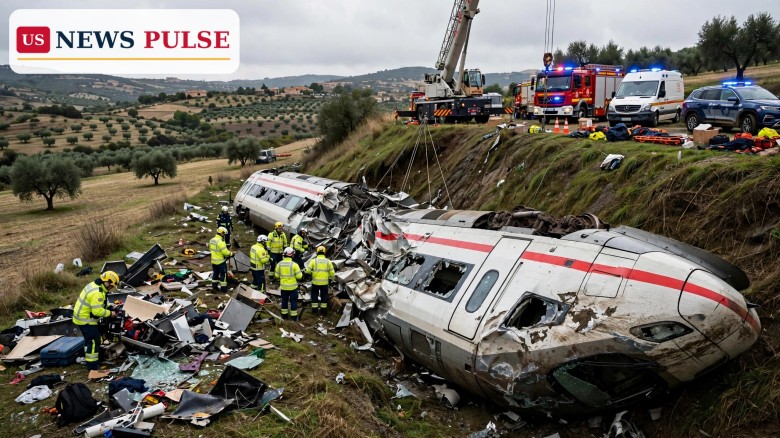
A Spain train crash killed 68 people and injured more than 100 others on Wednesday, October 28, 2026, when a high-speed Renfe train ran into the back of a stationary Iryo train between Urda and Los Yébenes in Toledo province, about 150 kilometres south of Madrid. It is one of Europe’s deadliest rail disasters this century, and the second fatal high-speed collision in Spain in less than a year.
Regional authorities said the death toll rose from 64 to 68 as rescue teams worked through the wreckage, and warned that it could rise further as carriages are lifted and searched. More than 100 people were injured, 15 of them critically, and 58 were taken to hospital, according to the Castilla-La Mancha regional government.
Key Points
- A Renfe AVE train collided with a stationary Iryo train near Urda, south of Madrid, on the morning of October 28, 2026.
- At least 68 people were killed and more than 100 injured, with 15 in a critical condition.
- The Renfe train carried 397 passengers and the Iryo train 147 passengers, according to reports citing the Associated Press.
- Transport Minister Óscar Puente blamed a control-centre decision to restart traffic after a safety-system failure, calling the circumstances “inexplicable”.
- Spain declared three days of national mourning, and campaigning for the November 29 general election was suspended.
What Happened
The collision happened shortly before 9 a.m. local time on the Madrid–Andalusia high-speed line. The Renfe service had left Madrid-Puerta de Atocha at 8 a.m. bound for Seville, where it was due at 10:39 a.m. The Iryo service was also travelling towards Seville, to Santa Justa station, and was stopped on the track when the Renfe train struck it from behind.
Photographs from the scene showed one train embedded into another, with carriages lying on their sides at the bottom of an embankment strewn with debris. Emergency vehicles worked through the night, using drones, floodlights and cranes to hoist mangled metal and search for further victims in the cold. Renfe confirmed that the main high-speed line from Madrid to southern Spain was suspended after the accident.
Survivors described a sudden, violent impact. Pablo Mejía, 42, said he survived with head injuries after changing his seat, telling reporters there was “a very strong hit. It lasted a long time until it stopped, lots of people on the floor, on top of each other, seats ripped out, suitcases, a lot of chaos.” Manuel Ortiz, 49, who lives in the nearby village of Urda, said he spent the morning driving survivors in his car and described a “horrific, horrible” scene that “smelled of an accident, of metal”.
Castilla-La Mancha leader Emiliano García-Page told reporters at the scene that 68 people had died, raising an earlier figure of 64. “We don’t know if another body might appear when the carriages are moved,” he added. The Civil Guard said DNA samples from relatives would be needed to identify some of the victims, a sign of how severe the damage to the trains was.
Background/Context
Spain’s high-speed network is the second largest in the world after China’s, and a source of national pride after years of heavy investment. Almost 26 million passengers used the network between January and August 2026, according to official statistics cited in reporting on the crash. The Madrid–Seville corridor, where the collision happened, is one of the country’s busiest routes.
The Urda disaster is the second deadly high-speed collision in Spain this year. In January 2026, a crash outside the southern village of Adamuz left 46 people dead and raised major questions about railway safety. Before that, Spain’s deadliest train accident in recent decades was at Santiago de Compostela in 2013, when 80 people died after a train came off a curved section of track. The Urda toll of 68 therefore sits between those two tragedies, and makes October 28 one of the worst days in the history of Spanish rail.
The crash also landed in the middle of a general election campaign. Prime Minister Pedro Sánchez, whose Socialist government faced heavy criticism after the January disaster, is seeking to overturn unfavourable polls and extend his eight-year premiership in an early general election on November 29. Both his Socialists and the main opposition conservative Popular Party suspended campaigning after the crash.
Spain Train Crash: What the Minister Said Went Wrong
Transport Minister Óscar Puente gave the first official reconstruction of events on Wednesday afternoon. He said that at about 8:30 a.m., a failure in the LZB safety system — the continuous monitoring system that controls train speed and spacing and orders braking when safety conditions require it — brought at least six trains to a halt over a stretch of about 60 to 69 kilometres of track.
According to Puente, all services on that stretch were halted, and an alternative signalling arrangement was in use, when the control centre decided to restart traffic even though the safety system had not been restored. “The decision to resume traffic, while that system had not been restored, belongs to the control centre,” he said, adding that traffic was restarted “in circumstances that, from our point of view, are inexplicable”.
Puente said the Renfe train then travelled 25 kilometres before colliding with the stationary Iryo service, at a speed that could have reached up to 200 kilometres per hour. “The control centre had more than enough time to verify the error, and they did not fix it,” he said. He stressed that the precise cause had not been confirmed by Adif, the rail infrastructure manager, and that investigators were examining the tracks and documenting evidence at the scene. Reports said the operator identified by the minister and all members of the control-centre shift were questioned by the Civil Guard, with the early investigation focused on how train movements were managed after the system failure.
Reactions/Quotes
Prime Minister Pedro Sánchez announced three days of national mourning from Thursday, saying: “Today all of Spain is grieving.” He conceded it was “not acceptable” that two high-speed collisions could happen within months, and vowed to investigate whether negligence contributed to the crash.
The leader of the main opposition conservative Popular Party, Alberto Núñez Feijóo, who leads in most polls, also suspended campaigning but said: “Spain has the right to know what is going on with its infrastructure.” Condolences flooded in from across Spain and Europe. The Spanish royal household said on X that it was “shocked and concerned”, conveying its support to the victims, their loved ones and the emergency services.
For families waiting at stations and hospitals, the official statements offered little comfort. With some victims still unidentified and the death toll not yet final, regional officials urged relatives to come forward and to follow guidance from emergency services rather than travelling to the closed crash site.
Why It Matters
The central question is no longer whether Spain’s high-speed network is large or modern — it plainly is — but whether its safety systems and human controls are reliable when something goes wrong. A safety system failed, trains stopped as designed, and then, according to the transport minister, a human decision restarted traffic before the system was restored. If investigators confirm that sequence, the Urda crash will be remembered less as a freak accident and more as a failure of procedure at the moment the system was most vulnerable.
The timing compounds the political damage. Two fatal high-speed collisions in one year, weeks before a general election, will put rail safety, infrastructure spending and ministerial accountability at the centre of the campaign once mourning ends. It also matters beyond Spain: high-speed operators across Europe and the United States watch each other’s safety cases closely, and a confirmed control-room error on a flagship line will prompt uncomfortable questions everywhere.
What Happens Next
Investigators will reconstruct the signalling failure, the control-centre decisions and the speed of the Renfe train from data recorders, control-room logs and track evidence. Adif and Renfe will face questions about why traffic resumed, who authorised it, and what safeguards should have prevented a train from entering an occupied section at speed. The Civil Guard questioning of control-centre staff is only the first step; a fuller judicial and technical inquiry is expected.
On the railway itself, services on the Madrid–Andalusia line were suspended after the crash, and travellers were helped to reach stations while trains remained halted. A phased reopening will depend on the investigation and on repairs to the track and signalling. Politically, campaigning is expected to resume after the mourning period, but rail safety is now likely to dominate the final month before the November 29 vote.
Frequently Asked Questions
How many people died in the Spain train crash? Regional authorities said 68 people had died, up from an earlier figure of 64, and warned the toll could rise further as carriages are moved and searched.
Where did the crash happen? Between Urda and Los Yébenes in Toledo province, about 150 kilometres south of Madrid, on the Madrid–Andalusia high-speed line.
What caused the collision? Transport Minister Óscar Puente said a failure in the LZB safety system halted trains, and the control centre then restarted traffic before the system was restored. The precise cause has not yet been confirmed by Adif, and an investigation is under way.
How many people were on the trains? Reports citing the Associated Press put 397 passengers on the Renfe train and 147 on the Iryo train.
Is this Spain’s worst train crash? No. It is Spain’s deadliest since the 2013 Santiago de Compostela crash, which killed 80 people, and the second fatal high-speed collision in Spain in 2026 after the January Adamuz crash, which killed 46.
Related coverage on US News Pulse: Israel election final results: Netanyahu bloc wins 53 seats, short of majority, US warns allies to brace for post-election Iran strikes, and Iran attack options briefed to Trump by top admiral.
© 2026 US News Pulse. All rights reserved.
 Print
 Save