
North Korea Missiles Fired Toward East Sea Today as Border Tensions Surge
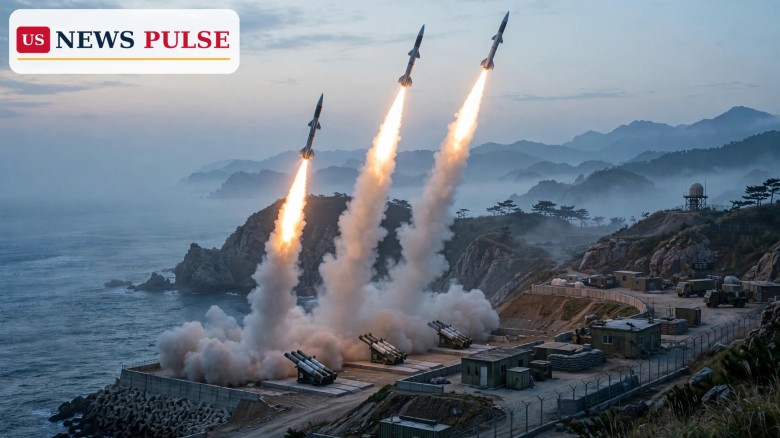
North Korea missiles streaked toward the East Sea on Thursday, October 29, 2026, in a barrage that South Korea's military said involved around 10 short-range ballistic missiles fired from the country's eastern coast. The launches, detected at about 12:30 p.m. local time, flew roughly 250 kilometres (155 miles) before falling into the sea, and they landed in the middle of the sharpest rise in inter-Korean border tensions in weeks. Seoul immediately stepped up surveillance, warned that it was ready for further launches, and began sharing information closely with the United States and Japan, while South Korea's presidential National Security Office convened an emergency meeting to assess the security implications.
Key Points
- South Korea's Joint Chiefs of Staff said North Korea fired around 10 short-range ballistic missiles from around Wonsan at about 12:30 p.m. local time on October 29, 2026.
- The missiles flew about 250 kilometres into the East Sea and did not land in Japan's Exclusive Economic Zone, according to Japan's Defence Ministry.
- It was North Korea's third ballistic missile launch this month and its first in 17 days, since October 12, with more than 10 missile tests recorded this year.
- The barrage came as border tensions surged after September 21 mine blasts in the Demilitarized Zone wounded three South Korean soldiers, and ahead of Pyongyang's end-of-month deadline to activate propaganda loudspeakers.
- South Korea's presidential office urged Pyongyang to halt the launches, calling them a serious violation of United Nations Security Council resolutions.
What Happened
South Korea's Joint Chiefs of Staff said the short-range missiles were launched from an area around Wonsan, a port city on North Korea's eastern coast, at around 12:30 p.m. (0330 GMT). The military said it detected and tracked the missiles immediately after launch, having monitored preparations in advance together with the United States. South Korea's military said it was strengthening surveillance and maintaining readiness in case of additional launches, while closely exchanging information with Washington and Tokyo.
Japan's Defence Ministry said North Korea had launched what could be a ballistic missile and that it did not appear to have landed within Japan's Exclusive Economic Zone. Japan's Coast Guard said earlier that the launched projectile could be a ballistic missile and had already fallen into the sea. No damage or casualties were reported in the accounts published on Thursday.
South Korea's presidential National Security Office convened an emergency meeting to assess the security implications of the launches. In a statement, the presidential office urged North Korea to halt its repeated ballistic missile launches, calling them a serious violation of UN Security Council resolutions, which bar Pyongyang from ballistic missile activity.
The launches were later corrected in reporting to be the third North Korean ballistic missile launch this month, not the second. North Korea last fired ballistic missiles on October 12, and Thursday's barrage was the first in 17 days. Pyongyang has conducted missile tests on more than 10 occasions this year, and recent weeks have also involved submarine-launched cruise missiles and hypersonic missiles, according to regional reporting.
Background: A Border on Edge
The launch came as tensions along the inter-Korean border have risen sharply since two mine explosions in the Demilitarized Zone on September 21 wounded three South Korean soldiers. Seoul says the mines were planted by North Korean forces and has called the incident an armistice violation and demanded an apology. Pyongyang has denied responsibility, accused Seoul of fabricating the incident, and warned of retaliation if provoked.
That dispute has since widened into a standoff over propaganda and firepower along the frontier. Kim Yo Jong, the influential sister of North Korean leader Kim Jong Un, announced last week that Pyongyang would place loudspeakers capable of blasting anti-South Korean propaganda on standby across the border within days. She had earlier said the broadcasts would operate along the entire border by the end of October, though analysts in Seoul questioned whether the devices would actually be activated. Thursday's launches arrived just ahead of that end-of-month deadline.
North Korea's military has also deployed artillery batteries visible from across the border. South Korea's military said earlier on Thursday that the batteries appeared largely intended for show. Reuters witnesses this week saw three North Korean armoured vehicles, identified by South Korean experts as self-propelled 122-mm howitzers, positioned near the border with their gun barrels pointed south. North Korean soldiers were also seen erecting fences inside the Demilitarized Zone.
Seoul, for its part, has proposed talks on clarifying the border to prevent accidental clashes, and its Defence Ministry said it was awaiting a response to two proposals for military talks while urging North Korea to return to dialogue. Last week, North Korea said it would restart propaganda broadcasts and deploy new weapons systems along the border in protest at what it called repeated warning shots by South Korean troops at border areas. South Korea's military says its forces have been issuing warning broadcasts and firing warning shots during incursions near the Military Demarcation Line bisecting the zone.
North Korea Missiles: What the Launch Signals
The scale of Thursday's barrage is part of the message. Firing around 10 missiles at once, from a single coastal area, is a show of salvo capability as much as a test of any one weapon: it demonstrates that North Korea can launch in volume, on short notice, toward the sea it uses as its usual test range. South Korean and US authorities were still conducting a detailed analysis of the exact specifications of the missiles, and some South Korean reporting raised the possibility that the launch involved a 600mm super-large multiple rocket launcher system, classified as a short-range ballistic missile, given the number of projectiles detected.
The timing points in two directions at once. Domestically for the region, it keeps pressure on Seoul in the middle of the border dispute over mines, loudspeakers and artillery. Internationally, analysts read it as a signal to Washington, Tokyo and the wider world about the state of North Korea's arsenal. The launch also followed leader Kim Jong Un's surprise weekend visit to China, the North's main ally and economic pipeline, where he visited the border city of Dandong on October 24 via a newly inaugurated bridge, paid respect at a memorial marking China's support during the 1950-53 Korean War, and met top Chinese Communist Party official Wang Huning. It was his sixth visit to China since taking office in late 2011, and it came as he has moved to bolster ties with Beijing after years of prioritising ties with Russia, including sending troops and ammunition to support its war against Ukraine.
Experts quoted in regional coverage said North Korea likely aimed to pressure the United States into making bigger concessions, at a moment when President Donald Trump has expressed a desire to restore diplomacy with Kim. That combination, a display of force alongside an open diplomatic channel, is a familiar North Korean pattern: raise the stakes visibly, then bargain from a position of demonstrated capability.
Reactions and Quotes
South Korea's Joint Chiefs of Staff said in its statement: "South Korea and the United States closely monitored North Korea's missile launch from the preparatory stage and detected and tracked it immediately after launch." The military added: "Under a firm South Korea-U.S. combined defense posture, our military is keeping a close watch on North Korea's various moves." It added that it was maintaining the capability and posture to respond overwhelmingly to any provocation.
Kim Yong-hyun, a professor of North Korean Studies at Seoul's Dongguk University, said: "The launch can be linked to the tensions along the border as part of a broader series of North Korean shows of force, although it is difficult to say the border situation directly prompted the missile launch." He added that the launch also appeared intended to demonstrate North Korea's increasingly advanced ballistic missile capabilities to the US, Japan and the broader international community.
On the propaganda loudspeaker threat, Lim Eul-chul, a professor at Kyungnam University in Seoul, said: "Rather than being a firm decision to begin broadcasts, North Korea seems to be saying it will have everything ready and watch how South Korea responds."
On the visible artillery, JCS spokesperson Jang Do-young told a briefing: "We assess that North Korea has several intentions, but the exposure of older weapon systems should be understood as being for show." Defence Ministry spokesperson Chung Binna said placing artillery where it could be easily seen "makes little tactical or military sense".
At the memorial in Dandong, Kim Jong Un said North Korea will firmly carry forward "the invincible" friendship with China, according to regional reporting of the visit.
Why It Matters
For the United States, Thursday's launch is a reminder that the Korean peninsula can escalate quickly even while Washington's attention is fixed on the Middle East and on domestic politics days before the November 3 midterm elections. American forces in South Korea and Japan sit inside the range envelope of the short-range systems North Korea tests most often, and every salvo gives US, South Korean and Japanese analysts fresh data on launch procedures, trajectories and readiness, while also testing how fast the three allies coordinate a public response.
For South Korea, the launch sharpens a dilemma. Seoul wants to avoid an accidental clash along a border where warning shots, fence-building and artillery displays are already routine, which is why it has proposed military talks on clarifying the frontier. But it also cannot ignore a barrage that follows mine blasts wounding its soldiers and a threat to restart propaganda broadcasts. Each North Korean show of force pushes Seoul toward a firmer posture, and each firmer posture gives Pyongyang another pretext for the next display.
For the wider region, the barrage tests the value of sanctions and diplomacy alike. UN Security Council resolutions prohibit North Korea's ballistic missile programme, yet Thursday marked more than the tenth missile test occasion this year. The launch also followed Kim's China visit, a reminder that Pyongyang's economic lifeline runs through Beijing, and that any US effort to tighten pressure or reopen talks will have to reckon with that relationship.
What Happens Next
The immediate watch is for further launches. South Korea's military said it was maintaining readiness for additional launches, and the coming days will show whether Thursday was a single salvo or the start of a longer series. The end-of-month loudspeaker deadline is the next tripwire: if Pyongyang activates propaganda broadcasts along the entire border, Seoul will have to decide how to respond without triggering the escalation both sides say they want to avoid.
Diplomatically, the open questions are whether North Korea answers Seoul's two proposals for military talks, and whether Washington makes a fresh move toward diplomacy with Kim. Experts see the launch partly as an attempt to shape those talks, by demonstrating capability before any negotiation. A US response, whether a statement, a sanctions step, or a diplomatic overture, will set the tone for the weeks ahead.
Analysts will also be watching the technical findings from the US-South Korean analysis of the missiles, including whether the barrage involved multiple weapon systems or a single large-calibre rocket system. Those details matter for missile defence planning in South Korea and Japan, and for judging how far North Korea's short-range arsenal has advanced since its October 12 launch.
Frequently Asked Questions
How many missiles did North Korea fire on October 29, 2026?
South Korea's Joint Chiefs of Staff said North Korea fired around 10 short-range ballistic missiles from around Wonsan on its eastern coast at about 12:30 p.m. local time.
How far did the missiles fly?
South Korea's military said the missiles flew about 250 kilometres (155 miles) into the East Sea. Japan's Defence Ministry said they did not appear to have landed within Japan's Exclusive Economic Zone.
Why did North Korea launch the missiles now?
No single motive has been confirmed. Analysts link the barrage to surging border tensions after September 21 mine blasts wounded three South Korean soldiers, to the looming loudspeaker deadline, and to an effort to demonstrate missile capabilities to the US, Japan and the wider world.
Was this North Korea's first missile launch in October 2026?
No. It was the third ballistic missile launch this month and the first in 17 days since October 12. North Korea has conducted missile tests on more than 10 occasions this year.
What happens next?
South Korea, the US and Japan are analysing the launch and watching for further tests. The next flashpoints are Pyongyang's end-of-month propaganda loudspeaker deadline and whether it responds to Seoul's proposals for military talks.
Related coverage on US News Pulse: US MQ-1 drone downed near Strait of Hormuz, Iran claims its 14th kill; Melania Trump ceasefire brings hope to Oleshky as Ukraine aid mission begins; Israel election 2026: Netanyahu fights for survival as Israel votes.
Sources: Reuters via South Korea's Joint Chiefs of Staff and Japan's Defence Ministry, October 29, 2026; The Hindu, October 29, 2026; Chosun Biz, October 29, 2026. The featured image is an original illustration for this article.
© 2026 US News Pulse. All rights reserved.
 Print
 Save